

A luxury timepiece is a high-performance engine that requires consistent motion to prevent internal lubricants from stagnating. You may often find yourself asking, are watch winders a good investment for a growing collection? It is a question that balances mechanical preservation against daily convenience. You likely know the frustration of reaching for a perpetual calendar watch only to find it has stopped, forcing a tedious recalibration of its complex complications. It is a common anxiety amongst enthusiasts that prolonged inactivity leads to "gumming up," which can shorten the time between expensive professional services.
This guide cuts through the noise to determine if a winder is a savvy financial move for your specific horological assets. We will explore how maintaining a steady winding cycle can help extend service intervals and preserve the resale value of your favourite pieces. From understanding turns-per-day settings to avoiding the myth of overwinding, we provide the clarity you need to keep your collection in peak condition and ready for the wrist at a moment's notice.
Key Takeaways
- Learn why consistent rotation is essential for preventing synthetic oils from migrating and compromising your watch's delicate calibre.
- Evaluate the financial benefits and determine if, for your specific collection, are watch winders a good investment to help offset rising manufacturer service costs.
- Master the technical nuances of Turns Per Day (TPD) settings to provide your automatic movements with optimal energy without risk.
- Save significant time and effort by maintaining the accuracy of complex complications like perpetual calendars and moon phases.
- Audit your current collection to choose the most appropriate storage, whether it is a single carbon fibre unit or a high-capacity winder safe.
The Mechanics of Stagnation: Why Automatic Watches Need Movement
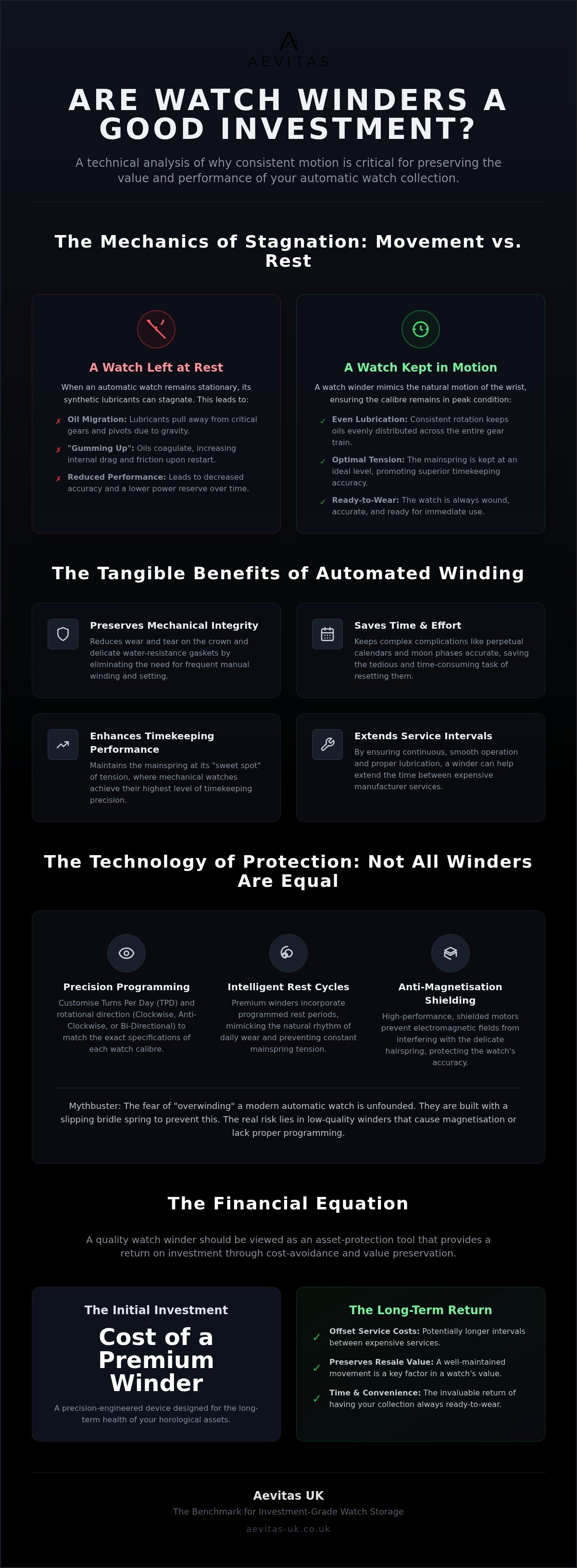
Many collectors believe that leaving a mechanical watch to "rest" preserves its lifespan by reducing friction. This is a common misconception that ignores the chemistry of horological maintenance. Modern calibres rely on ultra-thin synthetic oils to ensure hundreds of tiny components glide with minimal resistance. When a watch sits idle for weeks, these oils can migrate away from critical contact points or begin to coagulate. This "gumming" effect increases internal drag once the watch is eventually restarted. It often leads to a sluggish movement, decreased power reserve, and compromised accuracy over the long term.

To determine whether are watch winders a good investment for your specific collection, it's vital to view them as a preventative maintenance tool rather than a mere luxury. For those unfamiliar with the device, What is a Watch Winder? Essentially, it is a precision-engineered unit that rotates the watch to mimic the kinetic energy generated by daily wear. By keeping the movement active, you ensure that lubricants remain evenly distributed across the escapement and gear train. This consistent motion acts as a service interval extender for your most prized horological assets.
The Problem with Manual Winding
Resetting a stopped watch introduces unnecessary physical stress. Every time you unscrew the crown to wind a movement manually, you put pressure on delicate rubber gaskets that maintain water resistance. Over time, frequent manipulation increases the risk of cross-threading or over-tightening the crown. It's a form of wear that compounds with every reset. A high-quality watch winder provides a gentler, more consistent transfer of energy. It keeps the mainspring at optimal tension without the abrasive start-stop cycles associated with manual winding, protecting the internal components from the sudden torque of a manual start.
Preserving Complications and Accuracy
Owners of complicated timepieces find the most immediate value in automated winding. Resetting a moon phase or a perpetual calendar is a precision task that can consume ten minutes or more. If you rotate a diverse collection, the cumulative effort and time lost to resetting these movements is significant. Beyond the sheer convenience, mechanical watches perform best when the mainspring is consistently wound. A winder maintains this "sweet spot" of tension, which aids in timekeeping precision. It ensures your watch is always ready-to-wear, transitioning from the winder to your wrist with its accuracy and settings fully preserved.
Technical Superiority: How Modern Winders Protect Your Asset
Protecting a high-value timepiece requires more than simple rotation; it demands technical precision. When evaluating if are watch winders a good investment, you must look beyond the motor to the programming. Modern automatic movements are designed with a bridle spring, a mechanism that allows the mainspring to "slip" once fully wound. This means the fear of physically overwinding a contemporary watch is largely a myth. However, constant tension without relief is still sub-optimal. Premium winders incorporate essential "rest" periods into their cycles, mimicking the natural rhythm of human activity and allowing the movement to discharge slightly before the next winding phase.
Magnetisation remains a silent threat to mechanical accuracy. Low-quality motors can emit electromagnetic fields that interfere with the hairspring, causing the watch to run fast or stop entirely. High-performance units solve this by utilising shielded motors. These components are encased to contain magnetic interference, ensuring the delicate calibre remains unaffected whilst stored. By prioritising these technical safeguards, a winder transforms from a convenience into a protective vault for your movement's long-term health.
TPD and Directionality Settings
Every movement has specific requirements for Turns Per Day (TPD) and directionality. A Rolex 3235 calibre, for example, typically requires bi-directional winding to maintain its power reserve effectively. In contrast, certain Patek Philippe or Valjoux movements may only wind in a clockwise or anti-clockwise direction. Using the wrong setting is inefficient and fails to keep the watch ready for wear. Advanced premium watch winders from Aevitas UK allow you to customise these variables for each individual rotor, ensuring every piece in your collection receives the exact energy profile it requires.
Material Matters: Carbon Fibre and Beyond
The exterior of a winder should match the calibre of the watch it protects. Carbon fibre is a preferred material for the modern collector, offering exceptional durability and a sleek, technical aesthetic that complements contemporary sports watches. The Aevitas Single Carbon Fibre Watch Winder exemplifies this standard — available mains or battery-powered, it is an ideal entry point for protecting a prized single timepiece without compromise. Inside, the focus shifts to preservation. Soft-touch interiors and adjustable cushions are critical to prevent micro-scratches on polished cases or delicate leather straps. High-quality housing is a necessary standard for an object that represents significant financial and emotional value. Choosing a winder with superior build quality ensures your storage solution lasts as long as the heirlooms it houses.
Financial Analysis: Are Watch Winders a Good Investment?
Determining if are watch winders a good investment requires a pragmatic look at the total cost of ownership. A luxury timepiece is a machine with ongoing maintenance requirements. When a movement remains idle, internal lubricants can settle, leading to friction and wear upon restart. By investing in a winder, you are purchasing a form of mechanical insurance. The cost of a high-quality winder is often significantly less than a single comprehensive manufacturer service, yet its impact on the watch's longevity is profound.
The hidden cost of time is equally significant for the modern collector. Resetting a perpetual calendar or moon phase complication can take ten to fifteen minutes of concentrated effort. If you rotate between several watches, you could spend hours every month simply winding and setting your collection. A winder eliminates this inefficiency. It ensures your time is spent enjoying your watches rather than maintaining them.
Extending the Service Interval
Manufacturer recommendations for service intervals often range between five to ten years. These intervals assume the watch is either worn regularly or maintained in a state of readiness. By keeping synthetic oils fluid and evenly distributed, a winder helps prevent the premature drying of lubricants. This proactive care can potentially push a standard five-year service requirement to seven or even ten years. Over a twenty-year period of ownership, avoiding just two full services results in cumulative savings that far exceed the price of a premium winder. Preventative maintenance is always more cost-effective than part replacement during a major overhaul.
Preserving Resale Value
When the time comes to trade or sell a piece, its mechanical health is scrutinised. Prospective buyers or dealers often use a Timegrapher to measure the amplitude and beat error of the movement. A watch that has been kept consistently wound and active typically shows more stable performance than one that has sat dormant for years. This technical health translates directly into a higher resale value. Storing your collection in a Watch Winder Safe with £175,000 Insurance Rating demonstrates a level of meticulous care that appeals to discerning buyers. It proves the assets have been protected from both mechanical stagnation and physical theft, providing the ultimate peace of mind for the next owner.
Choosing the Right Winder for Your Specific Collection
Selecting a storage solution requires a methodical approach. To decide if are watch winders a good investment for your home, you must first assess your current horological assets. A diverse set of watches often demands a unit with independent controls for each rotor. Follow these five steps to ensure your choice provides maximum utility and protection:
- Audit your collection: Identify the specific TPD and directionality requirements for every calibre you own.
- Determine capacity: Balance your current needs against future acquisitions to avoid outgrowing your storage too quickly.
- Evaluate the environment: Choose between a high-security winder safe, an elegant display case, or a portable travel solution.
- Prioritise motor quality: Select ultra-quiet motors with shielded components if the unit will reside in a bedroom or study.
- Match your aesthetic: Opt for materials like carbon fibre, leather, or polished wood that complement your interior decor.
Single vs. Multi-Watch Winders
Investing in a Multi Watch Winder is a strategic move for collectors who rotate three or more pieces. These systems offer significant space-saving benefits compared to multiple individual units. They allow you to manage different TPD settings in one centralised hub. For a growing collection of four pieces, the 4 Watch Winder in Carbon Fibre with Extra Storage is a natural progression — independent rotor control and generous storage drawers in a single refined unit. Modular designs provide the flexibility to expand your storage as your collection grows, ensuring your organisation remains seamless and refined.
Travel Solutions: The Watch Roll
Maintenance should not stop when you leave your home. A Luxury Watch Roll Travel Case is essential for the mobile collector who values protection as much as presentation. These cases protect your watches from vibration and impact whilst in transit. Luxury leather exteriors and soft suede linings prevent abrasions, maintaining the pristine condition of your cases and bracelets. It is a necessary addition for any collector who views their timepieces as high-value assets that require constant care, regardless of location.
Discover the perfect balance of engineering and elegance by exploring our full range of British-designed watch winders today.
Aevitas UK: The Benchmark for Investment-Grade Storage
Aevitas UK stands as a premier authority in horological maintenance, bridging the gap between traditional British craftsmanship and modern engineering. Our philosophy centres on the belief that a winder should be as meticulously designed as the calibre it protects. When evaluating if are watch winders a good investment, the answer lies in the technical standards of the storage solution itself. We prioritise universal compatibility, ensuring our rotors are perfectly calibrated for all major luxury brands, including Rolex and Patek Philippe. This commitment to excellence is paired with a seamless client experience, including free insured worldwide delivery as a standard service for every collector.
Modern collectors often favour Carbon Fibre Watch Winders for their blend of lightweight durability and technical aesthetic. This material reflects a heritage of performance whilst providing a resilient housing for high-value movements. The Aevitas Single Carbon Fibre Winder is the definitive starting point for collectors who refuse to compromise on build quality. By choosing a brand that understands the intersection of aesthetics and mechanical utility, you ensure your collection remains both protected and prominently displayed. Precision is a requirement, not a luxury, and our designs reflect this through every component and finish.
The Ultimate Protection: Watch Winder Safes
For high-value collections, physical security is as critical as mechanical maintenance. Aevitas UK specialises in watch winder safes that combine these two essential functions. These units feature insurance-approved security standards, offering a robust barrier against theft whilst simultaneously keeping your watches wound and ready for the wrist. The Grade 2 Watch Winder Safe, rated to £175,000 insurance value, is the benchmark choice for serious collectors. For a deeper dive into these advanced security solutions, consult our Watch Winder Safe Guide.
Why Aevitas UK is the Best-Selling Premium Brand
Our status as the UK's best-selling premium winder brand is built upon a dedication to whisper-quiet motor technology. We utilise advanced shielded motors that eliminate the risk of magnetisation, a common concern for discerning enthusiasts. Whether you prefer the classic elegance of a hand-polished wood veneer or the contemporary edge of carbon fibre, our range offers a solution for every interior. We provide the tools to transition your collection from a state of disorder to one of absolute refinement. Take the next step in preserving your horological legacy and explore the full Aevitas UK collection today.
Securing Your Horological Legacy for the Future
Maintaining a rotating collection requires more than a simple storage box. It requires a commitment to long-term mechanical health. When you consider whether are watch winders a good investment, remember that preventative care is always more affordable than a full movement overhaul. By keeping your synthetic oils fluid and your complications precise, you preserve both the function and the future resale value of your favourite pieces. It is a transition from the risk of stagnation to the refinement of a ready-to-wear collection.
As the UK's best-selling premium watch winder brand, Aevitas UK provides technical excellence compatible with all major luxury brands. Every purchase includes free insured worldwide delivery, ensuring your equipment arrives with the same care you give your watches. It is the ultimate way to maintain order and longevity for your horological assets. Take the next step in professional maintenance today.
Shop the Aevitas Single Carbon Fibre Watch Winder — the definitive entry point for the serious collector. Or explore our full watch winder range to find the perfect fit for your collection.
Frequently Asked Questions
Do watch winders damage automatic watches over time?
High-quality watch winders do not damage automatic movements. Modern calibres feature a bridle spring that prevents overwinding by allowing the mainspring to slip once full tension is reached. Damage only occurs if using a low-quality unit that lacks rest periods or emits magnetic interference. Professional-grade winders are designed to mimic the kinetic energy of daily wear, ensuring that components remain lubricated without putting undue stress on the internal gear train or gaskets.
How many turns per day (TPD) does my watch actually need?
Most automatic watches require between 650 and 950 Turns Per Day (TPD) to maintain their power reserve. For example, a Rolex calibre 3235 performs optimally at approximately 650 TPD with bi-directional rotation. It's essential to consult your manufacturer's specifications, as under-winding leads to the watch stopping, whilst over-winding is inefficient. Advanced winders allow you to customise these settings for each rotor, providing the precise energy profile required by your specific timepiece.
Are cheap watch winders a bad investment?
Inexpensive units are often a poor choice for high-value collections. When asking are watch winders a good investment, you must consider the motor quality and shielding. Cheap winders frequently lack programmable TPD settings and often use unshielded motors that can magnetise your movement. They are also prone to mechanical failure and excessive noise. Investing in a premium, British-designed unit ensures your watches are protected by reliable, whisper-quiet technology that lasts for years.
Can a watch winder magnetise my timepiece?
A premium winder will not magnetise your timepiece because it utilises shielded motors. Magnetisation is a risk only with poorly constructed, unbranded units where the motor is placed too close to the watch without adequate protection. Magnetic fields can cause a mechanical watch to run fast or stop entirely. Quality brands like Aevitas UK ensure their motors are encased to contain electromagnetic fields, keeping your delicate hairspring and escapement safe from any interference.
Is it okay to leave a watch on a winder indefinitely?
It is perfectly safe to leave your watch on a high-quality winder indefinitely. These units are programmed with intermittent rotation cycles and rest periods to prevent the mainspring from remaining under constant peak tension. This cycle keeps the synthetic oils fluid and evenly distributed, which is vital for long-term accuracy. Continuous storage on a winder ensures your watch is always ready to wear, which is particularly beneficial for pieces with complex perpetual calendars.
What is the best watch winder for a Rolex?
The best winder for a Rolex is one that offers bi-directional rotation and adjustable TPD settings. Most modern Rolex models, such as the Submariner or GMT-Master II, require around 650 TPD to stay fully wound. Aevitas UK winders are specifically designed for compatibility with these luxury standards. Choosing a unit with a soft-touch interior and adjustable cushions ensures the Oyster bracelet and polished case remain free from micro-scratches whilst stored in a secure environment.
Should I buy a watch winder or a watch box?
The choice depends on whether your priority is simple organisation or mechanical maintenance. A watch box is an excellent solution for quartz watches or pieces you wear rarely and don't mind resetting. However, for automatic watches, are watch winders a good investment because they provide the motion needed to prevent oil stagnation. If you own complicated timepieces like moon phases, a winder saves the significant time and effort required to reset these delicate functions manually.
Do I need a winder if I wear my watch every other day?
Whilst a watch with a 48-hour power reserve might stay running if worn every other day, a winder still provides value. It ensures the watch never reaches the end of its power reserve, where accuracy often fluctuates. Consistent motion keeps the internal lubricants active, which can help extend the time between professional services. It also provides a secure, dedicated location for your watch, reducing the risk of accidental drops or surface scratches on a nightstand.
0 comments