

An automatic timepiece is more than a tool for telling time; it is a delicate mechanical ecosystem that requires constant vigilance. You likely understand that leaving a high-end movement dormant for too long isn't just a matter of convenience; it's a risk to the internal lubricants and precision calibration. Many collectors feel a persistent anxiety over magnetic interference from household electronics or the creeping threat of dust whilst their pieces aren't on the wrist. Mastering how to store automatic watches is the definitive line between maintaining a decaying asset and preserving a legacy heirloom.
This guide provides the professional methods you need to protect your collection from environmental hazards and mechanical stagnation. We'll explore the critical differences between using a presentation box and a precision watch winder to maintain your movement's health. You'll gain a clear understanding of how to mitigate risks like moisture and magnetism. By the end, you'll have a definitive routine for long-term preservation and the confidence to select a luxury storage solution that reflects the quality of your horological investment.
Key Takeaways
- Understand why movement oils congeal and how professional storage prevents mechanical stagnation in your timepieces.
- Identify the environmental risks of humidity and magnetism that threaten your watch's accuracy and long-term value.
- Learn how to store automatic watches by choosing between presentation boxes and precision winders for complex movements.
- Master the essential pre-storage routine, from meticulous cleaning to securing crowns against moisture ingress.
- Explore high-strength carbon fibre cases and insurance-approved safes to provide your collection with ultimate protection.
Why Correct Storage is Essential for Automatic Watch Longevity
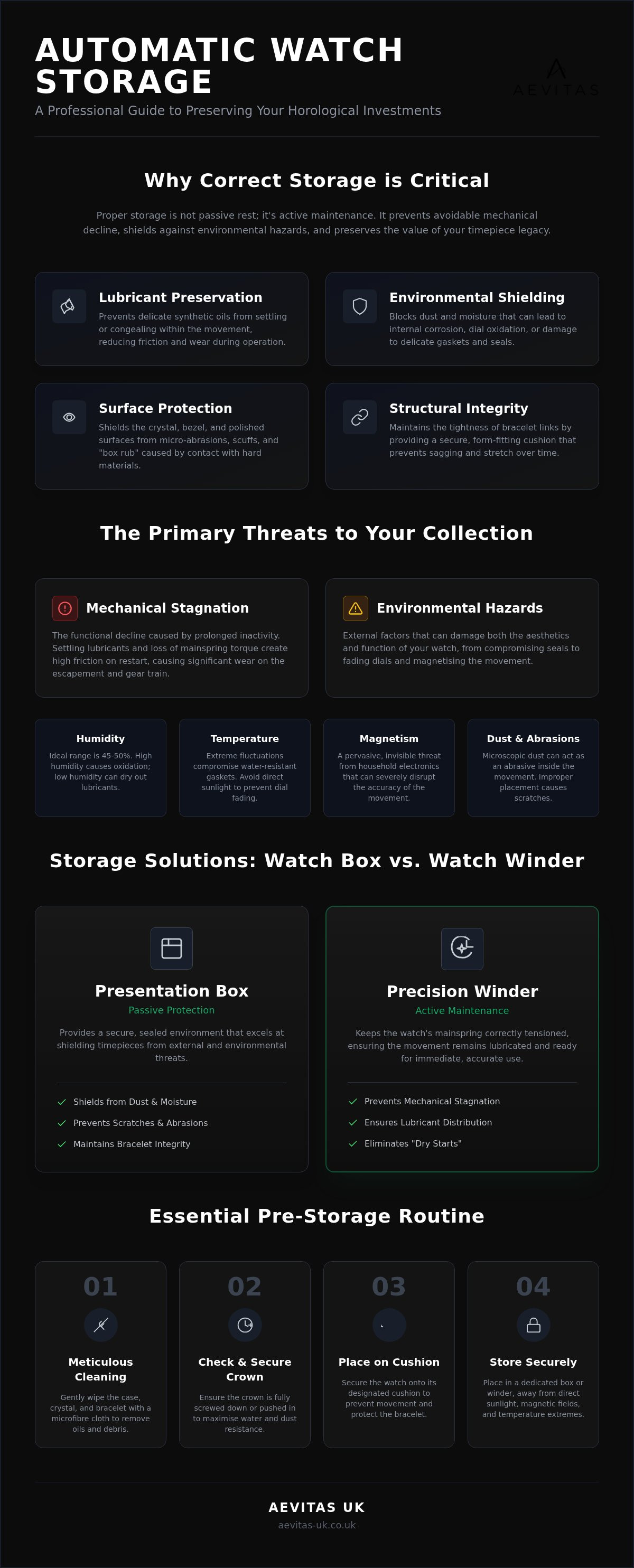
An automatic watch is a masterpiece of micro-engineering. It relies on hundreds of moving parts working in perfect synchronisation. When you consider how to store automatic watches, you must view the process as an active form of maintenance rather than a passive state of rest. Neglecting proper storage leads to avoidable mechanical decline and a significant loss in resale value. Even the most hermetically sealed cases are not entirely immune to the passage of time. Dust particles, which often contain silica, can act as an abrasive amongst moving parts if they penetrate the gaskets. Establishing a consistent storage routine ensures that your investment remains as precise and pristine as the day it left the boutique.
Proper storage provides several critical benefits for the discerning collector:
- Lubricant Preservation: Prevents the delicate synthetic oils from settling or congealing within the movement.
- Environmental Shielding: Blocks dust and moisture that can lead to internal corrosion or dial oxidation.
- Surface Protection: Shields the crystal and polished surfaces from micro-abrasions caused by contact with hard furniture.
- Structural Integrity: Maintains the tightness of the bracelet links by providing a secure, form-fitting cushion.
The Risk of Mechanical Stagnation
Mechanical stagnation is the functional decline of a movement caused by the settling of lubricants and the loss of mainspring torque during prolonged inactivity. Modern horological oils are highly refined, yet they can still migrate or congeal if the gears remain stationary for months. This creates increased friction when the watch is eventually restarted, potentially damaging delicate pivots and reducing the power reserve. Keeping the mainspring under consistent tension through regular movement or a watch winder ensures the calibre remains primed for accuracy. It prevents the "dry start" scenario that causes the most significant wear on the escapement and gear train.
Protecting the Exterior Finish
The aesthetic condition of your timepiece is just as vital as its mechanical health. Placing a watch on a hard bedside table or a glass shelf invites unnecessary scratches on the case back and lugs. Dedicated watch boxes utilise soft-lined interiors to eliminate "box rub," which is a phenomenon where polished steel or gold surfaces are dulled by contact with abrasive materials. Secure cushions are also essential for preventing bracelet stretch. When a watch is left loosely on its side, gravity places uneven pressure on the pins and links. Over several years, this leads to a permanent loss of tightness in the metal. A professional storage solution holds the piece in a neutral, tension-free position to preserve its original silhouette and ensure it remains a high-value asset for decades.
Choosing the Right Environment: Temperature, Humidity, and Magnetism
The external environment acts as a constant force on your timepiece's delicate internals. When considering how to store automatic watches, temperature stability is paramount. Extreme fluctuations cause rubber and silicone gaskets to expand and contract. This cycle eventually compromises the water-resistant seals, leaving the movement vulnerable to microscopic debris and moisture. Direct sunlight is another often overlooked hazard. Ultraviolet rays can cause significant dial fading and degrade the luminous material on hands and indices over time. A stable, dark, and climate-controlled setting is the only way to ensure your watch remains in showroom condition.
Managing Moisture and Humidity
Maintaining the correct atmosphere is a delicate balancing act for any collector. The ideal humidity range for luxury watch storage is typically between 45% and 50%. If the air is too dry, internal lubricants can evaporate faster than intended, leading to increased friction. Conversely, high humidity triggers dial oxidation or unwanted "patina," which can drastically reduce the resale value of modern pieces. A sealed environment, such as a luxury watch presentation box, provides a superior barrier compared to an open-air stand or a simple shelf. For an added layer of protection during the damp British winter months, placing a small silica gel packet inside the storage unit helps regulate the micro-climate and absorb any stray moisture before it reaches the movement.
The Hidden Danger of Magnetic Fields
Magnetism is perhaps the most pervasive threat to modern horological accuracy. It is a silent killer of precision that exists in everyday items like hifi speakers, laptop chargers, and magnetic tablet covers. When a watch becomes magnetised, the coils of the hairspring stick together. This effectively shortens the spring, causing the balance wheel to oscillate much faster and the watch to gain several minutes per day. To prevent this, ensure your storage unit is positioned at least 30cm away from any powerful electronics. Understanding how to store automatic watches correctly means identifying these invisible fields before they impact your calibre's performance. If you are storing high-value assets, an insurance-approved safe with anti-magnetic properties offers the ultimate level of environmental security.
Watch Boxes vs. Watch Winders: Which Should You Choose?
The choice between a static display and a mechanical winder is a fundamental decision for any serious horologist. It dictates how you interact with your collection on a daily basis. Whilst both solutions offer protection from dust and physical damage, they serve very different functional purposes. Mastering how to store automatic watches requires a clear strategy based on the specific movements you own and how often you wear them. A collector with a few daily pieces has very different needs than one managing a dozen high-complication heirlooms.
When to Opt for a Luxury Watch Box
A watch presentation box is the ideal solution for collectors who value the ritual of horology. There is a distinct pleasure in selecting a timepiece, winding the crown, and setting the hands to the exact second. If your collection includes several manual-wind watches or pieces you wear in a frequent, large rotation, a static box provides the necessary protection without unnecessary mechanical wear. It keeps your collection organised and secure in one central location.
These units are also superior for aesthetic display. A well-crafted box allows you to view your collection through a glass lid, turning your timepieces into a focal point of a room. Beyond simple storage, these boxes often provide additional utility. They can house spare straps, spring bar tools, and even jewellery in dedicated drawers. This makes them a versatile choice for the collector who views their watches as part of a broader curated wardrobe. For vintage pieces with older gaskets, a secure box is often the safest environment to prevent accidental stress on the movement.
The Benefits of a Precision Watch Winder
When your collection includes high-complication pieces, automatic watch winders become a technical necessity. Perpetual calendars, annual calendars, and moon phase complications are notoriously difficult to reset if the power reserve reaches zero. A winder ensures these watches remain synchronised and ready to wear at a moment's notice. This convenience is a primary factor when considering how to store automatic watches that feature complex calendars.
High-end winders are not mere rotating motors; they are precision instruments designed to mimic the varied motion of the human wrist. This is vital because different movements have specific requirements. Most modern Rolex models perform best with 650 Turns Per Day (TPD) in a bidirectional setting. Conversely, certain Patek Philippe calibres may require 800 TPD or a strictly clockwise rotation. Using a multi-watch winder with individual TPD customisation ensures each piece receives the correct amount of energy. This prevents the mainspring from being under constant, maximum tension, which preserves the clutch mechanism over time. It is a sophisticated way to manage your collection while ensuring every movement remains in peak condition.
A Step-by-Step Guide to Storing Your Timepieces Safely
Storing a high-end timepiece is a precise ritual that extends beyond simply placing it in a drawer. Every action you take before the watch enters its case impacts its mechanical longevity and aesthetic brilliance. Understanding how to store automatic watches involves more than just selecting a location; it requires a systematic approach to physical care. By following a professional protocol, you eliminate the risks of chemical corrosion and mechanical strain that often plague neglected collections. This process ensures your watches remain in "ready-to-wear" condition, whether they are resting for a weekend or several months.
Before securing your watch, follow these essential steps:
- Surface Decontamination: Gently remove skin oils, perspiration, and environmental salts using a dedicated cloth.
- Hardware Audit: Verify that the crown is fully screwed down and all chronograph pushers are in their neutral, secured positions.
- Cushion Calibration: Select a cushion that fits the bracelet or strap circumference without applying excessive outward pressure.
- Movement Priming: If using a static box for more than 48 hours, ensure the mainspring has sufficient tension to prevent immediate stagnation.
Cleaning and Inspection Protocol
Daily wear exposes your watch to the natural acidity of your skin and microscopic debris from the environment. Over time, these elements can dull the finish of 904L steel or precious metals. Use a lint-free microfibre cloth for a gentle daily wipe-down to maintain the case's lustre. It is critical that you never store a watch with the crown in the "pulled" or hacking position. Whilst this stops the movement, it often bypasses the internal gaskets, leaving the calibre open to moisture ingress and dust. For a complete maintenance kit, consult our guide on essential watch collector accessories to find the correct tools for your routine.
Orientation and Placement
The orientation of your watch during storage affects the distribution of lubricants and the health of the balance wheel. Storing a watch on its side for extended periods can place uneven gravitational pressure on the delicate pivots of the escapement. A neutral, dial-up position is generally preferred for even oil distribution across the gear train. Ensure the watch fits snugly on its cushion; a loose fit allows the piece to shift, leading to potential impact damage. When you are moving between locations, a luxury watch roll provides the necessary compression to keep the timepiece stationary and protected from external shocks. This level of care is the hallmark of a discerning collector who understands that preservation is an active duty.
To provide your collection with the professional environment it deserves, explore our range of luxury watch presentation boxes designed for the ultimate in protection and display.
Premium Solutions for the Discerning British Collector
Selecting the correct hardware is the final stage in mastering how to store automatic watches. Whilst the principles of environment and orientation remain constant, the quality of your storage solution determines the ultimate safety of your collection. For the British collector, storage is an extension of the watch itself; it is a statement of respect for the craftsmanship involved. Transitioning from basic containers to professional-grade equipment provides the mechanical consistency and security that high-value movements demand. Aevitas UK specialises in this intersection of luxury and utility, offering engineered solutions that protect your assets against every conceivable risk.
Advanced Protection with Carbon Fibre
Carbon fibre has become the material of choice for enthusiasts who value modern engineering and high-strength protection. Originally developed for aerospace and motorsport, its application in carbon fibre watch winders offers a unique combination of lightweight durability and a sophisticated, high-tech aesthetic. These units are particularly well-suited for luxury sports watches, such as those from Rolex or Audemars Piguet, as the woven texture complements the brushed steel and ceramic bezels of modern horology. Beyond its visual appeal, carbon fibre provides a rigid, stable housing that minimises external vibrations. It is a material that speaks to the technical curiosity of the collector, providing a sleek interior design element that feels both contemporary and timeless.
Maximum Security: The Watch Winder Safe
As a collection grows in both size and valuation, the need for physical security becomes undeniable. A dedicated watch winder safe is the pinnacle of preservation for multi-million pound collections. These units integrate precision winding technology within an insurance-approved, fireproof steel chassis. They eliminate the compromise between keeping a watch ready to wear and keeping it protected from theft or environmental catastrophe. High-capacity safes allow you to organise your entire rotation in a single, fortress-like environment. For those planning a permanent installation, our Watch Winder Safe Installation Guide provides the necessary technical specifications for secure home integration. This level of protection offers the ultimate peace of mind, ensuring your legacy remains intact for the next generation.
To complement this physical security, a private archive like Vesta Viva allows you to store the photographs, documents, and stories that provide the provenance for your collection, ensuring its history is never lost.
For the gentleman on the move, portability is just as vital as home security. Luxury watch roll travel cases provide a compact, secure solution for transporting timepieces without the risk of impact damage or scratches. These rolls utilise the same high-quality linings found in our presentation boxes, ensuring your watches remain stationary whilst in transit. Whether you are at home or abroad, Aevitas UK combines British design heritage with world-class engineering to provide a comprehensive storage ecosystem. By investing in professional solutions, you ensure that the delicate mechanics of your automatic watches continue to perform with absolute precision for decades to come.
Securing the Future of Your Horological Investment
Mastering how to store automatic watches is an essential discipline for any discerning collector. By controlling your immediate environment and establishing a meticulous cleaning routine, you mitigate the silent risks of mechanical stagnation and aesthetic decline. Whether you choose the precision of a customised winder for your perpetual calendars or the elegance of a soft-lined presentation box, your decision reflects a deep respect for horological excellence. Consistency in these habits ensures your timepieces remain as accurate and vibrant as the day they were first commissioned.
Timing is everything, both in horology and in life. Just as you seek expert guidance to protect your investments, finding personal clarity through Avid Advice can provide valuable foresight for your future plans.
Aevitas UK remains the UK’s best-selling premium brand, providing engineered solutions compatible with the movements of Rolex, Omega, and Patek Philippe. Every item in our curated range is designed to provide the ultimate sanctuary for your watches, supported by the confidence of free insured worldwide delivery. It's time to move beyond simple storage and embrace a standard of preservation that matches the financial and emotional value of your collection.
Explore the Aevitas UK Collection of Luxury Watch Storage Solutions and give your timepieces the protection they deserve.
Frequently Asked Questions
Is it better to store an automatic watch on a winder or in a box?
The choice depends on the complexity of your calibre and your wearing habits. A watch winder is essential for perpetual calendars or moon phase complications to avoid the tedious process of resetting the movement. A presentation box is often preferred for manual-wind pieces or watches you wear frequently in a large rotation. Both solutions protect the exterior finish, but the winder actively maintains the movement's health by preventing internal lubricants from settling.
How long can an automatic watch sit without being wound?
Most modern automatic movements possess a power reserve of 40 to 72 hours. Once this energy is depleted, the watch will stop. Whilst occasional stops are harmless, leaving a watch dormant for several months can lead to congealed oils. This is a primary concern when learning how to store automatic watches correctly for the long term. Regular movement ensures the gear train remains lubricated and accurate over decades of use.
Does storing a watch in a safe damage the movement?
Storing a watch in a safe is perfectly safe provided you manage the internal environment. Safes can sometimes be damp or prone to temperature shifts if they are placed against external walls. Using a watch winder safe ensures your timepieces remain wound whilst being protected by insurance-approved security. You should always include a silica gel packet to regulate humidity levels within the heavy steel enclosure to prevent dial oxidation.
Can I store my automatic watch on its side?
You should avoid storing a watch on its side for extended periods. This orientation can place uneven gravitational pressure on the delicate balance wheel pivots and may affect the distribution of internal lubricants. Placing the watch dial-up on a secure cushion is the professional standard for collectors. This neutral position ensures the escapement performs consistently and reduces unnecessary wear when you next strap the piece to your wrist.
How do I protect my watch from magnetism during storage?
Protection from magnetism requires keeping your storage unit at least 30cm away from electronics like hifi speakers, tablet covers, and laptops. These devices emit invisible fields that can cause the hairspring to stick, making the watch run fast. If you're serious about how to store automatic watches, consider using a carbon fibre winder or an anti-magnetic safe. These materials provide a superior barrier against the silent threat of magnetic interference in a modern home.
Should I leave the crown open when storing my watch?
You must never leave the crown in the open or "hacking" position during storage. Whilst this stops the hands, it also bypasses the internal gaskets designed to keep out moisture and dust. An open crown is an invitation for microscopic debris to enter the calibre, which leads to significant abrasive wear on the moving parts. Always ensure the crown is fully screwed down or pushed in before placing the watch in its case.
What is the best temperature for watch storage?
The ideal temperature for watch storage is a stable room temperature between 18°C and 22°C. Extreme heat can thin the lubricants, causing them to migrate away from critical friction points. Conversely, extreme cold can cause gaskets to stiffen and oils to thicken, affecting accuracy. You should avoid storing your collection near radiators, air conditioning units, or in direct sunlight, as these environmental fluctuations compromise the movement's long-term precision and reliability.
How often should I clean my watch storage box?
You should perform a light cleaning of your storage box or winder once a month. Use a lint-free microfibre cloth to remove any dust that has settled on the exterior or the glass display lid. Every six months, remove the watches to vacuum the interior linings gently, ensuring no abrasive particles remain on the cushions. This routine prevents "box rub" and maintains the pristine condition of your collection's home whilst ensuring a dust-free environment.
0 comments