

Is your bedside drawer slowly degrading the precision of your most valuable assets? For the serious horologist, a secure storage solution is no longer just a steel box. It's a mechanical life-support system. You likely understand the growing unease that comes with a high-value collection, from the fear of a targeted burglary to the frustration of finding a favourite piece has stopped because its oils have settled. Finding a professional watch safe for collectors that balances aesthetics with technical performance is the only way to reclaim your peace of mind.
We agree that your timepieces deserve better than cluttered surfaces or inadequate security. This guide shows you how to transition to professional-grade protection whilst maintaining the mechanical health of your luxury collection. We will examine the specific UK insurance cash ratings required for 2026 and how integrated winding technology ensures your watches remain beautifully organised and ready for the wrist.
Key Takeaways
- Understand how Eurograde levels and UK insurance cash ratings dictate the specific level of protection required for your horological assets.
- Learn why a dedicated watch safe for collectors is the superior choice for preventing movement stagnation whilst providing professional-grade security.
- Identify the critical technical features, including fire-resistant barriers and magnetic shielding, that protect delicate hairsprings and essential documentation.
- Discover the functional advantages of integrated watch winders for maintaining movement longevity compared to traditional static storage.
- Optimise your purchase by applying the growth margin rule to ensure your secure storage accommodates future collection expansions.
Why Every Serious Collector Eventually Needs a Watch Safe
Every collection begins with a single acquisition. Over time, that solitary piece grows into a curated assembly of horological art. There comes a moment when a bedside drawer or a basic lockbox no longer suffices. This is the tipping point where you require a specialised watch safe for collectors. Unlike a standard domestic safe, these units are engineered specifically to house delicate mechanical instruments. They balance heavy-duty security with a refined, controlled environment. You aren't just buying a box; you're investing in a mechanical life-support system.
Beyond the physical barrier, the primary benefit is psychological. You gain total peace of mind whilst away from your primary residence, knowing your assets are shielded. True security accounts for more than just theft. It involves protecting your investment against fire, flooding, and accidental domestic damage. Understanding safe security and fire-resistance ratings is essential for ensuring your collection survives more than just a burglary attempt. These ratings provide the technical assurance that your watches remain intact even during catastrophic events. A flood or a fire can be just as devastating as a thief.
The Tipping Point: Assessing Your Collection Value
Replacement costs often surprise collectors. When the market value of your pieces outpaces your home insurance limits, a professional solution is mandatory. Standard home safes often lack the interior refinement needed for luxury watches. They might protect against a pry bar, but they can easily scratch a polished case or a delicate strap. Many experts suggest the "Five Watch Rule". Once you own five high-value pieces, the volume alone makes you a more likely target for targeted theft. At this stage, the combined value usually justifies the investment in professional-grade storage. It's the moment your hobby becomes a serious asset portfolio.
The Risks of Inadequate Storage
Storing a mechanical watch in a static environment for too long carries mechanical risks. Lubricants within the movement can settle or gum up, leading to erratic timekeeping and costly service bills. Moisture ingress is another silent killer. It causes internal corrosion that devalues a piece instantly. Burglars are trained to check common hiding spots like wardrobes or under beds first. A dedicated watch winder safe acts as a powerful deterrent. It's too heavy to move and too sophisticated to bypass quickly. This forces intruders to abandon their attempts in favour of easier targets. It keeps your collection both secure and mechanically sound.
Understanding Security Grades and Insurance Ratings for Timepieces
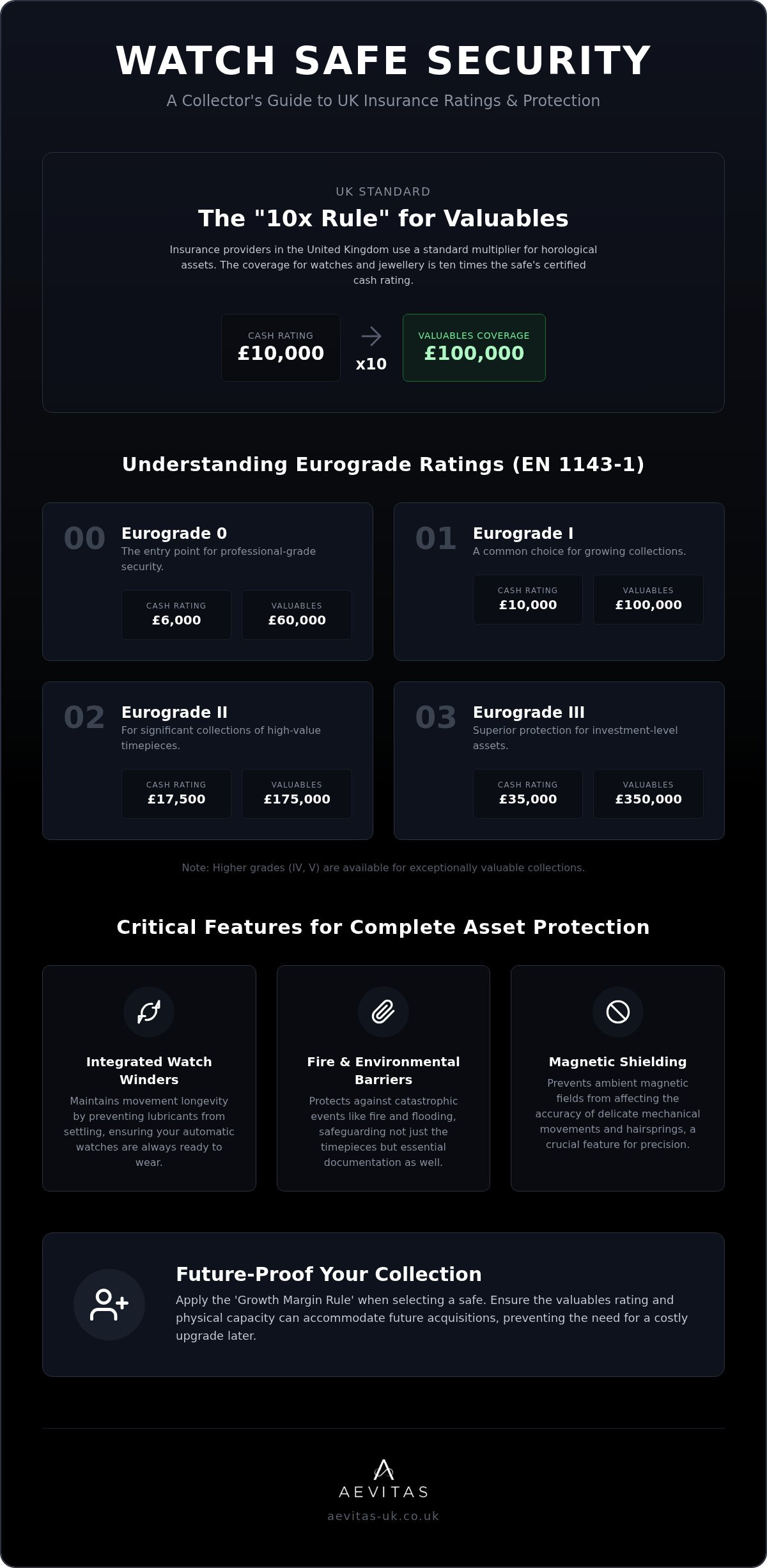
Selecting a watch safe for collectors involves more than just assessing physical weight. It's a matter of technical certification. Insurance providers in the United Kingdom rely on standardised testing to determine how much risk they are willing to underwrite. The most common standard is EN 1143-1, which categorises safes into Eurograde levels. These grades, ranging from Grade 0 to Grade 5, indicate the safe's resistance to forced entry using sophisticated tools. For a collector, these numbers aren't just technical jargon. They are the difference between a successful insurance claim and a total financial loss.
The "10x Rule" is the most vital concept to master. In the UK, the valuables rating for jewellery and watches is always ten times the cash rating. If a safe is certified with a £6,000 cash rating, it provides £60,000 of coverage for your horological assets. This multiplier is standard across the industry, but you must confirm the specific requirements of your policy. Many underwriters mandate an AIS (Association of Insurance Surveyors) approved safe to ensure the unit has been independently vetted. To ensure your collection meets these stringent criteria, consider a certified watch winder safe that balances Eurograde security with technical precision.
Decoding the Cash Rating System
A Cash Rating is the officially certified limit that an insurance provider will cover for cash stored within the safe overnight. For owners of multiple high-value pieces from Rolex or Patek Philippe, the valuables rating is what matters most. A Grade 1 safe, which carries a £10,000 cash rating, covers up to £100,000 in watches. If the replacement value of your collection exceeds this figure, you must move to a Grade 2 or higher unit to maintain full coverage. It's a simple calculation that provides immediate clarity on the level of protection you require.
Installation Requirements for Insurance Compliance
A safe is only as secure as its mounting. If a unit weighs less than 1,000kg, most UK insurers demand it be bolted to a solid concrete floor or a load-bearing wall. This prevents "carry-away" thefts, where burglars remove the entire safe to open it elsewhere. Professional installation is often a condition of your insurance policy. Using a certified technician ensures the safe is fixed according to the manufacturer's precise specifications. Always keep your installation certificate and photographs of the secure setup. This documentation is essential for your broker to ensure any future claims are honoured without dispute.
Choosing Between Traditional Safes and Integrated Watch Winder Safes
A traditional safe provides a static vault. It offers formidable security but lacks the mechanical support your collection requires to thrive. When selecting a watch safe for collectors, the primary dilemma is whether to prioritise raw security alone or integrate active preservation. Mechanical movements rely on synthetic oils that must remain in motion to function correctly. Static storage for extended periods leads to these lubricants settling or gumming up. This results in increased friction and erratic timekeeping when you finally decide to wear the piece.
Integrated winding technology transforms a safe from a passive box into an active curator. It's particularly vital for those who own timepieces with complex complications. Perpetual calendars and moon phase indicators are notoriously tedious to set. Integrated winders ensure these instruments remain accurate and ready for immediate wear. Beyond the mechanical health, these units help you manage space more effectively. Multi-watch winders within a safe organise large collections into a structured, accessible display. This eliminates the clutter of individual boxes and ensures every piece is visible at a glance.
The Mechanical Benefits of Constant Winding
Maintaining the distribution of synthetic lubricants within the escapement is essential for long-term accuracy. If a watch remains stationary for months, the oils can migrate away from critical friction points. This leads to premature wear on the delicate gears and pivots. By using integrated winding, you significantly reduce the wear and tear on crowns and winding stems. Frequent manual setting often leads to cross-threading or seal degradation over time. You can learn more about automatic watch winders and their role in movement health to understand how they extend the intervals between professional services.
Aesthetics and Interior Organisation
The interior of a luxury safe should reflect the quality of the items it protects. High-end units utilise luxury linings such as faux suede and velvet. These materials are essential to prevent microscopic scratches on polished cases and precious metal bracelets. Adjustable watch cushions are another critical feature. They must accommodate a range of wrist sizes, from delicate vintage models to modern, oversized sports watches. LED interior lighting completes the experience. It provides the clarity needed to select your timepiece in low-light conditions whilst creating a beautifully organised display that highlights the craftsmanship of your collection. It's the final touch that turns a security requirement into a refined horological gallery.
Essential Features: From Fire Protection to Biometric Access
A professional watch safe for collectors must defend against more than just physical intrusion. It acts as a controlled environment where physics is kept at bay. Whilst the outer shell stops a thief, the internal engineering protects against the invisible threats of heat, moisture, and magnetism. For the modern horologist, these environmental safeguards are just as vital as the thickness of the steel door. Precision instruments require stability, and any deviation in the internal atmosphere can lead to long-term damage or costly restoration work.
Fire protection is a non-negotiable requirement. Most collectors store original papers, certificates, and boxes alongside their timepieces. Ratings of 30, 60, or 90 minutes indicate how long the internal temperature will remain below the point where paper chars and watch lubricants degrade. Magnetism is another silent threat. Delicate hairsprings are highly susceptible to magnetic fields, which can cause a watch to run fast or stop entirely. High-quality safes incorporate specific shielding to ensure that the internal environment remains neutral and safe for sensitive movements. To find a solution that integrates these protective layers, you can explore the range of watch winder safes designed for total preservation.
Fire and Humidity Control
Modern safes utilise intumescent seals that expand when exposed to heat. This creates a hermetic barrier that prevents smoke and hot gases from entering the chamber. Humidity control is equally critical to prevent dial oxidation and the "foxing" of vintage paperwork. The ideal humidity range for storing vintage horological assets sits between 45% and 55% to prevent both the drying of lubricants and the oxidation of metal components. Using desiccant packs or active climate control systems ensures this balance is maintained throughout the year, regardless of external weather conditions.
Advanced Locking Technologies
Access speed must be balanced with absolute security. Biometric fingerprint scanners provide the fastest entry, allowing you to select a timepiece without fumbling for keys or remembering complex codes. For high-net-worth individuals, dual-authentication is becoming the standard. This requires two separate forms of identification, such as a biometric scan followed by a digital PIN, to release the bolts. Hidden engineering features like anti-drill plates and glass re-lockers provide a final line of defence. If a thief attempts to drill into the lock, the glass plate shatters, triggering multiple independent spring-loaded bolts that permanently jam the mechanism. It's a sophisticated solution that ensures the safe remains impenetrable even under sustained professional attack.
Organising Your Assets: How to Future-Proof Your Secure Storage
A collection is rarely a finished project. It is an evolving portfolio of horological art. When selecting a watch safe for collectors, the most common error is purchasing for the current inventory rather than the future vision. Experts recommend applying a "Growth Margin" of at least 30%. If you currently own ten pieces, your safe should accommodate thirteen. This foresight prevents the logistical headache of upgrading your entire security infrastructure as your collection expands. It ensures your investment remains relevant for years to come.
Modern secure storage should be modular. High-end units allow you to swap winder modules for jewellery drawers or dedicated document space as your needs change. This flexibility is essential for maintaining an organised environment. Your safe should also integrate into a broader home security ecosystem. Connecting your safe to a monitored alarm system or placing it within the field of high-definition CCTV provides multiple layers of defence. For daily wear items that transition in and out of high security, using watch boxes provides a sophisticated staging area on your dressing table or desk.
Planning for Collection Expansion
Investing in a multi-watch winder safe early in your journey is a sound financial decision. High-quality safes retain significant resale value because their structural integrity and security certifications do not expire. You must also consider the physical constraints of your property. Modern residential buildings often have specific floor load capacities. A large, high-grade safe is exceptionally heavy. You should verify that your chosen location, especially on upper floors, can support the concentrated weight of a professional vault. Concrete floors are ideal, but timber joists may require structural reinforcement.
Daily Rotation and Travel
The ritual of selecting a timepiece is a central part of the ownership experience. A well-organised safe enhances this moment, turning a security requirement into a refined daily habit. For those who move items between a primary residence and a second location, leather watch rolls offer the necessary protection during transit. They bridge the gap between the absolute security of the safe and the practical needs of a mobile lifestyle. Choosing your first professional-grade safe is the final step in transitioning from a hobbyist to a serious curator. It provides the calm and control needed to enjoy your collection with total confidence.
Elevating Your Collection's Security and Health
Transitioning to a professional watch safe for collectors is the definitive mark of a serious horologist. You've learned how Eurograde ratings ensure insurance compliance whilst integrated winding technology preserves the delicate movements of your timepieces. By planning for future growth and implementing environmental safeguards, you protect both the financial value and mechanical integrity of your assets. It's the final step in moving from simple storage to professional-grade curation.
As a leading UK premium watch accessory brand, Aevitas UK understands the specific needs of high-end collections. Our safes are fully compatible with Rolex, Patek Philippe, and Omega movements; they ensure your watches remain in peak condition. We provide free insured worldwide delivery to ensure your security solution arrives safely and efficiently. Reclaim your peace of mind and give your collection the protection it deserves today.
Explore the Aevitas UK Collection of Insurance Approved Watch Winder Safes and invest in the longevity of your horological legacy.
Frequently Asked Questions
Does a watch safe need to be insurance approved?
Yes, your safe must be insurance approved if you want your policy to remain valid for high-value items. Most UK insurers require a unit tested to EN 1143-1 standards and recognised by the Association of Insurance Surveyors (AIS). Without this specific certification, you may find that your provider refuses to cover the full replacement value of your collection in the event of a loss.
What is the difference between a fire safe and a burglary safe for watches?
A burglary safe is engineered to resist physical attacks like drilling or prying; a fire safe uses specialised insulation to keep internal temperatures low. For a luxury collection, a hybrid solution is mandatory. Standard fire safes often lack the robust locking mechanisms needed to stop thieves, whilst pure burglary safes can become heat traps that destroy delicate watch oils and dial finishes during a fire.
How much should I spend on a watch safe for my collection?
Budgeting for a safe should be proportional to the total value of your assets and the technical features required for preservation. A professional watch safe for collectors is a long-term investment that protects both the physical and mechanical integrity of your timepieces. You should prioritise a unit that meets your insurance broker's minimum cash rating whilst offering the winding technology needed for your specific movements.
Can I install a watch winder safe in an upstairs bedroom?
You can install a safe upstairs as long as your floor joists are capable of supporting the concentrated weight. Professional installers can provide a structural assessment before delivery to ensure safety. If the unit weighs under 1,000kg, UK insurance standards mandate that it must be securely bolted to either a solid floor or a load-bearing wall to prevent it from being removed during a burglary.
Do integrated watch winders in safes cause magnetic interference?
High-quality integrated winders utilise shielded motors specifically designed to eliminate magnetic interference. This is a critical feature in a watch safe for collectors because it prevents the magnetisation of delicate hairsprings. Cheaper, unshielded motors found in budget units can cause your watches to run fast or stop entirely, necessitating a professional service to demagnetise the movement.
What happens to my watches if the digital safe battery dies?
Your collection remains completely secure if the battery fails. Professional safes are equipped with either an external battery override contact point or a high-security manual override key. These fail-safe measures ensure that you can always regain access to your watches. It's a standard feature in luxury security units, so you won't be locked out of your assets due to a simple power failure.
Is a biometric watch safe more secure than a keypad?
Biometric safes offer superior convenience and speed, but their security level is generally comparable to a high-quality digital keypad. The primary advantage of biometrics is that it eliminates the risk of "code surfing" or forgotten PINs. Many collectors prefer fingerprint scanners for the one-touch access they provide, whilst others opt for dual-authentication systems that require both a scan and a code for maximum protection.
How do I calculate the cash rating I need for my watch collection?
You should apply the "10x Rule" common in the UK insurance industry. The valuables rating for jewellery and watches is ten times the safe's certified cash rating. For example, if your collection is worth £60,000, you require a safe with a minimum cash rating of £6,000. Always verify this with your specific insurance broker, as some specialist policies may have different requirements for horological assets.
0 comments