

A luxury watch collection represents a significant investment in both capital and craftsmanship, yet many collectors leave their most prized assets vulnerable in standard drawers or basic display cases. It's a risk that extends beyond theft; fire damage and mechanical degradation from improper storage can be just as devastating to a portfolio of Patek Philippe or Rolex timepieces. This watch winder safe buying guide bridges the gap between high-level security and expert horological care.
You understand that protecting these items requires more than a simple lock and key. You need a solution that satisfies 2026 insurance cash ratings whilst providing the silent, precise rotation your movements require to stay accurate. We'll master the technical details of UL and EN 1143-1 security standards, explain the importance of anti-magnetic shielding, and help you select a vault that fits seamlessly into a refined interior. By the end of this guide, you'll have the confidence to choose a professional-grade safe that preserves both the financial value and the mechanical integrity of your collection for generations.
Key Takeaways
- Understand how domestic insurance cash ratings dictate the level of protection required for your specific collection value.
- Learn why customisable Turns Per Day (TPD) and directional settings are essential to prevent mechanical wear and ensure winding precision.
- Use this watch winder safe buying guide to navigate the critical differences between fire-resistant and burglary-rated vaults for your horological assets.
- Discover how to audit your collection's growth and assess floor load-bearing capacity before committing to a high-capacity installation.
- Explore why choosing British-engineered storage ensures total compatibility with movements from prestigious houses like Rolex, Patek Philippe, and Omega.
The Critical Case for a Watch Winder Safe: Security Meets Maintenance
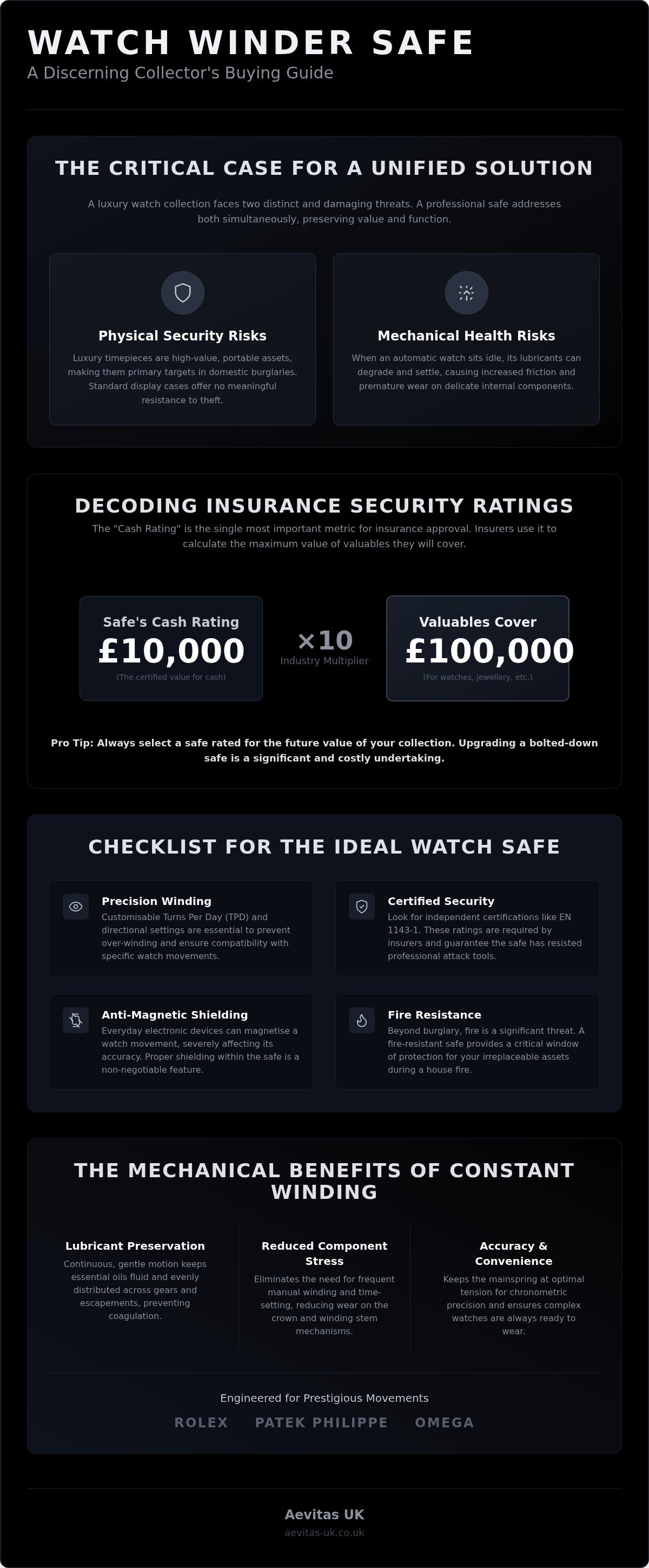
Protecting a luxury watch collection requires a strategy that addresses two distinct vulnerabilities: physical security and mechanical health. A standard display box might showcase your favourite pieces, but it offers zero resistance against a determined intruder or the subtle degradation of stagnant movements. This watch winder safe buying guide highlights why a unified solution is now the gold standard for serious collectors. It's about more than just storage; it's about preserving the long term viability of your horological assets.
The dual threat of theft and mechanical stagnation creates a high stakes environment for any collector. Whilst a watch sits idle, the synthetic lubricants inside the movement can begin to settle or lose their viscosity. This leads to increased friction when the watch is finally worn, potentially causing premature wear. Simultaneously, luxury watches remain one of the most targeted items in domestic burglaries due to their high value and portability. A watch winder safe provides a definitive resolution to both problems in a single, elegant unit.
The Evolution of Home Watch Storage
Collector behaviour has shifted significantly. In 2026, the trend of "hidden luxury" has replaced overt displays in many high end homes. High value assets are no longer left on dressing tables or in glass cabinets. They are secured in sophisticated vaults that blend into refined interiors. This shift is partly driven by necessity. Modern insurance providers are increasingly specific about their requirements, often mandating the use of certified safes for collections that exceed a certain valuation. Transitioning from a simple box to a secure vault offers a sense of calm and control that matches the sophistication of the watches themselves.
Mechanical Benefits of Constant Winding
Maintaining an automatic movement requires consistent, gentle motion. A watch winder safe ensures your timepieces are always ready for immediate wear, which is particularly vital for complex perpetual calendars or moon phase complications that are time consuming to reset. The technical benefits include:
- Lubricant Preservation: Continuous movement keeps oils fluid and evenly distributed amongst the gears.
- Reduced Component Stress: Regular winding reduces the need to frequently pull the crown and adjust the winding stem, which are common points of mechanical failure.
- Accuracy Maintenance: Keeping the mainspring at an optimal tension level ensures the movement operates within its intended chronometric tolerances.
Investing in a secure winding solution is a proactive step in horological care. It eliminates the disorder of multiple individual winders and provides a centralised, protected environment for your most valued possessions.
Decoding Security Ratings: Cash Ratings and Insurance Approval
Selecting a vault involves understanding the technical language used by insurers to quantify risk. The term "Cash Rating" is the most critical metric in any watch winder safe buying guide. It represents the level of security the safe provides and, by extension, the maximum value an insurance provider will cover for the contents stored within. For UK collectors, ensuring your safe meets these specific standards is not optional; it is a prerequisite for a valid policy.
The distinction between a standard cabinet and an insurance-approved vault lies in the testing. Professional safes undergo rigorous attacks using thermal and mechanical tools to earn their certification. This provides a sense of calm, knowing your assets are protected by more than just a simple lock. Whether you prefer biometric access for speed or a digital keypad for shared family access, the underlying security rating remains the foundation of your protection strategy.
Calculating Your Required Cash Rating
Insurers typically apply a 10x multiplier to a safe's cash rating to determine its "valuable" limit. If a safe is rated for £6,000 in cash, it is generally approved for up to £60,000 in jewellery or watches. When choosing your model, always buy for the collection you intend to build, not just the pieces you currently own. A collection can grow quickly; upgrading a heavy, bolted-down safe later is a complex and costly endeavour. Always consult with your insurance broker to confirm that a safe's rating aligns with their 2026 domestic policy requirements before finalising your purchase.
Physical Construction and Fire Protection
A truly secure vault relies on advanced metallurgy and engineering. High-grade safes utilise thick steel walls and manganese plates specifically designed to shatter drill bits upon contact. This burglary resistance is distinct from fire protection. Whilst a burglary-rated safe prevents theft, a fire-rated safe uses moisture-releasing insulation to keep internal temperatures below the point where delicate watch components might warp.
- 30-Minute Protection: Sufficient for most domestic settings with rapid emergency response times.
- 60-Minute Protection: Recommended for rural locations or collections containing high-sensitivity vintage movements.
- Internal Storage: Look for units that include integrated jewellery boxes or drawers for non-winding items like bracelets or loose stones.
Managing a rural estate involves maintaining complex systems beyond security; for example, you can learn more about Lil' Stinky Septic Service to ensure your essential infrastructure is handled with the same care as your timepieces.
The physical footprint of the safe is determined by this construction. Heavier walls mean better protection but require a thorough assessment of your home's floor load-bearing capacity. By prioritising certified burglary and fire resistance, you ensure your horological investment remains secure against all domestic threats.
Technical Specifications: Precision Winding within a Vault
Integrating a mechanical winder into a reinforced steel vault introduces unique technical challenges that standard display cases never face. A primary focus of any professional watch winder safe buying guide must be the relationship between the electronic components and the delicate hairsprings of your timepieces. High-quality safes don't just provide physical protection; they ensure a controlled environment where precision winding occurs without the risk of electronic interference.
The most critical setting for any collector is the Turns Per Day (TPD) customisation. Luxury calibres require specific TPD counts to maintain optimal mainspring tension without over-winding. Whilst a Rolex Submariner might thrive on 650 TPD, other complex movements may require upwards of 900. Modern watch winder safes allow for individual rotor programming, including clockwise, counter-clockwise, and bi-directional rotations. This ensures every piece in your collection, from vintage Omega models to modern Patek Philippe complications, receives the exact motion profile it requires.
Magnetism remains a silent threat within metal enclosures. Inexpensive electronics can create magnetic fields that are trapped and potentially amplified by the steel walls of a safe. Premium units utilise shielded motors and anti-magnetic materials to protect your movements from this invisible hazard. Additionally, "Rest and Sleep" cycles are programmed into the software. These cycles mimic the natural behaviour of a watch on the wrist, allowing the mainspring to unwind slightly and preventing the constant stress that can lead to mechanical fatigue.
Motor Technology and Silent Operation
Motor reliability is the foundation of a vault-mounted system. Because these units are often installed in master suites or private offices, silent operation is a non-negotiable requirement. High-end units employ Japanese brushless motors, which are celebrated for their near-silent acoustic profile and exceptional longevity. These motors operate with minimal vibration, ensuring that the only sound in your room is the subtle click of the safe's locking bolts. This level of refinement ensures the safe remains a discreet addition to your interior whilst providing decades of reliable service.
Power Solutions Inside the Safe
Reliable power delivery is essential for consistent winding. Most collectors prefer a mains power connection, which often requires a pre-drilled cable port in the back of the safe. This eliminates the need to monitor battery levels. However, battery backup remains a popular secondary option for those who prioritise placement flexibility. When using internal LED lighting to showcase your collection, ensure the system uses low-heat diodes. Excessive heat build-up in a sealed vault can negatively affect watch lubricants over time. Finally, always choose a safe with an external power bypass or a physical override key to ensure you can access your collection even if the digital lock's internal power fails.
Selecting the Right Dimensions and Installation Strategy
Planning the physical integration of a vault into your home is as critical as the security ratings themselves. This watch winder safe buying guide prioritises a methodical approach to ensure your chosen unit provides both utility and permanence. The process begins with a rigorous audit of your current assets. Don't just measure for the watches you wear today; forecast your acquisitions for the next five years. A safe is a long-term fixture, and underestimating your future capacity requirements is a common oversight that leads to logistical frustration.
Once you've established the internal volume, you must assess the structural integrity of your property. Professional-grade safes are exceptionally heavy, often exceeding 100kg even for compact models. You must verify that your floor can support this concentrated load, particularly in older British homes with timber joists. Accessibility is the next consideration. Ensure there is a reliable power socket near the installation site to power the winding rotors and internal lighting. Without a proximate mains source, you may be forced to rely on battery power, which requires more frequent maintenance.
Capacity Planning for Growing Collections
For many serious collectors, an 8-watch winder safe represents the ideal "sweet spot" for a rotating daily collection. It offers enough variety for different occasions whilst maintaining a manageable footprint. If your collection includes quartz pieces or manual-wind heritage watches, look for models that combine active winding rotors with static storage drawers. This hybrid approach keeps your automatic movements primed whilst providing a secure, organised home for your entire horological portfolio. For more on managing larger sets, consult our Guide to Multi-Watch Winders.
Discreet Placement and Home Security Integration
The most effective security strategy balances physical strength with stealth. A "safe within a cupboard" approach remains a favourite for high-end interiors, allowing the safe to be bolted to the floor whilst remaining completely hidden behind bespoke cabinetry. This provides an additional layer of psychological security, as the vault is not immediately visible to casual visitors or staff. For total protection, integrate your safe into your existing home alarm system using tilt sensors or vibration detectors. Professional bolting to a solid concrete floor or a load-bearing wall is non-negotiable; most insurers will void a policy if a safe under 1,000kg is not correctly anchored. Our Watch Winder Safe Installation Guide provides deeper technical insights into this process.
To secure your collection with a vault that meets these exacting standards, explore the Watch Winder Safe collection at Aevitas UK today.
The Aevitas UK Distinction: Premium Safes for Discerning Collectors
Aevitas UK represents the pinnacle of British horological storage. Our expertly curated Watch Winder Safes are designed specifically for the requirements of high-end British homes, balancing heavy-duty security with an aesthetic that complements a luxury interior. Choosing a vault from this collection ensures that your mechanical assets are protected by a brand that understands the emotional and financial significance of your horology. This watch winder safe buying guide concludes by highlighting how heritage-focused craftsmanship meets modern digital security to create a sanctuary for your timepieces.
Every safe in our range offers unrivalled compatibility with the world's most prestigious movements, including Rolex, Patek Philippe, Omega, and Breitling. We recognise that moving a high-security vault is a logistical challenge that requires professional handling. To provide total peace of mind, we offer free insured worldwide delivery on all our safes. This service ensures your investment arrives securely and ready for installation without the hidden costs or risks often associated with heavy-duty transport. It's this commitment to the customer experience that defines our status as a premier authority.
Why British Collectors Trust Aevitas UK
As the UK’s best-selling premium watch winder brand, we've built a reputation on reliability and technical expertise. Collectors choose us because we provide more than just hardware; we offer direct access to expert horological advice to ensure every movement receives the correct care. Whether you are adjusting TPD settings or reviewing insurance requirements, our team acts as a knowledgeable guide. You can learn more about Aevitas Winders and our commitment to engineering excellence through our dedicated brand pages. We prioritise order and longevity in everything we produce.
Beyond the Safe: A Complete Storage Ecosystem
Refinement shouldn't end at the vault door. Aevitas UK provides a comprehensive ecosystem of products designed to maintain order across every aspect of your collection. When you travel, our Leather Watch Rolls provide the same level of internal protection and style as your home safe. For your daily wearer, a Luxury Watch Stand offers a dignified resting place that keeps the watch accessible whilst preventing scratches on the case back. Finally, our Premium Jewellery Boxes ensure that your non-horological valuables are organised with the same precision and care as your timepieces. This holistic approach to storage transforms a disparate collection into a curated gallery of personal history, providing a sense of calm and control to the discerning collector.
Secure the Future of Your Collection
Protecting a luxury collection requires a commitment to both physical security and mechanical precision. By aligning your storage with 2026 insurance requirements and technical winding standards, you ensure your timepieces remain as accurate as the day they were acquired. This watch winder safe buying guide has outlined the necessity of certified cash ratings, the importance of silent motor technology, and the strategic planning required for a permanent home installation.
Aevitas UK remains the UK’s best-selling premium watch winder brand, offering a curated selection of vaults compatible with all major luxury houses including Rolex, Patek Philippe, and Omega. We understand the logistical complexities of high-security storage; that's why we provide free insured worldwide delivery on every safe we sell. It's time to transition your collection from simple storage to a refined, secure sanctuary. Explore the Aevitas UK Watch Winder Safe Collection and invest in the long-term protection your horological assets deserve. Your collection is a legacy; ensure it is preserved with absolute confidence.
Frequently Asked Questions
Do I really need a watch winder safe for a Rolex?
Yes, a watch winder safe is essential for a Rolex collection to mitigate the high risk of domestic theft whilst maintaining the movement. Rolex calibres typically require 650 Turns Per Day (TPD) to remain at peak performance. Using a dedicated vault ensures your chronometer is ready for immediate wear and protected by a certified cash rating that satisfies your insurance provider. This dual-purpose approach is a core recommendation in any professional watch winder safe buying guide.
Will the motors in a watch winder safe magnetise my watches?
Premium watch winder safes use shielded, anti-magnetic motors to eliminate the risk of electronic interference. High-quality Japanese brushless motors are specifically designed to operate in close proximity to delicate hairsprings without causing magnetisation. Inexpensive, unshielded alternatives can lead to timing inaccuracies, but professional-grade safes provide a protected environment. This ensures your movements remain as precise as the day they left the manufacture, regardless of how long they are stored.
What is the best cash rating for a collection worth £50,000?
For a collection valued at £50,000, you typically require a safe with a minimum cash rating of £5,000. Under the standard "10x rule" used by most UK insurers, the jewellery and watch cover is ten times the stated cash limit. You should always verify these requirements with your specific insurance broker, as 2026 domestic policy conditions can vary. Buying a safe with a slightly higher rating provides essential room for future acquisitions.
Can a watch winder safe be bolted to a wooden floor?
You can bolt a safe to a wooden floor, but it is technically superior to anchor it into a solid concrete base or a load-bearing brick wall. If a wooden floor is the only option, you must use heavy-duty coach bolts secured directly into the structural floor joists. Most insurance-approved installations require the safe to be anchored to a solid substrate to prevent it from being physically removed during a burglary.
How long do batteries last in a watch winder safe?
Battery life in a vault-mounted winder typically ranges from six to twelve months, though this varies based on the number of active rotors. If you frequently use high TPD settings or integrated LED lighting, the power consumption will increase. Because opening a heavy safe door frequently is inconvenient, many collectors prefer using a mains power connection. This watch winder safe buying guide suggests prioritising a mains-powered unit for consistent, maintenance-free operation.
Are watch winder safes fireproof?
Many watch winder safes offer fire protection, but you must check the specific certification. A fire-rated safe uses intumescent seals that expand when heated to block smoke and flames. It also features moisture-releasing insulation to keep the internal temperature below the point where lubricants might dry out or components warp. Look for a 30-minute or 60-minute rating to ensure your collection survives a domestic fire incident whilst stored in the vault.
Is a biometric lock better than a digital keypad for a watch safe?
Biometric locks offer superior speed and convenience, allowing you to access your collection with a single touch. Digital keypads provide a reliable alternative that doesn't rely on fingerprint clarity, which can be affected by skin conditions or temperature. Many modern luxury safes now feature dual-locking systems that combine both technologies. This provides a sense of calm, knowing you have multiple secure methods to access your timepieces in any situation or environment.
Does a watch winder safe require a mains power connection?
Whilst many models offer a battery backup, a mains power connection is strongly recommended for consistent performance. Winding rotors require steady power to maintain precise TPD cycles over long periods. Most high-end safes include a pre-drilled power port at the rear to facilitate a discreet cable connection. Relying on mains power eliminates the risk of the winder stopping unexpectedly, which could lead to stagnant movements and the "setting" of internal oils.
0 comments