

Your luxury watch collection is only as secure as the structure supporting it. Finding the right spot for a high-security vault involves more than just clearing a corner in the dressing room. Deciding where to install a watch winder safe requires a precise balance of structural integrity, insurance compliance, and daily convenience. You've spent years curating a portfolio of horological excellence. Ensuring it remains both protected and perfectly wound is the final, essential step in your collecting journey.
We understand the anxiety that comes with storing high-value assets at home, from floor load concerns for units weighing over 200kg to the technicalities of powering internal winders. This guide discovers the most secure and practical locations to install your watch winder safe to protect your collection whilst ensuring your timepieces remain ready for wear. We'll examine UK insurance standards for 2026, explore discreet installation methods that satisfy Eurograde requirements, and address the vital environmental factors that keep your movements in peak condition.
Key Takeaways
- Identify the most discreet, structurally sound locations in your home to balance high-level security with effortless daily access to your collection.
- Discover where to install a watch winder safe to meet 2026 UK insurance standards, ensuring your vault is correctly anchored to solid concrete or load-bearing walls.
- Assess floor integrity and "dead load" requirements to safely accommodate heavy-duty safes that often exceed 200kg in weight.
- Plan for seamless power integration to keep internal winding motors operational without compromising the safe's fire resistance or theft protection.
- Optimise environmental conditions by positioning your safe away from external walls to maintain the stable humidity and temperature required for delicate horological movements.
The Importance of Strategic Placement for Your Watch Winder Safe
The decision of where to install a watch winder safe is a defining moment for any serious collector. It isn't merely about finding a corner that fits; it's about protecting the mechanical soul of your timepieces. While standard security measures focus on theft prevention, a winder safe serves a dual purpose. It must provide a fortress-like exterior whilst maintaining the delicate internal environment required for automatic movements. Unlike different types of safes used for documents or cash, these units require a dedicated power source and specific spatial considerations to function effectively.
Discretion is paramount. A visible safe is a target. The goal is to integrate the unit into your home's architecture so it remains invisible to guests and staff. This "out of sight, out of mind" approach forms the foundation of modern home security. If a thief doesn't know the safe exists, they can't plan to breach it. Strategic placement dictates both the security level of your assets and the long-term reliability of your watch movements.
Security vs. Accessibility: Finding the Middle Ground
A safe that's too difficult to access becomes a burden rather than a benefit. If your morning routine is hindered by a safe located in a distant loft or a cramped basement, you're more likely to leave your timepiece on a desk watch stand overnight. While these stands are perfect for display in secure environments, they offer no protection against theft. The ideal location allows you to retrieve your watch in seconds whilst keeping the unit hidden from casual observation. This balance provides a psychological sense of order; you know your collection is wound, protected, and ready for the day without the friction of a complex retrieval process.
Protecting the Movement: Environmental Factors
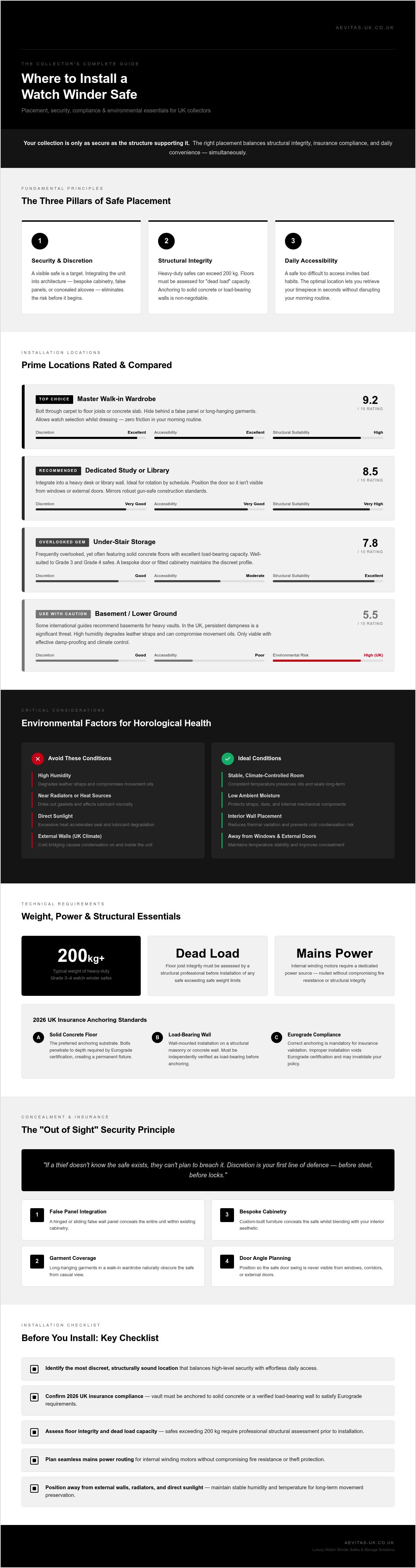
Environmental factors are often overlooked in home security planning. Some international guides suggest basements are the ultimate location for heavy vaults, but in the UK, dampness is a persistent threat. High humidity can degrade leather straps and, in extreme cases, compromise the internal oils of a movement. Similarly, avoid placing your safe near radiators or in direct sunlight. Excessive heat can dry out gaskets and affect the viscosity of lubricants. A stable, climate-controlled room is essential for long-term horological health. When considering where to install a watch winder safe, prioritise rooms with consistent temperatures and low moisture levels to ensure your investment remains in pristine condition.
Prime Locations for Home Watch Safe Installation
Selecting where to install a watch winder safe involves balancing your daily routine with sophisticated concealment strategies. While a bedroom might seem the most intuitive choice, it requires a higher level of discretion than other areas of the home. Professional collectors often look for spaces that offer structural strength without sacrificing the ease of access required for a morning rotation.
The Master Wardrobe: A Classic Choice
The back of a walk-in wardrobe remains a classic choice for a reason. By bolting the unit directly to the floor joists or a concrete slab through the carpet, you create a permanent fixture that is incredibly difficult to remove. To enhance security, hide the safe behind a false panel or a row of long-hanging garments. While statistics show that master bedrooms are often the first place intruders search, a safe that's integrated into bespoke cabinetry is significantly harder to detect than a freestanding unit. This placement allows you to select your timepiece whilst dressing, keeping your routine streamlined and your collection hidden from casual view.
The Dedicated Study or Library
The home office offers a different set of advantages for the modern collector. Integrating a safe into a heavy desk or a library wall allows for easy access during the day. This is particularly useful if you enjoy rotating your timepieces based on your schedule or evening events. Ensure the safe is positioned so the door swing isn't visible from windows or external doors. While watch safes focus on precision winding, their construction often mirrors the robust build quality found in regulatory gun safe standards, featuring reinforced steel and complex locking arrays designed to thwart determined attacks.
Under-stair storage is a frequently overlooked option that offers excellent security. These areas often feature solid concrete floors, providing the necessary support for heavier Grade 3 or Grade 4 safes that can weigh several hundred kilograms. This location is also less likely to be targeted during a fast-paced burglary. For those with a dedicated dressing room, the safe can become the centrepiece of a horological station, organised alongside your other luxury accessories. When deciding where to install a watch winder safe, consider the floor's weight capacity alongside the proximity to a power socket.
Not every piece in a collection requires the same level of vault-grade protection. For your secondary timepieces or daily "beaters", a luxury watch storage box placed in a more accessible dressing table drawer is a practical solution. This frees up space in your primary safe for high-complication pieces or heirloom watches that demand the highest level of security. If you're planning a new installation, exploring the Aevitas UK collection of insurance-approved safes is an excellent starting point for your project.
Technical Requirements: Weight, Power, and Floor Integrity
Technical precision extends beyond the watch movement to the very floor beneath your vault. When determining where to install a watch winder safe, you must account for a "dead load" that far exceeds that of a standard document safe. The inclusion of internal motors, sophisticated electronics, and heavy-duty insulation adds significant mass. A high-security Grade 3 safe, for instance, can easily weigh upwards of 350kg. This weight is concentrated over a relatively small surface area, creating intense pressure on your home's structural elements.
Managing Weight and Floor Loading
Consulting a structural engineer is a non-negotiable step if you plan to install a safe exceeding 150kg on traditional timber joists. Standard UK domestic floors are designed for live loads, such as furniture and people, but a permanent heavy vault requires a professional assessment. If the joists are insufficient, you may need a steel spreader plate. This plate distributes the weight across multiple joists, preventing structural sagging or floor failure over time. Ground floor concrete slabs remain the gold standard for installation. They provide a rock-solid foundation that eliminates weight concerns whilst offering the most secure anchoring point for insurance-mandated bolts.
Powering Your Winders Discreetly
A constant power supply is the lifeblood of your automatic watch winders. Planning for a recessed wall socket directly behind the safe is the most professional approach. This allows the safe to sit flush against the wall, which is essential for both aesthetics and security. Using extension leads is a significant risk; they are prone to overheating and can be easily unplugged, leaving your watches stationary. For collectors concerned about UK power cuts, many premium units offer battery-powered backup options to maintain winding cycles during temporary outages. Ensuring your power source is both hidden and reliable is a critical part of the installation process.
Magnetic interference is another technical hurdle to clear. High-performance speakers, large appliances, or even some home cinema equipment can generate magnetic fields that potentially affect delicate hairsprings. Keep your safe at a safe distance from these items to avoid the need for frequent demagnetisation. By addressing these technical requirements early, you ensure that your chosen location is not only secure but also horologically sound. This methodical approach protects the structural integrity of your home whilst maintaining the precision of your most valued timepieces. Choosing where to install a watch winder safe is a decision that requires equal parts security expertise and engineering foresight.
Concealment Strategies and Insurance Compliance
Securing your collection requires a layered approach. A high-security vault is your second line of defence; your first is ensuring it's never discovered. When planning where to install a watch winder safe, consider the psychological advantage of invisibility. A safe disguised as a standard wardrobe section or tucked behind a false panel in a study is far more effective than one left in plain sight. This strategy buys time, which is the one thing an intruder cannot afford. Discretion isn't just about aesthetics; it's a fundamental security protocol.
UK insurance providers are specific about installation standards. For most policies, a safe weighing less than 1,000kg must be professionally bolted to a solid concrete floor or a load-bearing wall. This isn't a mere suggestion. Failing to follow these requirements can void your coverage entirely. Insurers typically follow a "10x rule" for valuables. A Eurograde 1 safe with a £10,000 cash rating provides £100,000 of coverage for your watches. For larger collections, a Grade 3 safe offers £350,000 of protection, whilst a Grade 4 safe extends this to £600,000.
Meeting British Insurance Standards
Your safe must carry an accredited European certification, specifically EN 1143-1. Look for the stamped metal plate on the inside of the door. Stickers are easily faked and rarely satisfy a surveyor. When deciding where to install a watch winder safe, document the bolting process. Taking photographs of the anchor points and the specific bolts used provides irrefutable proof for your insurer. This level of diligence ensures your premium remains accurate and your claim validity is never in question.
Creative Disguise Techniques
Bespoke cabinetry is the ultimate tool for concealment. You can integrate your vault into a wardrobe system, using false-front drawers to hide the heavy steel door. Inside, the environment should be as refined as the exterior is rugged. Many collectors choose to house a carbon fibre watch winder display within the safe, illuminated by internal LEDs. This creates a private sanctuary for your collection that remains entirely hidden from guests or household staff. Using "decoy" storage for less valuable accessories can also divert attention away from your primary vault.
Explore our range of insurance-approved watch winder safes to find the perfect balance of security and sophistication for your home.
Integrating an Aevitas UK Watch Winder Safe into Your Home
Aevitas UK safes represent the ultimate union of a high-security vault and a precision watch winder. These units aren't merely steel boxes; they're sophisticated instruments designed to maintain the horological health of your most valued assets. Choosing the correct model involves more than just security ratings. It's about finding a piece that fits your current collection whilst allowing for future growth. Whether you require a compact Grade 1 unit for a modest rotation or the flagship 22-watch Grade 4 vault, our designs prioritise both protection and presentation.
Determining exactly where to install a watch winder safe is the first step in a larger strategy of refinement. Our internal winder configurations are engineered to support a diverse range of movements, from the robust calibres of a Rolex Submariner to the delicate complications of a Patek Philippe. Each module is individually programmable, ensuring that every timepiece receives the exact turns-per-day and directional rotation it requires to remain perfectly wound and ready for wear.
Selecting the Right Model for Your Space
Before committing to a specific location, measure the internal dimensions of the safe carefully. It's vital to ensure your largest cases, including crowns and pushers, fit comfortably within the winder modules without touching the door or adjacent watches. If you plan to integrate the unit into bespoke cabinetry, allow for the door's swing radius and ventilation. You can explore our full watch winder safe collection to compare the footprints of different Eurograde models. Selecting a unit with a few extra winding modules than you currently need is a prudent way to future-proof your investment.
Final Installation Checklist
Once you've chosen your location and your Aevitas UK safe has arrived, follow this final checklist to ensure a flawless setup. Accuracy at this stage prevents costly mistakes and ensures your insurance policy remains valid. We recommend a final verification of these three pillars:
- Structural Integrity: Confirm the floor strength and the quality of the concrete or timber joists one last time before drilling.
- Power Connectivity: Ensure the recessed socket is functional and provides a stable, surge-protected supply to the internal electronics.
- Concealment Level: Verify that the safe is fully hidden from external sightlines, especially when the room's main door is open.
After the safe is level and bolted, test each winder module's rotation pattern. This ensures the internal motors are functioning correctly after transit and installation. To further enhance your collection's organisation, review our guide on essential watch collector accessories to complete your horological station. Investing in an Aevitas UK safe provides the quiet confidence that comes from British-designed security, ensuring your timepieces remain protected for generations.
Refining Your Horological Security Strategy
Establishing the perfect environment for your timepieces requires a blend of engineering foresight and discreet design. Your choice of where to install a watch winder safe ultimately dictates the long-term safety and mechanical reliability of your most valued assets. By balancing structural floor requirements with insurance-mandated anchoring protocols, you create a fortress that respects the craftsmanship of your collection. True security lies in the layers of protection you build, from Eurograde-certified steel to the hidden power sources that keep your movements in peak condition.
Take the next step in your collecting journey with a British-designed vault. Browse the Aevitas UK Watch Winder Safe Collection today. Our units are compatible with all luxury automatic watch brands and come with the assurance of UK-based expert support. Benefit from free insured delivery worldwide as you transition your collection into a secure, organised, and perfectly maintained sanctuary. Your investment deserves nothing less than the highest standard of protection.
Frequently Asked Questions
Do I need a professional to install my watch winder safe?
Professional installation is highly recommended to ensure the vault meets 2026 UK insurance standards and structural safety requirements. Certified installers possess the specialised equipment needed to anchor heavy units to concrete or load-bearing walls without damaging your home's infrastructure. This provides an essential paper trail for your insurer, confirming the safe is fitted according to the manufacturer's security specifications and the EN 1143-1 certification.
Can I install a watch winder safe on a wooden floor?
You can install a safe on a wooden floor, provided you use a steel spreader plate to distribute the weight across multiple joists. For units exceeding 150kg, a structural assessment is vital to prevent floor sagging or joist failure over time. When deciding where to install a watch winder safe on timber, always aim for a corner where the floor is naturally stiffer and closer to the wall supports.
How do I get power to the winders inside a bolted-down safe?
Aevitas safes feature a dedicated access hole at the rear or base designed specifically for the power cable. You should ideally position the safe in front of a recessed wall socket, allowing the cable to remain hidden and the safe to sit flush against the wall. This setup ensures a constant power supply for the winding modules whilst maintaining a clean, professional appearance that doesn't compromise the vault's fire or theft resistance.
Will the magnets in the winder motors affect the security of the safe?
The micro-motors used in modern winders are electronically shielded and possess a magnetic field far too weak to interfere with the safe's locking mechanism. These motors are designed to be horologically safe, protecting your watch's hairspring from magnetisation. Their operation has zero impact on the structural integrity or the electronic keypad performance of the vault itself, ensuring your security remains uncompromised.
Does a watch winder safe need to be bolted to the wall or the floor?
Floor bolting to a solid concrete slab is the preferred method for UK insurance compliance, though dual-anchoring to both floor and wall offers maximum security. If you are bolting to a timber floor, wall anchoring into solid brick or stone becomes even more critical. Most insurers mandate that any safe weighing less than 1,000kg must be securely fixed to prevent "carry-away" theft, regardless of the safe's individual weight.
What should I do if my insurance company requires a specific installation method?
You must follow your insurance surveyor's instructions exactly to ensure your policy remains valid for high-value horological assets. This often involves using specific bolt types or depths that exceed standard installation kits provided with the unit. Document the entire process with high-resolution photographs of the anchor points before the safe is finally positioned, as this serves as irrefutable evidence during a future claim review.
Is it safe to keep my watch winder safe in a garage or outbuilding?
Installing a watch winder safe in a garage or unheated outbuilding is not recommended due to the risk of condensation and extreme temperature fluctuations. The UK's damp climate can cause internal gaskets to fail and leather straps to mould. When considering where to install a watch winder safe, always prioritise a climate-controlled room with a stable relative humidity to protect the mechanical precision of your collection.
How often should I check the winder settings inside the safe?
You should verify your winder settings every time you rotate a timepiece or at least once every six months. This routine check ensures that the power supply remains uninterrupted and that the turns-per-day settings still align with the specific requirements of your current rotation. Regular monitoring prevents the accidental depletion of a watch's power reserve and confirms the internal electronics are performing optimally within the secure environment.
0 comments