

Why would you invest in a masterpiece of horological engineering only to let its intricate movement grind to a halt on your dressing table? If you've ever wondered what is a watch winder, you've likely felt the frustration of resetting a complex perpetual calendar or a moon phase complication after a few days of inactivity. It's a tedious process that many collectors find unnecessary. You may also worry about internal lubricants drying out when a watch sits idle, or perhaps you feel anxious about the mechanical wear caused by constant motion. These concerns are valid for anyone who values precision and craftsmanship.
This guide explains how a sophisticated winding device serves as a vital maintenance tool rather than a mere luxury accessory. You'll discover how these units preserve the accuracy of your automatic timepieces whilst simplifying your morning routine. We'll explore how the correct rotation settings protect the longevity of your movement, keep your collection ready for the wrist at any moment, and provide a refined way to organise your finest watches with quiet confidence.
Key Takeaways
- Understand what is a watch winder and how it maintains your timepiece's power reserve by mimicking natural wrist movement.
- Learn how programmed rotation cycles and rest periods protect intricate movements from mechanical strain whilst ensuring they're always ready to wear.
- Identify why winders are essential for complex complications, such as perpetual calendars, that require significant effort to synchronise manually.
- Discover the importance of technical features like ultra-quiet motors and customisable turns-per-day settings for preserving luxury watch longevity.
Understanding the Watch Winder: Definition and Essential Purpose
An automatic watch is a masterpiece of mechanical engineering, yet its functionality depends entirely on motion. If you've ever questioned what is a watch winder, it's best described as a mechanical surrogate for the human wrist. This motorised device rotates your timepiece in specific cycles to maintain the power reserve whilst the watch isn't being worn. It's an essential tool for any collector who values both the precision of their movements and the efficiency of their daily routine.
The primary purpose of a winder is to keep the mainspring wound. This ensures that the watch remains in a "ready-to-wear" state at all times. For those with complex complications, such as perpetual calendars or moon phases, this is a significant advantage. Manually synchronising these functions after a watch has stopped is a tedious and delicate process. Beyond its mechanical utility, a premium winder provides a protective, dust-free environment that serves as a sophisticated display for your finest pieces.
How it Differs from a Standard Watch Box
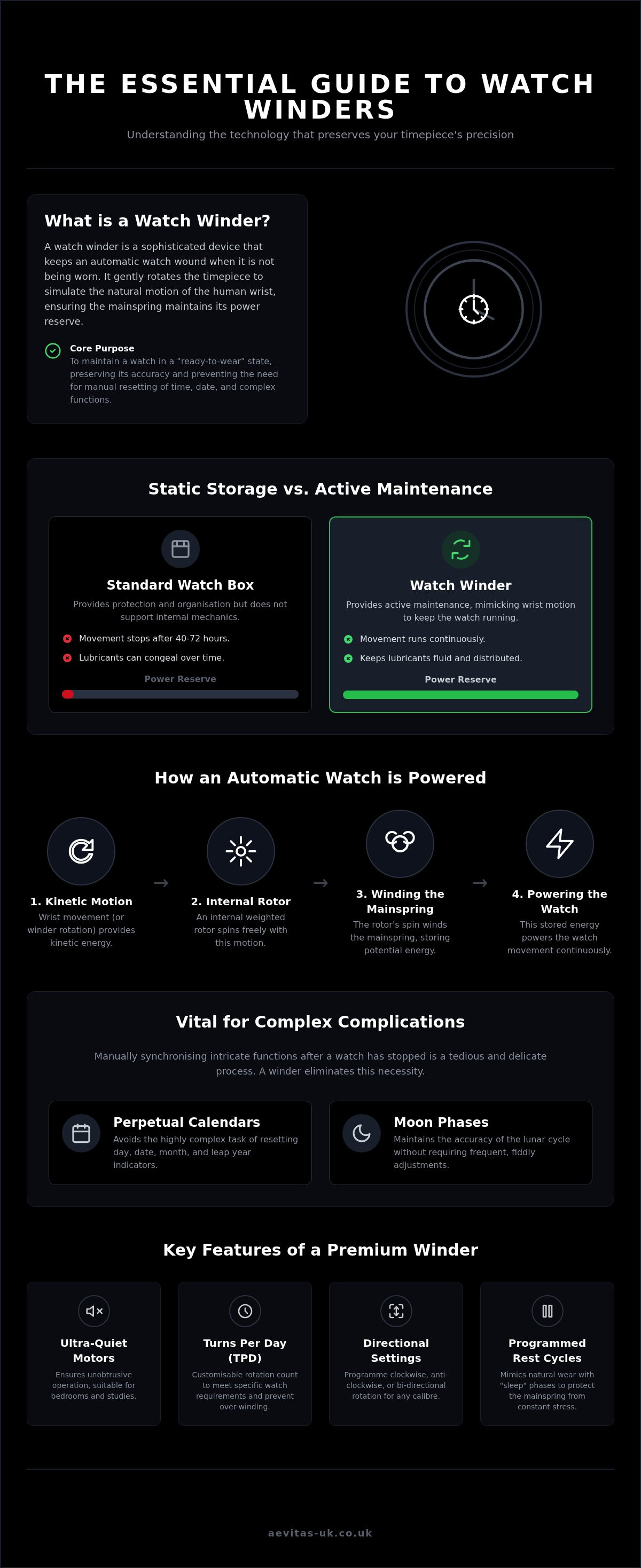
The distinction between a luxury watch box and a winder is the difference between static storage and active maintenance. A standard box is designed for protection and organisation. It shields your collection from external elements but doesn't support the internal mechanics. Most automatic movements possess a power reserve of approximately 40 to 72 hours. Once this window passes, the watch stops, requiring a manual reset of the time and date.
Active maintenance is where the watch winder excels. By keeping the movement in motion, it prevents internal lubricants from congealing or migrating over long periods of inactivity. This constant, gentle movement ensures that the gears remain engaged and the oils stay fluid. It's a proactive approach to horological health that can extend the intervals between professional services, offering a sense of calm and control over your collection's longevity.
The Science of the Automatic Movement
To appreciate the necessity of a winder, you must understand the science behind the automatic movement. Unlike a manual-wind watch that requires a physical turn of the crown, an automatic watch features an internal weighted rotor. This rotor spins freely as you move your arm, converting kinetic energy into potential energy stored within the mainspring. When the watch sits on a dressing table, this energy source is lost.
The winder mimics this natural kinetic energy through controlled, programmed rotation. This technology is specifically designed for automatic watches. Quartz watches are battery-powered, and manual-wind watches lack the internal rotor necessary to benefit from a winder's motion. For the automatic enthusiast, a winder is the only way to ensure the heartbeat of a timepiece never falters, preserving the integrity of the movement through consistent, reliable engineering.
The Mechanics of Motion: How a Watch Winder Functions
To truly grasp what is a watch winder, one must look beyond the exterior casing and into the precision engineering that drives it. These devices are far more than simple revolving platforms. They utilise ultra-quiet motors, such as the renowned Japanese Mabuchi technology, to ensure the rotation is practically silent. This makes them suitable for placement on a bedside table or within a quiet study. The goal is active maintenance that remains entirely unobtrusive to your daily life whilst providing the kinetic energy your timepiece requires.
Motion is only one part of the equation. Intelligence is the other. A premium winder doesn't spin indefinitely. Instead, it follows a programmed cycle of activity and dormancy. This prevents the mainspring from being kept at maximum tension for too long, which could cause unnecessary stress on the internal components. Directionality is equally critical. Depending on the specific calibre, a movement may wind clockwise, anti-clockwise, or in both directions. High-end models allow you to customise these settings for each individual watch in your collection.
Turns Per Day is the specific number of full rotations required to maintain a watch’s energy.
Simulating Natural Wrist Movement
Modern winders are designed to mimic human behaviour with remarkable accuracy. They use gentle oscillation rather than rapid spinning to simulate the natural movement of a wrist throughout a typical day. Rest cycles are a fundamental part of this process. They allow the mainspring to unwind slightly, just as it would whilst you sleep. Aevitas winders incorporate pre-programmed "sleep" phases to maintain movement health. This ensures the mechanical components aren't overworked. For those with larger collections, our multi watch winders offer the ability to set unique patterns for each timepiece simultaneously, providing a centralised solution for varied mechanical needs.
Understanding Turns Per Day (TPD)
Every movement has a "sweet spot" for energy intake. When determining what is a watch winder's most critical setting, TPD often tops the list. A Rolex often requires different settings than a Patek Philippe or an Omega. Most luxury movements require between 650 and 1,800 TPD to stay fully wound. Setting the TPD too low means the watch will eventually lose time and stop. Setting it too high leads to avoidable mechanical wear over years of use. Precision is the mark of a true collector. For a comprehensive database of settings for all major luxury brands, refer to our Watch Winder Turns Per Day: The Definitive Guide for Luxury Collections. This resource helps you calibrate your equipment with absolute confidence.
Evaluating the Necessity: Does Your Collection Require a Winder?
Determining whether your collection warrants an investment in active storage requires an honest assessment of your wearing habits. If you own a single automatic timepiece that never leaves your wrist, the question of what is a watch winder remains largely academic. However, for the serious collector rotating amongst three or more pieces, the utility is immediate. A winder serves as a central organisation hub. It reduces the physical handling of your watches, which in turn lowers the risk of accidental drops or crown damage during frequent manual winding and resetting.
Complexity dictates necessity. A time-only watch is easily adjusted in seconds. A perpetual calendar is a different matter entirely. These instruments track days, months, and leap years. If they stop, the synchronisation process is arduous. For some high-end calibres, a mistake during setting can even necessitate a trip to a professional watchmaker. Using a watch winder ensures these watches remain accurate and ready for the wrist without the stress of a manual reset.
Benefits for Complicated Timepieces
Complications like annual calendars and moon phases are designed to run continuously. When these movements halt, the internal gears for the calendar functions may become difficult to align. Keeping them in motion preserves the "grab-and-go" convenience that defines a modern luxury lifestyle. You shouldn't have to spend ten minutes at your dressing table just to wear your favourite piece. A winder maintains that precision effortlessly, ensuring that the date and time are always synchronised to the second.
Addressing the Wear and Tear Misconceptions
A common concern amongst new collectors is the fear of mechanical wear from constant motion. This is a common myth often found on enthusiast forums. Modern synthetic lubricants are exceptionally stable, yet they still benefit from periodic distribution through movement. Wear is almost exclusively a result of poor-quality equipment. Premium winders, such as those in the Aevitas collection, are engineered with sophisticated rest cycles to mimic natural wear. They also account for the slipping clutch mechanism found in all automatic watches. This safety feature ensures the mainspring cannot be overwound, providing absolute peace of mind for your most valuable assets.
Key Features to Consider When Selecting a Premium Winder
Selecting the right equipment requires a discerning eye for technical detail. Understanding what is a watch winder in a professional context allows you to identify the features that separate a basic accessory from a high-grade maintenance tool. A premium winder should be viewed as an extension of your timepiece's own engineering. It must provide a seamless environment that prioritises movement protection, quiet operation, and aesthetic refinement. These units are not merely storage; they are sophisticated instruments designed to uphold the standards of your collection.
Technical specifications are the foundation of a quality choice. The rotation range is a primary consideration, as most luxury movements require between 650 and 1800 TPD (turns per day) to maintain their energy levels without overstressing the mainspring. Look for units that offer independent control for each watch. This allows you to calibrate settings for a Rolex and a Patek Philippe simultaneously within the same unit, ensuring each movement receives the precise care it requires.
Motor Quality and Noise Reduction
The motor is the heart of the device. Inferior motors often produce a persistent mechanical hum that can disrupt the tranquillity of a bedroom or a professional office. Premium winders utilise ultra-quiet Japanese Mabuchi motors, which are renowned for their longevity and near-silent operation. These high-grade components ensure the device is virtually imperceptible during its rotation cycles. Protection against magnetism is equally vital. Quality winders use shielded motors to prevent magnetic interference, which could otherwise compromise the accuracy of your watch’s hairspring.
Material Excellence: From Leather to Carbon Fibre
Material choice reflects both the durability of the unit and the personality of the collector. Carbon fibre has become a favoured choice for modern enthusiasts, offering a high-performance aesthetic that is exceptionally resilient. You can explore the benefits of this material in The Ultimate Guide to Carbon Fibre Watch Winders for Luxury Collections. For those who prefer a more heritage-focused feel, leather and wood finishes provide a traditional elegance that complements classic dress watches. Regardless of the exterior, the internal cushions must be adjustable. This ensures that both small bracelets and larger straps fit securely, preventing any movement whilst the watch is in motion.
Investing in the correct technology is the only way to ensure your collection remains in peak condition. To find the perfect match for your timepieces, explore our range of premium watch winders and discover the difference that British design and engineering can make to your daily routine.
Elevating Your Storage with Aevitas UK
Choosing the correct maintenance environment for your collection is a decision that impacts the long-term health of your timepieces. When you first ask what is a watch winder, you're looking for more than just a motor; you're seeking a partner in preservation. Aevitas UK provides that partnership by combining deep horological expertise with premium British design. We understand that your collection represents both a financial and emotional investment. Our mission is to provide a storage solution that reflects the same level of craftsmanship found within the watches themselves.
Our range is engineered for total compatibility. Whether you own a vintage Rolex or a modern Omega, our winding modules are calibrated to handle the specific requirements of every major luxury brand. We cater to every stage of a collector's journey. You might require a compact single unit for a daily wearer or a bespoke multi-winder cabinet for a growing ensemble of complications. Each product serves as a testament to our commitment to precision and order. It's about creating a transition from disorder to refinement, giving you total control over how your collection is maintained and displayed.
British Design and Engineering Standards
We take pride in our heritage. Our products are designed in the UK to meet the exacting standards of local collectors who value durability alongside aesthetics. We don't just sell equipment; we offer a reliable support system for our clientele. Every component is selected for its longevity, from the silent motor technology to the hand-finished exteriors. We prioritise reliability because we know your watches deserve nothing less. You can explore our full range of Premium Watch Winders today to find a model that aligns with your specific needs and lifestyle.
Integrating Security with Watch Winder Safes
For those with high-value assets, simple storage isn't enough. Security becomes a primary concern that many standard guides overlook. A Watch Winder Safe provides a dual-purpose solution that combines active maintenance with robust physical protection. These units are designed to withstand fire and theft whilst keeping your movements in peak condition. It's the ultimate choice for collectors who require insurance-approved storage for their most precious pieces. By integrating world-class winding modules into a high-security safe, we ensure your collection is protected from both mechanical stagnation and external threats, offering a sense of calm that only true security can provide.
Securing the Future of Your Collection
Maintaining a luxury collection requires more than just appreciation; it demands the right tools for preservation. You now understand what is a watch winder and how it serves as an essential guardian for your automatic movements. By simulating natural motion whilst providing critical rest periods, these devices protect the mechanical health of your timepieces. Whether you're managing a single daily wearer or a complex ensemble of perpetual calendars, the right winding solution ensures your watches remain accurate and ready for the wrist.
It's time to transition from manual resets to effortless maintenance. Aevitas UK combines British design expertise with whisper-quiet technology to offer a superior storage experience. Our units are compatible with all major luxury brands and come with the peace of mind of free insured delivery worldwide. Discover the UK’s best-selling premium watch winders at Aevitas UK and give your collection the protection it deserves. Your timepieces are masterpieces of engineering; ensure they're always treated with the precision they embody.
Frequently Asked Questions
Do automatic watches really need a winder?
Automatic watches don't strictly require a winder to function, but they are essential for maintaining the "ready-to-wear" status of a multi-watch collection. For timepieces with complex calendar functions, a winder saves significant time by preventing the movement from stopping. It also provides a secure, organised environment that protects your investment from accidental damage whilst on display.
Can a watch winder damage my watch movement?
A high-quality winder won't damage your movement if it's programmed with appropriate rest cycles. Problems generally arise from inferior devices that lack customisable settings or run constantly. Premium units are engineered to mimic natural wrist motion, ensuring the internal components aren't subjected to constant, unnecessary stress. This keeps the lubricants distributed evenly without causing mechanical strain.
How many turns per day (TPD) does my watch need?
Most luxury movements require between 650 and 1,800 TPD to remain fully wound. The specific requirement varies by manufacturer and calibre. Setting your device to the manufacturer's recommended TPD ensures the mainspring stays under optimal tension. This precision prevents the watch from stopping whilst avoiding excessive rotation that could lead to wear over several years.
Are watch winders noisy to keep in a bedroom?
High-end winders are designed to be virtually silent and are perfectly suitable for bedroom use. We utilise ultra-quiet motors, such as Japanese Mabuchi technology, which operate without an intrusive mechanical hum. This allows you to keep your collection organised and maintained on a bedside table without any disruption to your sleep or quiet home environment.
Is it okay to leave a watch on a winder all the time?
It's perfectly safe to leave your watch on a winder indefinitely, provided the device includes programmed dormancy periods. These rest phases are crucial because they allow the mainspring to relax, just as it would when you aren't moving. Constant rotation without breaks is unnecessary and doesn't reflect the natural behaviour of a watch on the wrist.
Do watch winders work for manual-wind or quartz watches?
Watch winders are specifically engineered for automatic movements and don't benefit manual-wind or quartz watches. Manual-wind timepieces lack the internal rotor necessary to translate rotation into power. Quartz watches are battery-operated and don't require kinetic energy. When you consider what is a watch winder, it's clear the technology is a specialist tool for rotor-driven mechanical calibres.
Can a watch winder overwind an automatic watch?
It's impossible to overwind a modern automatic watch due to an internal safety feature called a slipping clutch. Once the mainspring is fully wound, the clutch allows the rotor to continue spinning without adding further tension. A sophisticated winder complements this by using intermittent rotation cycles, ensuring the movement is maintained with the same care as if it were worn.
What rotation direction should I choose for my watch?
The correct rotation direction depends entirely on the specific movement inside your watch. Calibres are designed to wind clockwise, anti-clockwise, or bi-directionally. Most premium winders offer customisable settings to accommodate these differences. Using the wrong direction won't damage the watch, but it won't add any power to the reserve, eventually causing the timepiece to stop.
0 comments