

Would you trust a £50 plastic box to regulate the delicate heartbeat of a £10,000 Rolex? You've invested significant capital into a collection that represents the pinnacle of horological engineering, so it's only natural to want every calibre ready for the wrist at a moment's notice. However, the recurring concern amongst enthusiasts is clear: can a cheap watch winder damage a watch? We understand the frustration of a noisy motor disturbing your sleep or the anxiety of seeing a prized timepiece lose accuracy because of a budget accessory that lacks proper magnetic shielding.
This guide exposes the hidden mechanical risks of low-quality winders, from unshielded magnetic fields that exceed ISO 764 standards to the internal wear caused by erratic rotation cycles. You'll learn how to identify the precise TPD settings your movements require and why British design standards are essential for long-term protection. We provide a deep dive into the technical criteria that separate a professional-grade instrument from a dangerous imitation, giving you total peace of mind whilst ensuring your collection remains in showroom condition.
Key Takeaways
- Understand how modern calibres utilise slipping clutches as a safety feature, yet remain vulnerable to the mechanical fatigue caused by low-quality rotation cycles.
- Discover the definitive technical evidence regarding whether can a cheap watch winder damage a watch, specifically focusing on the risks of unshielded motor magnetism.
- Learn to identify the subtle symptoms of a magnetised movement and how to protect your hairspring from the interference common in budget electronics.
- Master the professional checklist for evaluating winder quality, from programmable Turns Per Day (TPD) to the necessity of turn-and-rest cycles.
- Explore the benefits of investing in premium British-designed engineering and durable materials like carbon fibre to ensure the long-term health of your horological assets.
The Mechanics of Automatic Watches and Winder Compatibility
The Mechanics of Automatic Watches rely on a weighted oscillating rotor that pivots freely with the wearer's arm movements. This kinetic energy tensions the mainspring, which then powers the complex gear train. For a collector, a precision watch winder is a vital tool to keep these calibres active. It eliminates the need to manually reset perpetual calendars or moon phase complications, which can be a laborious task for those with extensive collections.
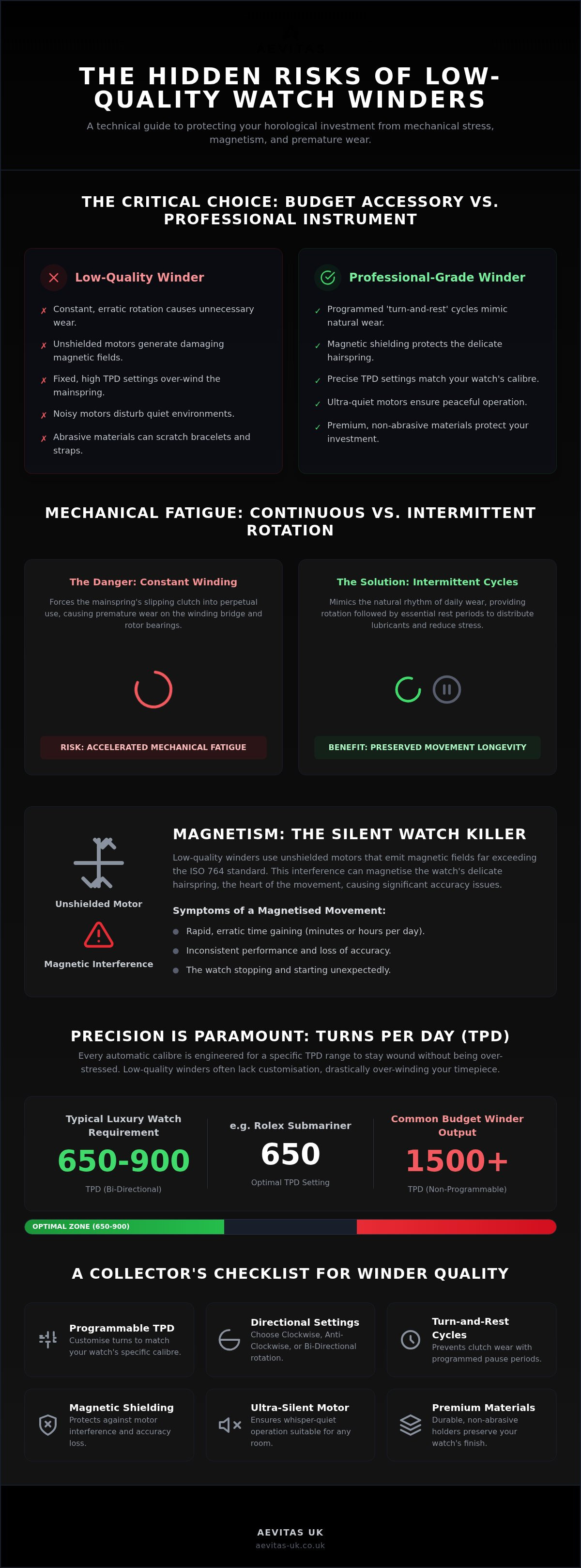
Modern automatic movements include a slipping clutch as a built-in safety feature. This prevents the mainspring from snapping once it reaches full tension. However, budget devices often lack the sophisticated programming required to stop when the watch is fully wound. When considering can a cheap watch winder damage a watch, the primary risk is the constant friction on this clutch. Unlike the natural, intermittent movement of a wrist, a low-quality winder may spin for hours on end, forcing the clutch to slip perpetually and causing unnecessary wear on the winding bridge and rotor bearings.
Authentic horological care requires a winder to mimic natural human behaviour. This means providing periods of activity followed by essential rest. A mechanical movement should not be kept at maximum tension indefinitely. A dedicated rest period allows the lubricants within the movement to remain properly distributed without the components being under constant load.
Understanding Turns Per Day (TPD)
Every calibre has a specific Turns Per Day (TPD) requirement to maintain its power reserve. Most luxury watches require between 650 and 900 TPD. For example, a Rolex Submariner typically performs best at 650 TPD with bi-directional rotation. If a winder provides 1,500 TPD because it lacks customisable settings, it doubles the mechanical stress on the movement. Directional needs also vary; some calibres only wind clockwise, whilst others require anti-clockwise or bi-directional turns to stay powered.
The Intermittent Rotation Strategy
A professional-grade winder never runs 24/7. It utilises an intermittent rotation strategy, turning for a set duration before entering a pause state. This cycle maintains the mainspring at a healthy 50% to 80% tension level, which is the "sweet spot" for accuracy and longevity. Premium models often feature a sleep mode, which suspends rotation for 12 hours. This ensures nocturnal silence in your bedroom whilst giving the mechanical components a necessary break from motion, effectively mirroring the rhythm of daily wear.
The Hidden Dangers of Low-Quality Watch Winders
A luxury timepiece is a masterpiece of precision engineering. Placing it inside a budget winder often introduces risks that the manufacturer never intended. Whilst the initial cost saving is attractive, many owners eventually ask: can a cheap watch winder damage a watch? The reality is that mass-produced alternatives often rely on inferior components that compromise the safety of your horological investment. Inconsistent rotation speeds are a primary culprit. If a motor fails to maintain a steady pace, it subjects the movement to erratic mechanical stress that goes beyond the standard slipping clutch protection discussed previously.
Physical damage is another overlooked factor. Cheap watch holders are frequently made from abrasive plastics or low-grade foams. These materials can react chemically with leather straps or leave micro-scratches on polished bracelet links. The structural integrity of the winder itself may also fail over time. Low-grade plastic gears tend to grind against one another, creating fine internal dust. This particulate matter can migrate into the winder's motor or settle on the exterior of your watch, acting as an abrasive during handling.
Mechanical Stress and Friction
Budget motors often exhibit jerky, non-fluid movements. This stuttering effect sends micro-vibrations through the watch's delicate escapement. Unlike the smooth, consistent rotation of a high-end motor, these shocks can lead to premature wear of the rotor bearings. Collectors should be wary of any device offering a one-size-fits-all setting. Without the ability to customise settings for your specific calibre, you risk forcing the movement into a state of perpetual friction. When considering can a cheap watch winder damage a watch, this lack of precision is a major red flag that inevitably leads to increased service intervals and expensive repair bills.
Material Degradation and Structural Integrity
The internal environment of a winder is critical for longevity. Cheap motors run hot, and because budget housings lack adequate ventilation, this heat can raise the internal temperature of your watch. Elevated temperatures thin the essential synthetic oils, leading to poor lubrication and timing issues. Unbalanced rotors in low-quality motors also cause the entire unit to vibrate. These constant tremors can eventually loosen internal screws within the watch movement. For those seeking to avoid these pitfalls, choosing premium watch winders ensures that every component is designed to protect, not just rotate, your timepiece.
Magnetism and Motor Interference: The Silent Watch Killers
Every electric motor relies on magnetic fields to generate motion. In the context of horology, this creates a fundamental conflict. Whilst your automatic movement needs kinetic energy, it is highly sensitive to the electromagnetic interference (EMI) produced by the very device intended to maintain it. When owners ask can a cheap watch winder damage a watch, the answer often lies in the lack of magnetic insulation. Budget winders typically use unshielded DC motors placed in close proximity to the watch cradle. This proximity is critical. Research indicates that magnetic field strength decreases by a factor of eight when the distance from the motor is doubled. Low-quality designs often ignore this physics, placing the motor directly behind the watch cushion.
How Magnetism Affects Timekeeping
The hairspring is the heart of a mechanical watch, regulating the beat through precise oscillations. When exposed to a magnetic field, the fine coils can become magnetised, causing them to stick together. This effectively shortens the spring and forces the movement to cycle faster than intended. Common symptoms of a magnetised watch include:
- A sudden gain of several minutes per day.
- The watch stopping entirely or behaving erratically.
- A significant loss of power reserve due to increased friction.
Even modern watches with silicon components or those meeting ISO 764 standards are not entirely immune to performance dips from cumulative exposure. Whilst a demagnetiser can resolve the issue, the process is a nuisance that requires professional intervention or specialised tools. This detracts from the seamless ownership experience a sophisticated collector expects.
Shielding: The Premium Difference
High-end engineering prioritises the separation of the motor's magnetic flux from the movement. A premium watch winder utilises specific positioning and shielding materials, such as Mu-metal, to block stray fields. The choice of motor is also paramount. Quality manufacturers opt for Japanese brushless motors, such as those from Mabuchi, which are designed for ultra-quiet operation below 20 dB and minimal EMI emission. A common enthusiast tip is the compass test, where a compass is held near the winder to detect magnetism. However, this is often insufficient for long-term safety. A compass may not react to the subtle, consistent fields that gradually degrade a hairspring's accuracy over months of storage. True protection comes from British-designed standards that ensure the magnetic field at the watch position is less than 10% of the ISO 764 threshold.
How to Evaluate Winder Quality: A Collector’s Checklist
Selecting a winder requires more than a glance at the price tag. Collectors must scrutinise the technical specifications to avoid the pitfalls of budget alternatives. A primary question remains: can a cheap watch winder damage a watch through poor programming? The answer is found in the flexibility of the settings. A quality unit must offer programmable Turns Per Day (TPD) and specific rotation directions to match the unique requirements of your calibre. Without these, you risk the mechanical fatigue discussed in earlier chapters.
TPD and Directional Flexibility
Precision is paramount when matching a winder to your specific timepiece. Most Rolex movements perform optimally between 650 and 800 TPD, whilst an Omega Calibre 8900 requires approximately 650 TPD. Bi-directional rotation is a must-have feature for modern collections to ensure even distribution of tension across the winding mechanism. If you are managing several timepieces with varying requirements, consult our Guide to Multi-Watch Winders for detailed configuration advice. A winder that only offers a single, non-adjustable setting is a significant risk to high-value movements.
The Quietness and Vibration Test
Acoustic output is a direct indicator of mechanical health. A noisy motor suggests poor gear alignment or excessive internal friction. These mechanical flaws translate into micro-vibrations that can reach your watch, potentially loosening delicate internal screws over months of use. Premium winders utilise Japanese Mabuchi motors that operate below 20 dB, making them virtually silent. This level of refinement is essential for placement in a bedroom or professional study. If you can hear the gears grinding from across the room, the internal components are likely suffering from the same lack of precision.
Beyond the motor, examine the contact points. Look for soft, non-reactive linings and adjustable watch holders that accommodate different wrist sizes without straining the bracelet. A reputable brand will offer transparent data on their motor longevity and magnetic shielding standards. When assessing if can a cheap watch winder damage a watch, the presence of generic, unbranded motors is usually a sign to look elsewhere. For those ready to upgrade their storage, explore our collection of British-designed watch winders to secure your collection's future.
Investing in Longevity: Why Premium Engineering Matters
A luxury watch is often the culmination of years of dedicated collecting. It represents a significant financial and emotional commitment. Viewing a winder as a mere display case is a mistake that many novice collectors make. In reality, a high-quality winder is a precision maintenance tool. It ensures the movement remains lubricated whilst protecting it from the environmental hazards and mechanical stresses discussed throughout this guide. When you ask can a cheap watch winder damage a watch, the answer is often found in the hidden costs of repair. A single service for a magnetised or worn calibre can easily exceed £500, a figure that far outstrips the initial saving of a budget accessory.
The Aevitas Standard of Protection
British engineering standards prioritise the longevity of the movement above all else. By utilising superior motors and meticulously shielded electronics, the risk of electromagnetic interference is virtually eliminated. The choice of materials is equally critical for the discerning collector. Our Carbon Fibre Watch Winder Collection offers more than just a modern, high-tech aesthetic. Carbon fibre provides exceptional structural integrity and durability, ensuring the winder remains a stable, vibration-free environment for decades. These units are designed to meet the rigorous demands of the most complex horological complications, keeping lubricants properly distributed without over-tensioning the mainspring.
Security and Presentation
For those with high-value collections, protection extends beyond mechanical health to physical security. Integrating winding technology with insurance-approved storage, the Watch Winder Safe provides a fortress for your horological assets. This dual-purpose approach ensures your watches are always wound, secure, and presented in a manner that reflects their heritage. A premium winder acts as a protective home, shielding your timepieces from dust, moisture, and accidental impact.
Ultimately, the decision to invest in premium engineering is a decision to protect your legacy. A budget device might save a few pounds today, but it lacks the programmable precision and magnetic shielding required for 2026 horological standards. As we have established, the question of can a cheap watch winder damage a watch is a genuine concern for any serious enthusiast. Choosing Aevitas quality ensures your timepieces remain in peak condition, ready for the next generation. With global insured delivery, the transition from disorder to horological refinement is both seamless and secure.
Securing the Future of Your Horological Assets
Protecting a luxury timepiece requires an understanding of the delicate balance between kinetic energy and mechanical fatigue. We've explored how unshielded motors and erratic rotation cycles compromise the integrity of high-end calibres. The technical evidence is definitive. Whilst the initial saving is tempting, can a cheap watch winder damage a watch through magnetism and unnecessary friction? The answer is a resounding yes. Authentic horological care demands British-designed precision that respects the engineering of brands like Rolex and Patek Philippe.
Investing in a professional-grade instrument is the only way to ensure your collection remains ready for the wrist without risking expensive repair bills. As the best-selling premium brand, Aevitas specialises in carbon fibre and luxury materials that offer both aesthetic refinement and technical protection. Protect your collection with an Aevitas Premium Watch Winder and enjoy free insured worldwide delivery. Your timepieces deserve a home that matches their exceptional craftsmanship.
Frequently Asked Questions
Can a watch winder actually damage my automatic watch?
Yes, a low-quality device can cause mechanical issues through unshielded magnetism and excessive rotation. Whilst modern watches have safety clutches, a winder without programmable settings forces this clutch to slip perpetually, leading to unnecessary friction and internal wear. To avoid these risks, collectors should prioritise British-designed units that offer precise control over rotation cycles and include essential rest periods to mimic natural wrist movement.
How do I know if my watch winder is magnetising my watch?
The primary symptom of a magnetised movement is a sudden, significant gain in time, often several minutes per day. This happens when the hairspring coils stick together due to electromagnetic interference from an unshielded motor. You can verify this using a compass; if the needle deflects when held near the watch, magnetism is likely present. Professional demagnetisation can resolve this, but prevention through shielded electronics is the superior strategy.
Is it better to leave an automatic watch to stop or keep it on a winder?
For watches with complex complications like perpetual calendars or moon phases, a winder is highly beneficial to avoid the laborious task of resetting. It also ensures that synthetic lubricants remain properly distributed throughout the movement. However, this only applies when using a high-quality instrument. Leaving a watch to stop is safer than using a budget device where can a cheap watch winder damage a watch through magnetic exposure.
What is the correct TPD setting for a Rolex or Omega?
Most modern Rolex calibres perform optimally between 650 and 800 Turns Per Day (TPD) with bi-directional rotation. For Omega timepieces featuring the Calibre 8900, a setting of 650 TPD is generally recommended. It's vital to use a winder that allows for these specific adjustments. Using a generic setting can lead to the recurring concern: can a cheap watch winder damage a watch by subjecting the movement to excessive mechanical stress?
Are cheap watch winders noisy over time?
Budget winders frequently develop a noticeable grinding or humming sound as their low-grade plastic gears degrade. This noise is a clear indicator of internal friction and poor component alignment. In contrast, premium winders utilise Japanese Mabuchi motors designed for ultra-quiet operation below 20 dB. This ensures the device remains silent enough for a bedroom or office whilst maintaining the structural integrity required for long-term horological care.
Does a watch winder wear out the movement faster?
A precision-engineered winder does not wear out a movement any faster than regular daily wear. By incorporating intermittent rotation and rest phases, a quality winder maintains the mainspring at a healthy tension level. Accelerated wear only occurs with inferior devices that lack programmable logic, causing the watch to rotate continuously. A professional winder acts as a maintenance tool that supports the longevity of the calibre through consistent, gentle motion.
Can I use a cheap watch winder for a vintage timepiece?
Using a budget winder for vintage watches is highly risky. Older movements often lack the advanced slipping clutches found in modern calibres and are far more sensitive to magnetic fields. The delicate hairsprings in heritage pieces can be easily compromised by the unshielded DC motors found in mass-market products. For vintage collections, only a winder with precise TPD control and proven magnetic shielding should be considered to ensure the movement's preservation.
What should I look for in a high-quality watch winder motor?
Look for brushless motors from reputable manufacturers like Mabuchi, which are celebrated for their longevity and minimal electromagnetic emissions. A high-quality motor must be shielded to prevent stray magnetic fields from reaching the watch cradle. Additionally, ensure the motor supports independent programming for each watch. This allows you to customise the direction and TPD for every individual calibre in your collection, providing the bespoke care that high-value horological assets require.