

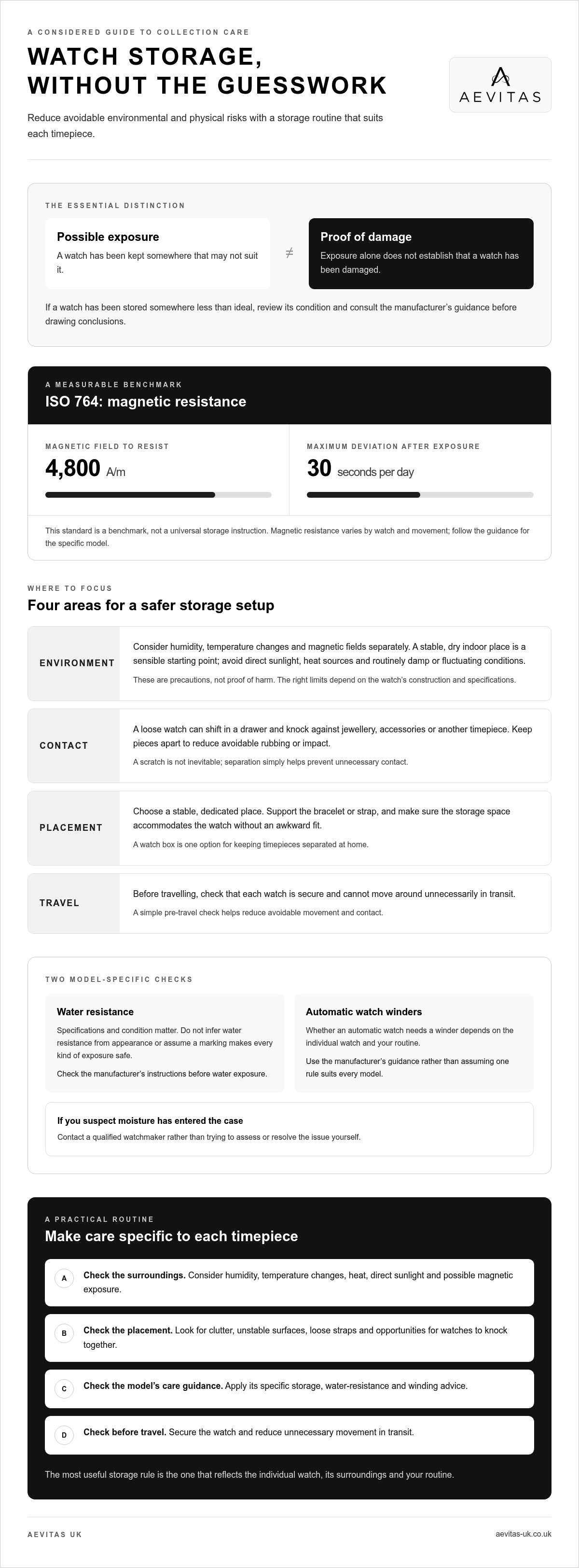
A collector’s appreciation of a watch may begin with its movement, design or the story behind a reference. The common watch storage mistakes to avoid are part of caring for a collection: even finely engineered timepieces need a considered place when they’re off the wrist. ISO 764 sets a measurable benchmark for magnetic resistance: a qualifying watch must resist a 4,800 A/m magnetic field and deviate by no more than 30 seconds per day after exposure.
That standard offers a glimpse of the precision behind watchmaking, but it isn’t a universal care instruction for every model. Storage choices should reflect the individual watch, its surroundings and your routine. Exposure to a possible risk is not proof that a watch has been damaged.
This guide explains how to assess environmental exposure, reduce unnecessary contact, prepare watches for travel and decide whether an automatic watch needs a winder. You’ll finish with a practical routine based on each timepiece’s manufacturer guidance.
Key Takeaways
- Distinguish avoidable exposure from evidence that a watch has been damaged.
- Assess humidity, temperature changes and magnetic fields separately, rather than assuming one storage rule suits every watch.
- Check whether clutter, unstable placement or loose bracelets could bring watches into contact with other items.
- Use a simple pre-travel check to secure watches and prevent unnecessary movement in transit.
- Identify the common watch storage mistakes to avoid, then build a routine around your collection, surroundings and each watch’s care guidance.
Common watch storage mistakes that expose timepieces to avoidable risks
There isn’t one storage rule for every watch. The right arrangement depends on the individual timepiece, its surroundings and how you use it day to day. A mechanical watch and a quartz watch, for example, may have different care considerations. For a general overview of watch types and movements, see Watch. For specific care, follow the manufacturer’s guidance.
Keep risk in perspective. A watch left in an unsuitable spot has been exposed to a possible risk, but that alone doesn’t prove it has been damaged. The common watch storage mistakes to avoid generally fall into four categories: environmental exposure, contact with other objects, poor placement and unsuitable storage during travel. Safe watch storage means reducing avoidable environmental and physical risks with a setup that suits the watch and your routine.
Start by checking where each watch rests when it’s not being worn. A dedicated, stable place can help prevent unnecessary movement and contact. For separated home storage, a watch box is one option. This four-watch walnut collectors’ box, for instance, provides a defined place for a small group of timepieces. Choose a format that accommodates the watches’ sizes and their bracelets or straps, rather than forcing them into an awkward fit.
Leaving watches in direct sunlight or near heat
A sunny windowsill or a surface beside a heat source may seem convenient, but prolonged exposure to direct sunlight or heat may not suit every watch. The effect can depend on the watch’s materials and construction, so don’t assume all models respond in the same way. Choose a place away from obvious sources of heat and direct sun, then check the manufacturer’s care instructions for guidance specific to the timepiece.
Storing watches where they can knock against other objects
A loose watch in a drawer can shift as the drawer opens or closes. Its case, bracelet or crystal may come into contact with jewellery, accessories or another watch. A scratch isn’t inevitable, but this creates avoidable opportunities for rubbing or impact. Keep pieces apart in a stable, dedicated space, and support the bracelet or strap rather than leaving it loose to move around.
These checks help separate environmental considerations from handling and placement choices. If a watch has been stored somewhere less than ideal, avoid assuming the worst. Review its condition and consult the manufacturer’s guidance if you’re unsure whether a particular exposure matters for that model.
Avoid humidity, temperature and magnetic-field storage mistakes
Environmental conditions deserve attention, but they aren't automatic proof of harm. Humidity, temperature changes and magnetic fields are separate considerations, and a watch's response depends on its construction and specifications. Rather than applying a universal threshold, use the manufacturer's guidance for the particular model. Longines also outlines ideal conditions for watch storage, including temperature and humidity considerations.
A general precaution can reduce avoidable exposure, while a manufacturer's stated storage requirement applies to a specific watch. That distinction matters when considering the common watch storage mistakes to avoid: sensible care doesn't mean assuming every model has identical limits.
Why damp or fluctuating conditions deserve attention
A stable, dry indoor location is a sensible starting point. Avoid routinely storing a watch somewhere that feels damp or experiences pronounced temperature changes, such as close to a heat source. These are precautions, not a diagnosis: the conditions alone don't establish that moisture has entered the case or that damage has occurred.
Water resistance is specific to a watch and its condition. Don't infer it from appearance or assume that a water-resistance marking makes every kind of exposure safe. Check the manufacturer's specification and care instructions, particularly before exposing a watch to water. If you suspect moisture has entered the case, contact a qualified watchmaker rather than trying to assess or resolve the issue yourself.
Magnetic exposure: check the watch before drawing conclusions
Magnetic sensitivity and resistance vary by model and movement. Electronics such as laptops or tablets are examples of everyday items to consider, but their presence doesn't mean a watch has necessarily been affected. Avoid treating every device as an equal or certain hazard, and consult the manufacturer's advice if you're unsure about a particular watch.
If you notice a change in timekeeping after suspected exposure, don't assume magnetism is the cause. Note what happened and seek model-specific guidance from the manufacturer or a qualified watchmaker. This is more useful than relying on a broad rule that may not apply to the movement in your collection.
For everyday organisation, Aevitas Watch Storage offers a watch box collection as one option for keeping pieces in a consistent place. Choose a location and storage format that suit your surroundings, then check each watch's care guidance before setting specific environmental limits.
Handling and placement mistakes that can scratch or strain a watch
Not every storage risk comes from the room itself. A cluttered drawer, an unstable bedside surface or a jewellery tray shared with watches can create unnecessary opportunities for contact. A watch may shift as a drawer opens, catch against a loose bracelet or sit where it can be knocked to the floor. These situations don’t guarantee a scratch or mechanical problem, but deliberate placement can help avoid them.
Think of separation as a practical precaution, not a promise that damage is otherwise inevitable. Keep watches on a stable surface and away from loose accessories. Before putting one down, check that its bracelet or strap won’t drag across another object and that it can’t roll or slide from its resting place.
Putting several watches together without separation
Cases and bracelets stored loosely together can touch as the watches move. Stacking pieces adds pressure and makes contact harder to control, while open bracelets may shift across neighbouring watches. Individual compartments, or another arrangement that keeps each piece apart, can make storage more orderly. Select a space that suits the case size and the watch’s bracelet or strap.
A dedicated watch box is one option for separated home storage. For example, a four-watch collectors’ box provides a defined place for a small group of watches. When comparing storage formats, consider how the watches fit and how you’ll reach for them in your regular routine, rather than choosing by capacity alone.
Handling a watch by its bracelet or crown without care
Careful handling starts with a secure grip and an uncluttered surface. Avoid letting a watch dangle from its bracelet or applying unnecessary force to the crown as you pick it up or put it away. The right method can depend on the watch’s design, so don’t treat one handling technique as suitable for every model.
Some watches have delicate complications or special mechanisms that call for model-specific handling instructions. If you’re unsure how to position, set or handle a particular watch, consult its manufacturer’s guidance or ask a qualified watchmaker. That’s more reliable than guessing, especially if a feature is unfamiliar.
These are common watch storage mistakes to avoid because they often come from routine, not a dramatic accident. A clear, stable place and a little space between each piece can reduce avoidable contact while keeping your collection easy to organise and access.
Travel and winding habits: storage mistakes collectors can prevent
Travel adds movement, and storage choices matter. A watch placed loose in a suitcase pocket or among chargers and accessories can shift against other belongings. Before setting off, secure each piece in a dedicated travel-storage method that suits the watch and journey. A leather watch travel roll is one option for keeping watches apart while travelling.
A simple pre-travel check can help prevent avoidable knocks:
- Place each watch in its own secure space, rather than loose in luggage.
- Check that bracelets or straps are fastened and won’t move freely against another watch.
- Choose a storage method suited to the watch’s size and the journey.
- Review the manufacturer’s care guidance if you’re unsure how a particular watch should be carried.
Packing watches loosely in luggage or a pocket
A pocket or an open section of a bag offers little separation from keys, accessories or other watches. Movement during a journey may bring these items into contact. Damage isn’t inevitable, but the risk is avoidable. Keep the watch secured and separated. Don’t assume a soft pouch or spare pocket is suitable unless it keeps the timepiece stable. Check the manufacturer’s advice for any model-specific travel considerations.
Using a watch winder when storage alone would suffice
An automatic watch doesn’t automatically need continuous winding while stored. Whether a winder is useful depends on the movement, any complications and your routine, including whether you prefer the watch to remain ready to wear. A winder works through configured turns rather than continuous spinning, and the appropriate settings can vary by movement. Check the watchmaker’s or manufacturer’s instructions before selecting settings or deciding to use one.
Storage alone may suit your routine, while another collector may value having an automatic watch ready to wear. Neither choice is right for every watch. Avoid treating a winder as essential or harmful across the board, and don’t guess at a model’s winding requirements. If the guidance is unclear, ask the manufacturer or a qualified watchmaker. For a dedicated travel-storage option, explore leather watch rolls.
Build a watch storage routine that avoids repeat mistakes
A useful routine doesn’t need to be complicated. It should reflect the watches you own, where you keep them and how you use them. Start with a quick assessment, then choose a consistent place and storage format. This turns the common watch storage mistakes to avoid into practical checks you can revisit as your collection changes.
A practical storage check for a growing collection
Ask yourself: how many watches need a place, and are they usually kept at home or taken travelling? Check that each can rest securely without touching its neighbours, and that the chosen spot works with its case size and bracelet or strap. If watches differ in materials, movements or complications, don’t assume one care routine applies to all. Review the manufacturer’s instructions for each model before setting specific storage or handling practices.
A simple sequence can keep the decision clear:
- Assess the collection: Count the watches you store regularly and note which ones travel.
- Choose a location: Pick a stable place that suits your surroundings and routine.
- Separate each piece: Make sure watches can be placed without rubbing against one another or nearby objects.
- Check care guidance: Follow model-specific advice, especially where movements or materials differ.
When to consider a box, roll or specialist storage
A watch box can provide organised, separated storage at home, whether you keep the collection out of sight or prefer an orderly display. A travel roll is intended for carrying watches, giving them separate places rather than leaving them loose among luggage. Choose based on how and where you’ll use it, not on the assumption that one format suits every collector.
Specialist options may make sense for particular routines. A watch winder could be relevant if you want an automatic watch kept ready to wear, but its usefulness and settings depend on the movement and manufacturer’s guidance. A watch winder safe may suit a collector considering a combined storage and winding format. Neither is a universal requirement, and no storage choice should be treated as a guarantee against every form of damage or loss.
Review your arrangement when the collection grows or your habits change. A box that once suited a few watches may no longer offer the space or separation you need; travel storage may be unnecessary for pieces that stay at home. For a considered next step, explore the watch box collection and compare formats with your collection and routine in mind.
Make watch care part of your routine
The common watch storage mistakes to avoid often come down to placement, unnecessary contact and assumptions about what every watch needs. A considered setup starts with a stable location, keeps pieces separated and accounts for each watch’s individual care guidance. For travel or winding, check the manufacturer’s recommendations instead of relying on a one-size-fits-all rule.
Choose storage around how you use your collection. Aevitas UK offers watch boxes, travel rolls, stands, winders and watch winder safes, providing different formats to consider for home organisation and travel. The right option is the one that fits your routine and the watches you own, not a universal fix.
Explore Aevitas UK’s watch storage options and find a considered place for your collection. Small, consistent choices can make watch care feel simpler and more organised.
Frequently Asked Questions
Is it bad to leave a watch in direct sunlight?
Leaving a watch in direct sunlight for prolonged periods may not be suitable, but the possible effects depend on the individual watch. A sunny windowsill is easy to overlook, particularly if it’s also near a heat source. As a sensible precaution, store the watch elsewhere and check its manufacturer’s care guidance for model-specific advice. Sun exposure alone doesn’t prove that damage has occurred.
Can I store different watches together in one box?
Yes, provided each watch has a secure place and can’t touch its neighbours. A box with separate compartments can help keep cases, bracelets and crystals apart. Check that each space suits the watch’s size and strap or bracelet. Stacking watches or leaving them loose together creates avoidable opportunities for contact. Keeping pieces separated is one of the common watch storage mistakes to avoid.
Should I keep an automatic watch on a winder when I am not wearing it?
Not necessarily. An automatic watch doesn’t automatically need to stay on a winder while it’s stored. Whether one is useful depends on the movement, any complications and your routine, such as whether you want the watch ready to wear. Check the manufacturer’s recommended winding settings before using a winder. If storage alone suits your needs, follow the watch’s care instructions rather than winding it without a reason.
Can magnetic fields affect every mechanical watch?
No. A watch’s sensitivity to magnetic fields varies by model and movement, so it isn’t accurate to assume every mechanical watch will be affected in the same way. If you suspect exposure or notice a change in timekeeping, consult the manufacturer’s guidance for your model. Don’t assume magnetism is the cause based on timing changes alone. Seek advice from the manufacturer or a qualified watchmaker if you’re unsure.
What is the safest way to store a watch when travelling?
Use a dedicated travel-storage method that keeps the watch secure and separate from other belongings. A travel roll can provide an individual space for a watch, while a loose pocket or section of luggage may allow it to shift against other items. Choose a format suited to the watch and journey, and follow the manufacturer’s care advice if your timepiece has particular handling or travel requirements.
What should I do if I think a watch has been stored in damp conditions?
If you suspect moisture has entered the watch, contact a qualified watchmaker for advice rather than trying to inspect the case yourself. Damp surroundings don’t by themselves confirm that moisture is inside, so avoid jumping to conclusions. Check the manufacturer’s care guidance and share what you know about the storage conditions. Don’t assume a water-resistance marking means the watch is protected in every situation.