

What if the very device you bought to protect your horological investment is actually doing nothing to lower your annual costs? Many collectors ask, do watch winders help with insurance premiums, only to find that insurers view mechanical maintenance and asset security through two entirely different lenses. While a high-quality winder is essential for the longevity of a complex movement, it doesn't provide the physical theft protection that underwriters demand.
You've likely invested significant time and capital into your collection; it's frustrating when your insurance provider remains unimpressed by a standard display case. We understand that the transition from simple storage to professional-grade security should be seamless. This guide reveals how to bridge that gap. Discover the critical distinction between watch maintenance and security storage to ensure your luxury collection is fully protected and your premiums are optimised. We will examine Eurograde certifications, the 2026 standards for home security, and how to choose a solution that satisfies both your watchmaker and your insurer.
Key Takeaways
- Understand the critical distinction between mechanical preservation and physical security. Whilst a winder maintains your movement, only a certified safe protects your financial investment.
- Understand the reality of whether do watch winders help with insurance premiums, as most underwriters prioritise physical security ratings over mechanical maintenance features.
- Learn how Eurograde EN 1143-1 standards determine your valuables rating. A Grade 1 certification currently supports up to £100,000 in coverage for your horological assets.
- Discover the importance of professional safe installation. Most insurers mandate that security units are anchored to a structural part of the building to maintain valid cover.
- Optimise your collection's care by integrating luxury aesthetics with high-security specs. Modern watch winder safes offer the perfect balance of maintenance and certified protection.
Understanding the Link Between Watch Care and Insurance Requirements
The evolution of the automatic movement, pioneered by John Harwood’s 1923 patent, fundamentally altered the trajectory of horological care. This innovation shifted the responsibility of winding from the owner to the movement itself, relying on kinetic energy to maintain a mechanical watch. In the current 2026 landscape, where a single Patek Philippe Nautilus or a limited-run Richard Mille can exceed the value of a high-end property, insurers have become increasingly granular in their risk assessments. Collectors frequently ask, do watch winders help with insurance premiums, seeking to understand if mechanical diligence is rewarded with lower costs. The answer lies in the distinction between preserving the movement and securing the asset.
Maintenance vs. Security: Defining the Terms
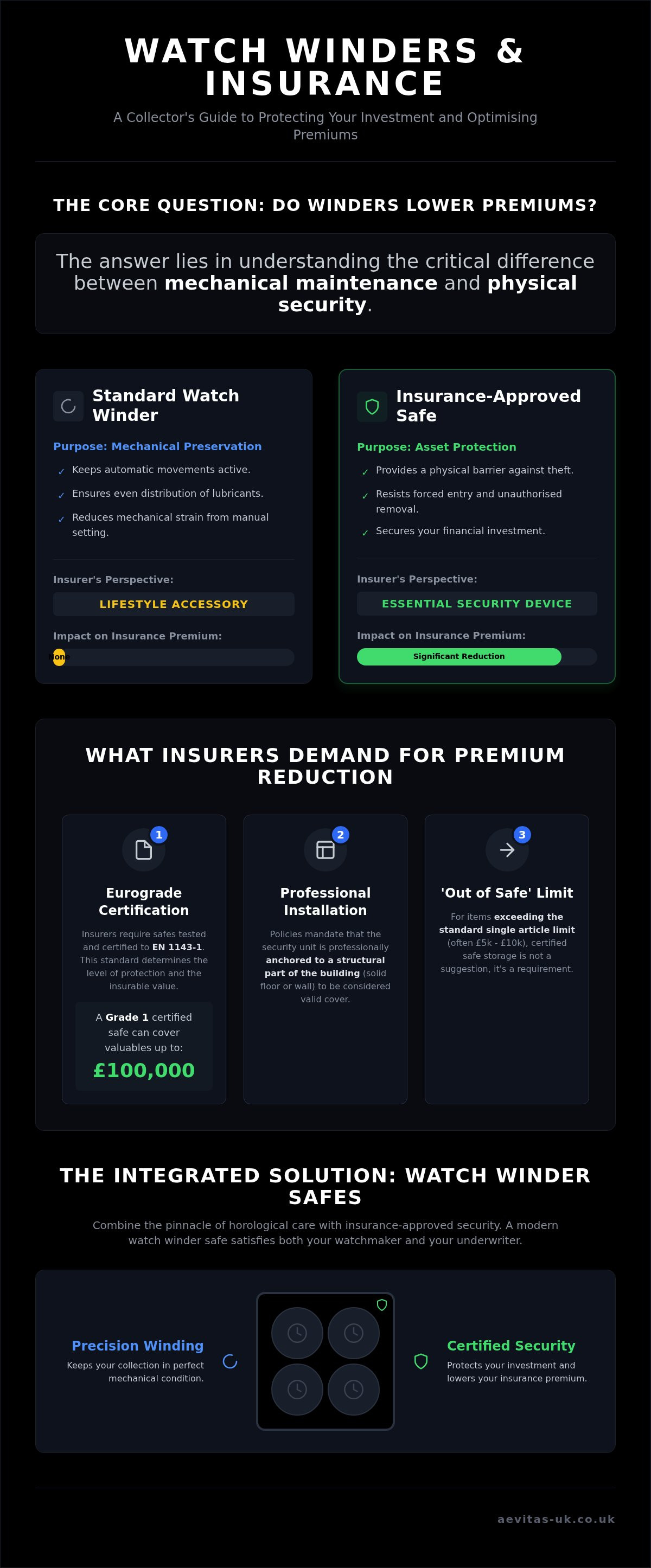
A watch winder is a precision maintenance tool. It's designed to keep automatic movements active, ensuring that the intricate lubricants within the calibre don't settle or dry out. Conversely, an insurance-rated safe is a physical security barrier. Its sole purpose is to resist forced entry and unauthorised removal. Collectors often confuse the two, assuming that keeping a collection in a high-end winder on a nightstand satisfies the security clauses of a policy. Aevitas Watch Storage bridges this gap by offering systems that combine both functions, but brokers remain focused on the Safe Rating rather than the TPD (Turns Per Day) settings.
The Insurer's Perspective on 'Reasonable Care'
Watch Winders vs. Watch Safes: What Actually Lowers Your Premium?
Understanding the distinction between a luxury accessory and a security device is fundamental for any serious collector. When you ask, do watch winders help with insurance premiums, the answer depends entirely on the housing of that winder. A standard carbon fibre watch winder is a masterpiece of engineering designed for mechanical health; however, it lacks the reinforced steel and locking mechanisms required to deter a professional thief. Insurers categorise these as lifestyle accessories rather than security measures.
Whilst a standalone winder won't typically trigger a premium discount, it remains essential for the physical integrity of your collection. By keeping your timepieces in motion, you avoid the mechanical strain of manual setting and ensure lubricants are evenly distributed. This reduces the likelihood of maintenance-related insurance claims, even if it doesn't directly lower the cost of your policy. For many brokers, the presence of an 'Insurance Approved' label on your storage solution is the only factor that shifts the needle on your annual costs.
When a Standard Winder is Sufficient
For collectors whose individual pieces fall below the 'out of safe' limit, a standard winder is often perfectly adequate. If your policy allows for £5,000 to £10,000 of jewellery to be kept outside a safe, a luxury watch storage box or winder provides the necessary organisation to keep your daily-wear items accessible. This is particularly beneficial for watches with complex calendars or moon phase complications. Keeping these set prevents the risk of accidental damage to the movement that often occurs during frequent manual adjustments.
The Transition to Insurance-Approved Safes
The conversation with your broker changes once your collection exceeds a specific valuation, typically around £15,000. At this threshold, many insurers issue a 'Safe Mandate'. They may refuse to cover a Rolex Daytona or a Patek Philippe Perpetual Calendar unless it's stored in a certified environment when not on the wrist. This is where integrated watch winder safes become an industry requirement rather than a luxury choice.
A rated winder safe provides a dual-purpose solution by maintaining the intricate movement of a timepiece whilst simultaneously fulfilling the stringent security requirements mandated by high-value insurance policies. It bridges the gap between horological care and financial protection. Aevitas Watch Storage offers a range of insurance approved watch winder safes to find a solution that satisfies your underwriter's specific demands.
Deciphering Security Ratings: Eurograde and Cash Ratings Explained
Security is measurable. For the discerning collector, understanding the technical specifications of a safe is as vital as knowing the calibre of a movement. In the UK, insurers rely on the Eurograde (EN 1143-1) standard to determine the level of cover provided for cash and valuables. When assessing if do watch winders help with insurance premiums, the technical certification of the safe is the deciding factor for most underwriters. Without an independent certification from a body like the LPCB, a storage unit is simply a metal box, regardless of its aesthetic appeal.
The UK 'Cash Rating' system acts as the foundation for these security tiers. A cash rating indicates the level of resistance a safe offers against professional attack. However, for horological enthusiasts, the most important figure is the valuables rating. The 10x rule is a standard industry multiplier; it states that the cover for jewellery and watches is ten times the cash rating. If a safe is rated for £10,000 in cash, it's automatically certified to protect up to £100,000 in horological assets.
Eurograde Ratings for Watch Collectors
Selecting the correct grade depends entirely on the current market value of your collection. Grade 0 safes offer a £6,000 cash rating, providing cover for £60,000 in valuables. Whilst this is sufficient for an entry-level collection, many enthusiasts find it restrictive as they acquire more pieces. A Grade 1 Watch Winder Safe is widely considered the industry 'sweet spot.' With a £10,000 cash rating and £100,000 valuables cover, it accommodates a significant collection, such as a multi-piece set of Rolex or Omega timepieces, whilst meeting the stringent requirements of high-net-worth insurers. Higher grades, from 2 to 5, are typically reserved for museum-grade collections or professional horologists with assets exceeding £175,000.
The 10x Jewellery Multiplier
Calculating the safe rating you need requires a proactive approach to valuation. You shouldn't rely on the original purchase price; you must use the current replacement value. In the volatile secondary market of 2026, a vintage Patek Philippe or a limited-edition Audemars Piguet can appreciate rapidly. If your collection's value outpaces your safe's rating, your insurance cover could be compromised. Regular professional valuations are essential to ensure your storage solution remains compliant with your policy mandates. By matching your collection's value to the 10x multiplier, you provide the 'duty of care' that underwriters demand to justify lower premiums and full coverage.
Practical Steps to Meeting Your Insurer’s Storage Mandates
Documentation is your most powerful tool during a policy review. We recommend maintaining a digital ledger that combines high-resolution photographs of each timepiece with proof of its storage location. Utilising a multi watch winder within your safe helps organise these assets for easier auditing. This level of precision shows the insurer that you're proactive about both mechanical maintenance and physical security. It provides the "duty of care" evidence necessary to justify lower rates.
Broker Communication Checklist
Effective negotiation starts with asking the right questions. You must ensure your storage choice aligns perfectly with your policy's fine print. Consider these points during your next renewal:
- Does my current policy require a specific Eurograde rating based on my collection's total replacement value?
- Are there specific "unattended" clauses that mandate watches be returned to the safe if the property is empty for more than 24 hours?
- Can the presence of a certified watch winder safe be used to negotiate a reduction in my annual premium?
Installation and Certification
A safe's security rating is only valid if it's installed correctly. For most UK insurers, professional floor-bolting is a non-negotiable requirement for compliance. You must ensure the certification plate, usually found on the inside of the door, remains intact and legible. This plate is the insurer's primary proof of quality and resistance. According to EN 1143-1 standards, any safe weighing less than 1,000kg must be professionally anchored to a structural part of the building to maintain its official rating. Without this professional installation, your insurance cover may be void in the event of a claim. To ensure your collection meets these rigorous standards, you can view our range of insurance-approved winder safes designed for structural anchoring.
Investing in Insurance-Approved Watch Winder Safes from Aevitas Watch Storage
Aevitas Watch Storage represents the pinnacle of British horological accessory design. We bridge the gap between sophisticated luxury and uncompromising security. When you evaluate the question, do watch winders help with insurance premiums, our range provides the definitive answer by integrating advanced winding technology into Eurograde-certified safes. Choosing our systems ensures you don't have to compromise between the mechanical health of your timepieces and the stringent security mandates of your insurer.
Our collection is designed for the modern home. We utilise high-end materials such as piano black lacquered wood and sleek carbon fibre to create units that serve as both security vaults and furniture-grade displays. For collectors with extensive sets, our 9 watch winder safe systems offer the ideal capacity. These units provide a centralised, secure location for your most valuable assets, simplifying the auditing process for your broker whilst enhancing the aesthetic of your private space.
Craftsmanship Meets Security
We specialise in the seamless integration of high-end winding technology into robust steel safes. Each winder within our safes features customisable TPD (Turns Per Day) settings. This precision allows you to match the exact winding requirements of any luxury brand, from Rolex to Patek Philippe. The refined interiors are finished with soft-touch linings to prevent scratches, complemented by subtle LED lighting that showcases your collection in its best light. You receive the protection of a vault with the presentation of a boutique gallery.
Peace of mind extends beyond the hardware. We provide free insured delivery worldwide, ensuring your investment arrives securely at your door. Our British-based expert support team is available to guide you through the technical specifications required by your underwriter in 2026.
The Final Verdict on Premiums
An Aevitas Watch Storage safe is a strategic investment that often pays for itself through cumulative premium savings. By meeting the Eurograde Grade 1 standard, you provide the physical protection that underwriters demand to reduce your risk profile. Beyond the financial incentives, there is the long-term value of protecting your heirlooms from both theft and mechanical wear. A well-maintained and properly secured watch preserves its value and its history for the next generation. You've spent years curating your collection; now is the time to ensure it is fully protected by the industry gold standard.
Explore our range of Insurance Approved Watch Winder Safes today.
Future-Proofing Your Horological Legacy
The transition from simple storage to professional protection is a defining step for any serious collector in 2026. It's no longer enough to rely on aesthetic appeal alone. While you may still wonder, do watch winders help with insurance premiums, the answer lies in the certification of the housing rather than the rotation of the motor. By integrating Eurograde-certified security with precision winding technology, you satisfy the underwriter's demand for "reasonable care" whilst maintaining the mechanical integrity of your timepieces.
Investing in a solution that offers a Grade 1 Euro Rated Security certification provides the necessary £100,000 insurance rating to cover even the most ambitious collections. This dual-purpose approach eliminates the confusion between maintenance and security; it ensures your assets are protected from both theft and technical degradation. With Free Insured UK Delivery, upgrading your home security has never been more straightforward.
Secure your collection with an Aevitas Insurance Approved Watch Winder Safe and enjoy the peace of mind that comes from knowing your investment is truly protected. Your collection deserves a home that matches its value and craftsmanship.
Frequently Asked Questions
Does a standard watch winder lower my home insurance premium?
A standard winder does not directly lower your premium because it lacks the certified security features insurers require. While it's essential for mechanical health, underwriters prioritise theft prevention over maintenance. To answer the question, do watch winders help with insurance premiums, you must look at the safe housing the device. Only an insurance-approved winder safe provides the physical barrier that brokers recognise as a risk-reducing measure.
What is a 'Cash Rating' and how does it apply to my watch collection?
A 'Cash Rating' indicates the level of resistance a safe offers against professional attack. In the UK, this figure is used to calculate the insurance cover for your assets. For watch collectors, the 'Valuables Rating' is the key number; it's ten times the cash rating. For example, a safe with a £10,000 cash rating protects up to £100,000 in horological assets, provided it meets the Eurograde EN 1143-1 standard.
Is a Eurograde 1 safe enough for a Rolex collection?
A Grade 1 safe is often the ideal choice for a Rolex collection, as it provides cover for up to £100,000 in valuables. This threshold typically accommodates several high-value timepieces, such as a Daytona or a Submariner, along with other jewellery. However, you must assess the current replacement value of your entire collection. If your assets exceed £100,000, you'll need to move to a Grade 2 safe to ensure full compliance.
Do insurers require watches to be kept in a winder safe at all times?
Most high-value policies include "unattended" clauses that mandate watches be returned to the safe when not in use. You aren't expected to lock them away whilst they're on your wrist. However, if you leave the property or go to sleep, insurers usually require your timepieces to be secured within a rated safe. Failure to follow these storage mandates can lead to a rejected claim if a theft occurs whilst watches are left on display.
Can I install a watch winder safe myself, or do I need a professional?
Professional installation is almost always a requirement for any safe weighing less than 1,000kg. To maintain the Eurograde certification, the unit must be anchored to a structural part of the building, such as a concrete floor or a solid brick wall. Many insurers won't recognise the security rating if the safe was installed as a DIY project. Professional anchoring ensures the safe cannot be easily removed from the property during a burglary.
What happens if my collection value exceeds my safe's insurance rating?
If your collection's value outpaces your safe's insurance rating, you're effectively under-insured. In the event of a total loss, the insurer may only pay out up to the safe's certified limit, or they might reject the claim entirely for breach of contract. It's vital to monitor secondary market prices in 2026. If the value of your Patek Philippe or Audemars Piguet rises, you must upgrade your safe grade to match.
Are carbon fibre watch winders more secure than wooden ones?
Carbon fibre is an aesthetic and structural choice for the winder itself, but it doesn't influence the safe's security level. Whether you choose a carbon fibre finish or a traditional wood veneer, the security comes from the steel-reinforced safe body and the locking mechanism. Aevitas Watch Storage utilises carbon fibre for its durability and modern look, but the insurance rating is derived from the Eurograde-certified safe that houses these motorised units.
How do I prove to my insurer that I have a rated safe?
You can prove your safe's rating by providing the insurer with a photograph of the official certification plate. This plate is usually located on the inside of the safe door and displays the Eurograde level and the EN 1143-1 standard. You should also keep the receipt from your professional installer and the original purchase invoice from Aevitas Watch Storage. These documents provide the necessary evidence that you've met your policy's duty of care requirements.