

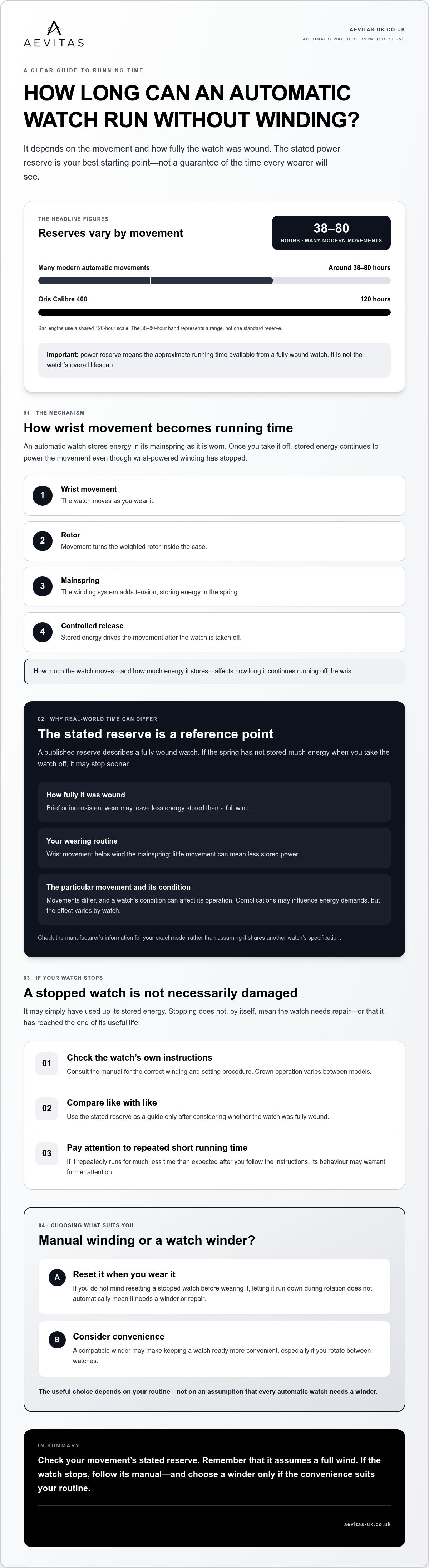
Could your automatic watch stop before the weekend is over? If you’re wondering how long can an automatic watch last without winding, the answer depends on its movement and how fully it was wound. Many modern models run for around 38 to 80 hours when fully wound, so two watches left on the bedside table may stop at very different times.
A stopped watch isn’t necessarily damaged, and its advertised power reserve may not match what you see in everyday use. The reserve describes how long a fully wound watch is expected to run. How much energy it has stored when you take it off, how it’s worn and the movement’s condition can all affect the result.
This guide explains how to check the reserve for your specific watch, what to expect when it stops and how to restart it with confidence. You’ll also learn when manual winding is enough and when a watch winder may make sense for convenience, especially if you rotate between watches. Letting a modern automatic watch run down during regular wear rotation doesn’t automatically mean it needs a winder or repair.
Key Takeaways
- To find out how long can an automatic watch last without winding, check the power reserve specified for its movement rather than relying on a general estimate.
- Learn how wrist movement winds the mainspring, and why the watch continues running on stored energy after you take it off.
- Compare the stated reserve with your wearing routine: a watch that isn’t fully wound may stop sooner than expected.
- If your watch stops, consult its manual for the correct winding and setting procedure, as crown operation varies between models.
- Decide whether resetting your watch before wearing it suits you, or whether a compatible winder would make keeping it ready more convenient.
How long can an automatic watch last without winding? Start with its power reserve
There’s no universal running time. The power reserve of the specific movement determines how long an automatic watch can run after it’s taken off and no longer receives energy from wrist movement. Many modern automatic movements offer around 38 to 80 hours, but some go further. Oris, for example, gives its Calibre 400 a 120-hour power reserve. Check your watch’s own documentation rather than assuming it shares that specification.
In brief: power reserve is the approximate running time available from a fully wound watch without further winding. It describes how long the watch may run before stopping, not its overall lifespan. A watch can stop when its stored energy is spent and still have years of use ahead of it.
What does power reserve mean on an automatic watch?
Automatic winding means the watch uses movement of your wrist to wind its mainspring. A weighted rotor inside the case turns as you move, helping store energy in the spring. That energy continues to drive the movement after you take the watch off, even though the rotor is no longer being moved by your wrist.
The term power reserve refers to the running time available from that stored energy when the watch is fully wound. Oris’s Calibre 400 illustrates how movement specifications can differ from the more familiar reserves found in many watches. The Automatic watch overview offers further background on the self-winding mechanism and its place in watchmaking.
Why is there no single answer for every watch?
Automatic movements don’t all store the same amount of energy. A reserve of 120 hours, such as the stated figure for the Oris Calibre 400, is substantially longer than the 38-to-80-hour range common to many modern movements. These figures are useful comparisons, not substitutes for checking the specification of your exact watch.
The published reserve is a movement specification, not a promise that every owner will see precisely the same elapsed time. A watch that starts fully wound has more stored energy than one worn briefly or inconsistently. If wrist movement hasn’t wound the spring sufficiently, it may stop earlier than the stated reserve suggests. Wearing habits, the particular movement and the watch’s condition can all affect real-world operation.
Complications, such as additional displays, may influence a movement’s energy demands, but their effect varies by watch. Don’t assume a feature changes the reserve by a particular amount. Check the manufacturer’s information for the exact model, including guidance on winding and operation. If your watch repeatedly runs for much less time than expected after following those instructions, its behaviour may warrant further attention.
Use the stated reserve as your starting point. Then check whether your watch was fully wound before you compare its running time with that figure. This is more useful than treating any one reserve as universal.
How an automatic movement stores energy and keeps the watch running
An automatic watch winds itself as it’s worn. Movement of the wrist turns a weighted component inside the case, which drives a winding mechanism and adds tension to the mainspring. The spring stores that energy, then releases it to keep the movement operating. Taking the watch off stops this wrist-powered winding, but the energy already stored doesn’t disappear at once.
From rotor movement to stored energy
The rotor converts wrist movement into the winding action that stores energy in the mainspring. The exact arrangement varies between movements. Some winding systems respond to rotor rotation in one direction, others in both, so consult the watch’s manual or calibre information for details specific to your model.
Think of the mechanism as a short chain:
- Wrist movement: the watch moves as you wear it.
- Rotor: that movement turns the weighted rotor.
- Winding system: the rotor’s motion winds the mainspring.
- Mainspring: stored energy passes through the movement to power timekeeping.
This is why time on the wrist doesn’t translate automatically into a fixed running time. If the watch has moved very little, or its winding system hasn’t built up much energy, it may have less stored power when you take it off.
Why the watch continues running after you remove it
Once wound, the mainspring continues to unwind in a controlled way. Its energy travels through the gear train, while the escapement regulates how it’s released in measured impulses. The balance then helps govern the movement’s rhythm. In plain terms, the watch keeps time using energy gathered earlier, even while it sits still.
That stored energy explains why the answer to how long can an automatic watch last without winding isn’t simply “until you take it off”. The rotor stops winding when wrist movement stops, but the mainspring continues powering the watch until its reserve is spent. The precise result depends on the movement and how much it was wound beforehand.
Automatic winding is a lasting example of mechanical engineering: it uses everyday motion to replenish stored energy without a battery. For broader watchmaking education, the American Watchmakers-Clockmakers Institute offers a professional point of reference on the craft. If you prefer a compatible watch to stay wound between wears, a watch winder can offer convenience, though it isn’t required simply because the watch has been taken off.
What changes an automatic watch’s real-world running time?
A movement’s published power reserve is a useful benchmark, but your watch may not have stored enough energy to reach it when you take it off. The specification describes the expected running time from a fully wound starting point. Your wearing pattern affects how much energy has been stored, so compare like with like before judging the result.
To find the official figure, check the documentation for your exact model or the manufacturer’s support information. For example, Seiko specifies a 72-hour, or three-day, power reserve for the Prospex Alpinist fitted with its Calibre 6R55. That figure is a movement specification, not a guarantee that every wearing routine will produce identical running time.
Stated power reserve versus everyday performance
Use the reserve as a reference, then consider how the watch was wound before it was left unworn. The comparison below shows what you can reasonably infer without assuming a precise shortfall.
| Specification or situation | Wearing pattern | Reasonable conclusion |
|---|---|---|
| Seiko Prospex Alpinist with Calibre 6R55, stated reserve of 72 hours | Fully wound before being left unworn | Use 72 hours as the manufacturer-stated reference for that movement. |
| The same movement and stated reserve | Worn briefly or with limited wrist movement | It may not be fully wound, so stopping before the stated duration doesn’t by itself show that the specification is inaccurate. |
| Any model’s published reserve | Worn regularly, then left unworn | Compare its running time with the official figure, while accounting for winding state and model-specific guidance. |
How wearing habits and complications can matter
Regular wear gives the automatic winding system more opportunity to replenish energy than occasional, short periods on the wrist. It doesn’t guarantee a full wind: activity and winding design vary. If you want to compare your watch with its stated reserve, follow the maker’s winding instructions first. Then note when you take it off and when it stops.
Additional functions, or complications, may affect a movement’s energy use, but the impact depends on the specific calibre. Don’t assume a complication reduces the reserve by a set amount. Age or service history alone also can’t establish how much running time has changed. If the watch repeatedly falls well short of its stated reserve after you’ve followed the manufacturer’s instructions, seek model-specific advice.
To assess how long can an automatic watch last without winding in your routine, compare the same starting wind and a similar wearing pattern with the maker’s stated specification.
What to do when an automatic watch stops
A watch that has stopped after being left unworn has often simply used the energy stored in its mainspring. That alone doesn’t mean it’s damaged. Follow a measured restart process rather than turning the crown or adjusting the hands by guesswork. The right method depends on the watch and its movement.
How to restart and set the watch carefully
Start with the manufacturer’s instructions for your exact model. Check how the crown should be operated, whether the watch needs manual winding before setting, and how to adjust the time and date. Some watches have restrictions on when the date should be changed. Don’t assume the procedure is identical across models.
A simple order of checks can help:
- Consult the manual: confirm the correct winding and crown instructions.
- Wind as directed: follow the maker’s method, without relying on a universal turn count.
- Set the watch: adjust the time and date according to the model’s guidance.
- Observe its operation: note whether it continues running and keeps time as expected.
Care rule: If model-specific instructions differ from general advice, follow the manufacturer’s guidance for your watch.
When to seek manufacturer or watchmaker advice
If the watch stopped after sitting unworn, restart it according to the manual and see how it behaves. That is different from repeated stopping during normal wear or unusual operation after winding. If the problem persists, avoid repeated adjustments and contact the manufacturer or a suitably qualified watchmaker for guidance. This isn’t a diagnosis; it’s a sensible next step when the watch doesn’t behave as its instructions describe.
Before making contact, record the model reference and what you observed: how it was worn, how you wound it, when it stopped and whether the time or date behaved unexpectedly. These details can help the manufacturer or watchmaker understand the issue without relying on guesswork.
Knowing how long can an automatic watch last without winding can help set expectations, but a stop after downtime is not, on its own, proof of damage. Nor does it automatically mean you need a winder. If you prefer a compatible watch to remain ready between wears, rather than winding and setting it when needed, explore watch winders for convenience. A winder is an optional convenience, not a repair solution.
Does a stopped automatic watch need a winder?
No. A stopped automatic watch doesn’t automatically need a winder. If you wear it occasionally, letting it stop and setting it again before wearing it is a perfectly practical routine. A winder is an optional convenience for a compatible watch, not a requirement simply because the watch has run down.
If you’re asking, “how long can an automatic watch last without winding?”, the movement’s power reserve gives you a reference for how long it runs after being wound. A winder doesn’t change that specification. It rotates the watch to keep its winding system active, which can help keep it ready to wear, provided the winder is suitable for the specific watch.
When a watch winder may be useful
A winder may suit someone who rotates between several automatic watches and would rather not wind and reset a watch each time it comes out of storage. This can be especially convenient if a particular model has settings you’d prefer to leave undisturbed. It’s a personal choice, not a measure of how well the watch is being cared for.
Check the watch manufacturer’s guidance before using a winder. Confirm that the watch is compatible and review any model-specific instructions for winding and settings. A winder should not be assumed to prevent damage or extend the watch’s life. For readers considering one, Aevitas Watch Storage’s automatic watch winders category offers a relevant place to explore the option.
Choosing storage that suits your routine
A winder and a watch box serve different purposes. A winder rotates a compatible automatic watch to maintain winding; a watch box stores watches without winding them. Choose according to whether your priority is having a watch ready to wear or keeping it organised when it’s not in use.
There’s no need to buy a winder just because your watch stops. If you’re comfortable setting it before wear, static storage may suit your routine. If you value readiness across a collection, a winder may be worth considering after checking each watch’s instructions.
For further reading, Aevitas Watch Storage’s guide, The Ultimate Guide to Carbon Fibre Watch Winders for Luxury Collections, explores the subject in more detail. If a winder fits your needs, you can explore the watch winder range and choose based on your watch’s guidance and your storage preferences.
Make your watch routine work for you
To answer how long can an automatic watch last without winding, check the power reserve for its specific movement. The stated figure is a guide, while the watch’s winding state and wearing pattern shape its real-world running time.
If it stops after being left unworn, that alone doesn’t mean it’s damaged or needs a winder. Follow the manufacturer’s instructions to wind and set it. A winder is optional: it may suit you if you’d rather keep a compatible watch ready to wear, whilst winding and resetting it when needed works well for many routines.
Aevitas UK specialises in premium watch winders and storage solutions, with options including carbon fibre and multi-watch winders. If convenience is a priority, explore automatic watch winders and consider what suits your collection and the manufacturer’s guidance.
With the right reserve information and a routine that fits how you wear your watch, you can care for it with confidence and enjoy it on your terms.
Frequently Asked Questions
How long can an automatic watch run without being worn?
The movement’s fully wound power reserve determines the approximate running time, so there’s no universal figure. To answer “how long can an automatic watch last without winding”, check the official documentation for your exact model. The stated reserve assumes a particular starting condition: a fully wound watch. Your wearing habits affect how much energy it has stored when you take it off, so brief or limited wear may not build a full reserve.
What happens if an automatic watch runs out of power?
When its stored energy is depleted, an automatic watch stops keeping time. You’ll usually need to wind it as directed and reset the time, and possibly the date. A stop after the watch has been left unworn doesn’t, by itself, prove that it’s damaged. Consult the model’s manual before operating the crown. If it repeatedly stops during normal wear or behaves unusually, ask the manufacturer or a qualified watchmaker for advice.
Does an automatic watch stop if you do not wear it every day?
It may stop once its power reserve is used, depending on the movement and how fully it was wound. Daily wear isn’t a universal requirement for an automatic watch, but a watch left unworn will no longer receive wrist movement to replenish its stored energy. Check the stated reserve for your model to understand how long it may run off the wrist, and follow the manufacturer’s winding guidance when you wear it again.
Can leaving an automatic watch unwound damage it?
A watch stopping after its reserve runs down isn’t, on its own, evidence of damage. For ordinary periods between wears, follow the maker’s instructions when winding and setting it again. For long-term storage, consult the manufacturer’s care guidance rather than assuming every movement should be stored in the same way. This is particularly relevant for watches with complications or specific storage instructions. If you’re unsure, ask the manufacturer for advice about your model.
How do I know the power reserve of my automatic watch?
Look up the exact model in its official manual or on the manufacturer’s website, or contact the manufacturer’s support team. Use the model reference where possible. Similar-looking watches can contain different movements, so a reserve quoted for another version may not apply to yours. Check that the information names your precise model or calibre, and treat its published reserve as a specification for a fully wound watch, not a guaranteed result in every wearing routine.
Does a stopped automatic watch need to go on a watch winder?
No. A winder isn’t an automatic requirement after a watch stops. It can be a convenience for keeping a compatible automatic watch ready to wear, while you can also leave the watch unwound and wind and reset it when needed. Check the manufacturer’s guidance before using a winder, including any movement-specific instructions. A winder performs a winding function; a watch box provides storage. Choose according to your routine and the watch’s requirements.