

What if the greatest threat to your timepieces isn't market volatility, but the quiet chaos of an untamed dressing room? Organising a large watch collection is an inevitable milestone every serious connoisseur faces, usually when mismatched manufacturer boxes begin crowding wardrobes and your daily rotation turns into a frustrating chore. You've spent years pursuing exceptional calibres, yet hunting for the right piece, constantly resetting intricate perpetual calendars, and worrying about gummed oils shouldn't dilute the pleasure of ownership.
Bringing structure to your horological portfolio should feel just as satisfying as winding a fine column-wheel chronograph. In this guide, you will discover how to categorise, store, and preserve your timepieces using professional curation strategies, tailored turns-per-day routines, and secure equipment. We'll examine robust classification frameworks, optimal storage integrating presentation boxes and automatic winders, and the meticulous provenance records required to keep your assets fully protected.
Key Takeaways
- Establish a functional classification system categorising timepieces by calibre, complications, and wear frequency rather than brand pedigree alone.
- Discover why organising a large watch collection requires an integrated storage layout pairing static presentation boxes with multi-unit winding systems.
- Calibrate bespoke Turns Per Day (TPD) settings and directional winding routines to preserve delicate movements and prevent synthetic lubricants from settling.
- Safeguard high-value portfolios by matching storage solutions to specialist insurance underwriting criteria and vault-grade safe standards.
- Build an exhaustive provenance archive separating original documentation from physical timepieces to defend long-term secondary market value.
Curation Principles: Categorising a Substantial Watch Collection
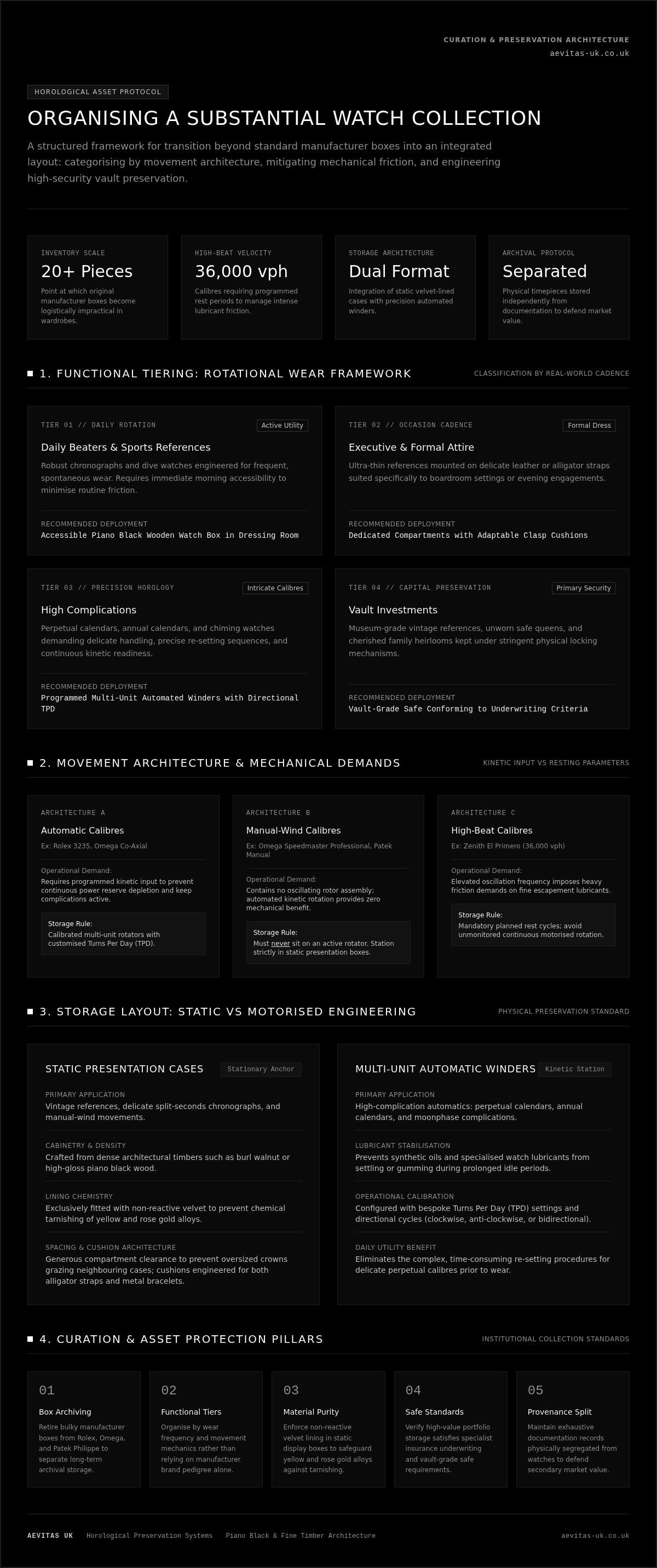
Retaining original manufacturer packaging on display is the first logistical hurdle serious collectors encounter. When an inventory expands beyond twenty pieces, bulky outer boxes from Rolex, Omega, or Patek Philippe consume disproportionate wardrobe space while obscuring your view of the collection. True horological curation is the deliberate discipline of preserving mechanical integrity while ensuring seamless daily utility. Successfully organising a large watch collection requires retiring original presentation boxes to archival storage, grouping your timepieces instead by mechanical necessity and lifestyle cadence.
Movement Architecture: Automatic, Manual, and High-Beat Calibres
Begin by classifying your inventory across fundamental calibres: manual-wind, automatic movements, and high-frequency quartz or tuning fork pieces. Within the broader science of timekeeping, distinct movement architectures require vastly different resting states. Modern automatic calibres, such as an Omega Co-Axial or Rolex 3235, require planned kinetic input to prevent power reserve depletion. Conversely, hand-wound references, like an Omega Speedmaster Professional or a manual Patek Philippe chronograph, must never sit on an active rotator. High-beat escapements like the Zenith El Primero, operating at 36,000 vibrations per hour, impose distinct friction demands on escapement lubricants, making tailored rest periods essential rather than unmonitored continuous operation.
Functional Tiering: Rotational Wear Versus Vault Investments
Structure your storage layout around real-world rotation rather than brand pedigree alone. Categorise your timepieces into clear operational tiers:
Consolidate your active weekly pieces in an accessible dressing area using a dedicated piano black wooden watch box. Organising a large watch collection by rotational frequency eliminates morning friction, ensuring your finest pieces remain ready to wear while high-value assets remain thoroughly safeguarded.
Designing the Storage Layout: Display Boxes to Multi-Winders
A mature horological collection cannot rely on a single storage format. Instead, a balanced layout pairs static display cases with high-precision motorised winders. While manual-wind calibres and quartz pieces thrive in stationary compartments, intricate complications require continuous kinetic input. Organising a large watch collection across both mediums preserves movement mechanics and turns your dressing room into an elegant personal gallery. Materials matter just as much as mechanics; choose cases built from dense timbers like burl walnut or high-gloss piano black, lined exclusively with non-reactive velvet to prevent the chemical tarnishing of precious yellow and rose gold alloys.
Static Presentation Cases: Preserving Manual-Wind and Vintage References
Stationary cases provide safe harbour for vintage references, delicate split-seconds chronographs, and manually wound movements. These calibres do not belong on automated rotors. A premium display case offers generous compartment spacing, preventing oversized crowns from grazing neighbouring cases. Look for plush, adaptable cushions that accommodate both supple alligator straps and rigid metal bracelets without exerting undue clasp tension. High-capacity luxury watch storage boxes form the bedrock of your static display, while specialised units like the Piano Black Wooden Watch Box Cufflinks Collection integrate bespoke compartments to secure matching accessories alongside your rotation.
Multi-Unit Automatic Winders: Maintaining Ready-to-Wear Complications
Perpetual calendars, annual calendars, and moonphase complications represent mechanical art, but resetting them after power depletion risks damage to delicate date-change gearing. Multi-unit automatic winders eliminate this hazard entirely. Modern systems feature independently programmable motor heads, letting you configure precise directional rotations and turns per day for each separate watch. Refer to our detailed guide to multi-watch winders to map your portfolio against manufacturer requirements. As you scale up, ensure your overall storage layout is formally catalogued to satisfy underwriting criteria for specialized watch insurance policies.
When curating your display, explore the British-engineered solutions at Aevitas Watch Storage to achieve an uncompromising balance of mechanical reliability, refined joinery, and daily wearing efficiency.
Mechanical Preservation: Programming Turns Per Day and Direction
A common misconception among emerging collectors is that automated winders risk straining delicate internal components. Modern automatic calibres feature a mainspring slip-bridle assembly, an ingenious clutch mechanism that allows the spring to slip safely within the barrel once fully wound. Overwinding is mechanically impossible. The genuine hazard lies in prolonged, stationary neglect; leaving an automatic watch dormant for months causes synthetic lubricants to settle, pool, and migrate away from vital friction points. Most luxury calibres achieve optimal winding equilibrium between 650 and 950 turns per day (TPD), maintaining stable mainspring tension without causing needless wear on the reversing wheels.
Calibre Requirements: Unidirectional Versus Bidirectional Rotations
Every movement architecture features distinct kinetic requirements. While many calibres wind bidirectionally, several legendary workhorses require strictly unidirectional winding. For instance, the renowned Valjoux 7750 chronograph movement winds solely in a clockwise direction, free-spinning harmlessly when rotated counter-clockwise. Compare this with Rolex calibres like the 3135 and 3235, or Audemars Piguet references like the 3120 and 4302, which require 650 TPD set to bidirectional winding. Meanwhile, Patek Philippe calibres such as the 324 S C require 650 to 800 TPD configured counter-clockwise. Successfully organising a large watch collection means cataloguing these individual mechanical profiles and applying tailored motor programs to each bay.
Advanced Materials: Shielding Movements with Carbon Fibre Construction
Housing heavy precious-metal watches requires advanced structural engineering. When you array multiple solid platinum or 18-carat gold timepieces on a single rig, the mechanical housing must resist structural deflection. High-tensile carbon fibre delivers outstanding torsional rigidity alongside modern aesthetics. Beyond physical strength, precision-moulded composite structures help shield sensitive hairsprings from external electromagnetic interference generated by adjacent household electronics. Integrating a carbon fibre watch winder into your setup ensures that both the aesthetic presentation and the mechanical integrity of your calibres remain uncompromised.
When organising a large watch collection across varied complications, individually programmable motors allow you to isolate each piece, matching factory rotations perfectly while preserving hand-finished components for decades to come.
Collection Security: Insurance Standards and Vault-Grade Storage
Standard household contents policies routinely cap jewellery and timepiece claims at severe sub-limits, often between £1,500 and £2,500 across an entire household. For high-value horological portfolios, this creates catastrophic underinsurance. Organising a large watch collection demands a professional physical defence strategy aligned precisely with specialist insurance underwriting requirements. Securing your investment requires certified residential vault storage that pairs heavy-gauge tool defence with an uncompromised interior environment. Environmental control is vital; maintain an internal relative humidity between 40% and 55% to stop rubber gaskets from drying out and prevent dial patinas from deteriorating.
Insurance Ratings: Navigating Cash Covers and Certification
Insurers assess safe defence through cash ratings. In the UK and Europe, valuables cover is calculated as a 10x multiplier of the base overnight cash rating. A certified safe with a £10,000 cash rating typically provides up to £100,000 in cover for jewellery and watches. Underwriters scrutinise testing accreditations such as Eurograde (EN 1143-1) or UL standards like RSC Level I, RSC Level II, and higher TL-15 or TL-30 ratings. Selecting an uncertified container voids your claims eligibility during an audit. Review our ultimate guide to watch winder safes to evaluate the exact engineering standards underwriters require for multi-piece collections.
Safe Placement and Environmental Protection Protocols
Physical positioning directly impacts vulnerability and structural safety. Follow these installation standards:
- Anchor the safe directly into structural masonry or solid concrete foundations using high-tensile expanding rawl bolts.
- Situate the unit along internal load-bearing walls to minimise exposure to exterior temperature swings and condensation damp.
- Specify biometric fingerprint access or illuminated electronic combination keypads, avoiding external magnetic fields that could magnetise hairsprings.
- Integrate internal silica gel desiccants or electronic dehumidification blocks to sustain constant atmospheric equilibrium.
Carefully execute the structural procedures detailed in our watch winder safe installation guide to ensure flawless anchoring compliance. If you need robust physical defence that meets strict underwriter expectations without sacrificing winding automation, upgrade your collection security with Aevitas Watch Storage today.
Maintaining Provenance: Cataloguing, Documentation, and Mobility
A timepiece's secondary market value relies heavily on the physical proof of its lineage. Incomplete records instantly reduce collector interest and complicate insurance settlements. Organising a large watch collection requires separating your primary horological hardware from the surrounding paperwork, receipts, and accessories. Meticulous tracking ensures that whether you are submitting annual valuation updates or rotating pieces between residences, every asset remains accounted for and fully authenticated.
Archiving Ephemera: Preserving Original Boxes, Papers, and Links
Manufacturer presentation packaging, spare bracelet links, and printed ephemera demand dedicated archival space away from your daily dressing area. Cardboard outer boxes degrade when exposed to humidity or direct sunlight. Punch-card guarantees, chronometer certificates, and original bill-of-sale receipts must be stored flat inside acid-free archival sleeves to prevent ink fading and paper yellowing. Maintain a centralised, fire-resistant filing chest specifically for this paperwork. Pair physical files with high-resolution digital scans documenting serial numbers, movement references, and clasp codes. These records form the indisputable evidence loss adjusters and specialist auction houses demand.
Mobility and Transit: Curating On-the-Go Selections
Transporting valuable calibres between private safes, bank vaults, or weekend estates introduces distinct mechanical risks. Generic watch rolls with shared central cushions permit case flanks to knock against each other. Professional transit solutions solve this through individual sliding cushion systems anchored onto rigid internal rails. Genuine leather exteriors absorb impact shocks, while deep recess partitions maintain complete physical isolation between watches.
- Select single or double cases for concise weekend rotations or visits to an authorised service centre.
- Deploy triple rolls when transporting high-value complications to ensure complete clasp stabilisation.
- Ensure internal cushions feature flexible side walls to prevent bracelet stretching on smaller wrist sizes.
Organising a large watch collection extends beyond static home storage; your travel infrastructure must offer equal protection. Collectors can explore luxury watch roll travel cases and engineered storage systems at Aevitas Watch Storage, establishing an integrated environment that protects every calibre across daily wear, secure home preservation, and international transit.
Elevating Your Horological Collection into a Curated Legacy
Organising a large watch collection is not merely about clearing wardrobe space; it is about establishing a purposeful ecosystem that honours fine watchmaking. By replacing haphazard packaging with an integrated hierarchy of static presentation boxes, programmable multi-winders, and certified vault security, you protect both mechanical health and monetary value. Pairing physical preservation with meticulous provenance documentation ensures your daily rotation remains an effortless ritual rather than a logistical chore.
When you are ready to upgrade your storage infrastructure, British engineering provides the standard your timepieces deserve. Aevitas Watch Storage crafts luxury solutions tailored specifically to the winding specifications and aesthetic demands of leading Swiss watch houses. Our comprehensive range spans high-tensile carbon fibre winders, solid wooden display boxes, and reinforced watch winder safes, all backed by complimentary insured worldwide delivery.
Explore the Aevitas Watch Storage Collection to transform your assembly of fine calibres into a masterfully curated exhibition.
Frequently Asked Questions
How many watches justify investing in a dedicated multi-watch winder?
Having three or more automatic watches in active rotation justifies investing in a dedicated multi-watch winder. When managing multiple calibres, manually winding and resetting dates or complicated moonphases every few days introduces unnecessary wear on winding stems. When organising a large watch collection, a multi-unit system ensures your core rotation remains primed and synchronised, allowing you to alternate timepieces seamlessly without morning disruption.
Will keeping my automatic watches on a winder wear out the movement components prematurely?
Quality programmable winders do not wear out components when configured correctly. Modern automatic calibres contain an internal mainspring slip-bridle that mechanically prevents overwinding. Wear only occurs if a winder runs constantly without rest intervals. Setting a winder to your movement's precise Turns Per Day (TPD) specification, typically 650 to 800 TPD, mimics natural wrist motion while keeping internal synthetic lubricants evenly distributed.
What is the ideal humidity level for storing vintage and modern luxury watches?
The ideal relative humidity for luxury watch preservation sits strictly between 40% and 55%. Excessive moisture promotes internal condensation, dial discolouration, and steel corrosion. Conversely, extremely arid environments dry out delicate leather straps and cause internal synthetic lubricants and rubber case gaskets to shrink and crack. Utilising sealed cases with desiccant packs or climate-regulated safes ensures environmental stability across varying seasons.
How should I categorise a collection that includes both quartz and automatic calibres?
Separate your calibres by mechanical needs before arranging them by aesthetic or functional use. When organising a large watch collection with mixed power sources, allocate battery-powered quartz models and manual-wind pieces to static wooden presentation cases. Keep your automatic complications in programmable motorised winding bays. This division prevents static watches from cluttering kinetic units while ensuring your most complex mechanical movements receive consistent daily rotation.
Can I store different watch brands on the same multi-watch winder setting?
You should not apply a universal setting across diverse luxury brands unless their calibres share identical winding criteria. A Rolex Submariner requires bidirectional rotation at approximately 650 TPD, whereas a Patek Philippe Nautilus calibre 324 S C requires counter-clockwise winding up to 800 TPD. Multi-watch winders with independent motor heads allow you to customise direction and turns per day for each separate brand and movement.
What security certification should I look for in an insurance-approved watch safe?
Look for recognised European EN 1143-1 Eurograde certifications or Underwriters Laboratories (UL) ratings such as RSC Level I, RSC Level II, or TL-15 and TL-30. In the UK, insurers calculate coverage using a 10x multiplier on the safe's base cash rating. A certified £10,000 cash rating generally covers £100,000 in valuables, ensuring compliance with specialist high-net-worth underwriting mandates.
How often should I update appraisal records and photographs for collection insurance?
Update professional appraisal valuations and detailed condition photographs every two to three years. Secondary luxury watch market values fluctuate significantly, meaning static documentation leaves your collection vulnerable to acute underinsurance. Capture macro photographs of serial numbers, case edges, and dials. Store digital copies securely in the cloud alongside physical paperwork filed in a fireproof safe to facilitate seamless insurance claims if required.