

That distinct, sickening snap inside a luxury timepiece is the sound every collector fears, yet for the owner of a modern automatic, it's a mechanical impossibility. You've likely felt that hesitation whilst turning the crown, wondering if one extra rotation will lead to a four-figure repair bill. The persistent debate regarding overwinding a watch myth or reality often leaves enthusiasts paralysed between two extremes, caught between outdated advice and the complex engineering of contemporary calibres.
We understand that your collection represents both a significant financial investment and a deep appreciation for horological excellence. This guide will provide the technical truth behind overwinding anxieties, helping you protect your luxury timepieces using modern maintenance standards. We'll examine the specific differences between manual and automatic movements, clarify the role of the slipping clutch, and demonstrate how choosing the correct storage environment offers total peace of mind for your most valued assets. By the end, you'll have the confidence to manage your collection with professional precision and technical clarity.
Key Takeaways
- Identify the fundamental mechanical differences between manual and automatic movements to understand which pieces in your collection require tactile caution.
- Understand why the debate surrounding overwinding a watch myth or reality is settled by the "slipping clutch" mechanism found in modern automatic calibres.
- Recognise the specific risks associated with vintage timepieces and why the "hard stop" phenomenon is a critical signal to stop winding immediately.
- Learn how to use precise Turns Per Day (TPD) settings to maintain movement health without placing unnecessary stress on internal components.
- Discover how professional storage solutions, such as Carbon Fibre Watch Winders, provide the precision and protection required for high-value horological investments.
Understanding the Overwinding Anxiety: Manual vs Automatic Movements
The question of overwinding a watch myth or reality is one of the most persistent debates in horology. For many collectors, the anxiety stems from a fundamental misunderstanding of how energy is stored and managed within a movement. At its core, overwinding is defined as the point where the mainspring reaches maximum tension. Whilst modern materials have significantly reduced the risk of catastrophic failure, the distinction between manual and automatic systems remains vital for proper maintenance.
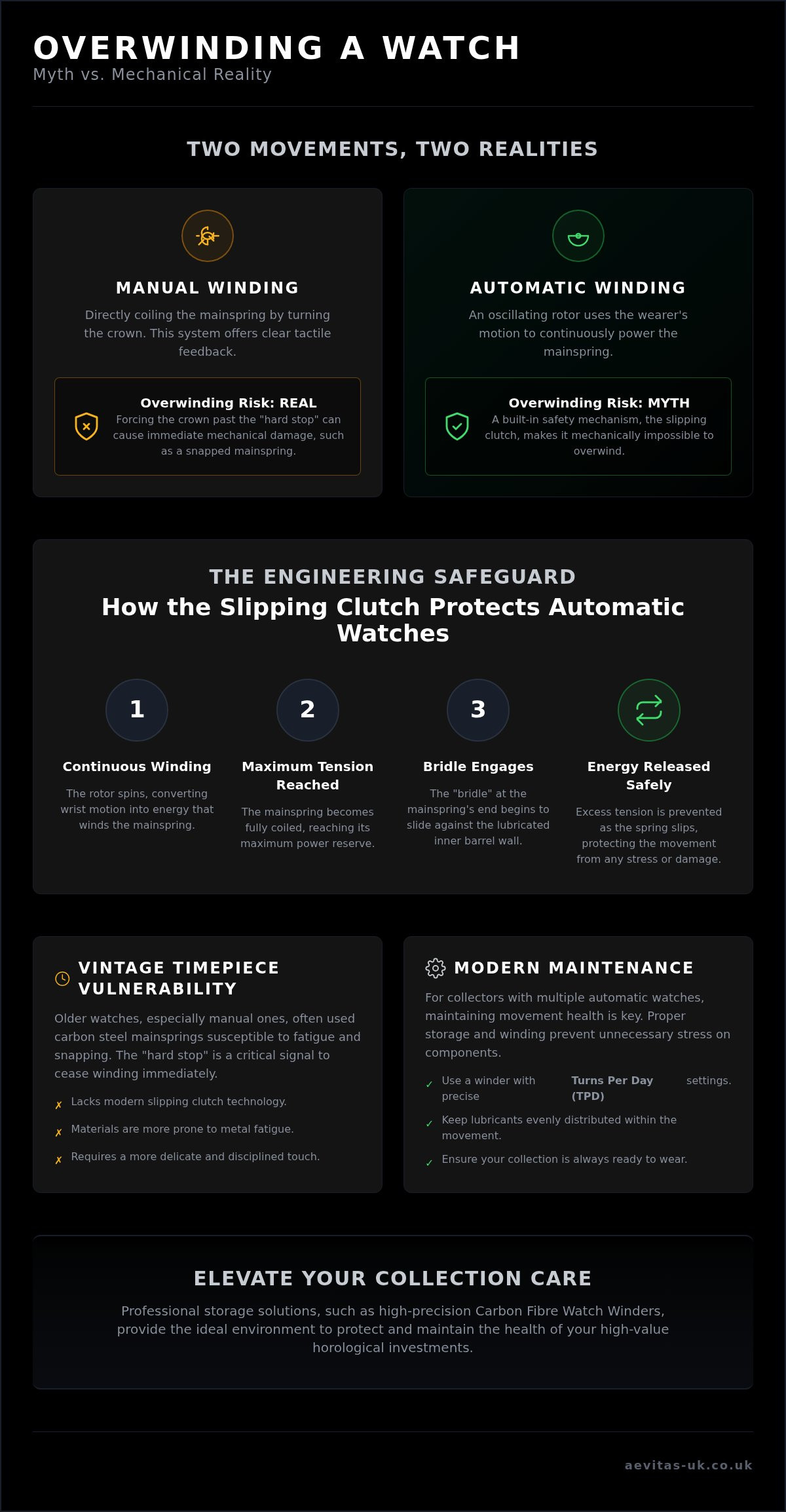
Historically, the "overwound" watch was a common casualty. This was largely due to the metallurgy of the early 20th century, where carbon steel mainsprings were susceptible to fatigue and sudden snaps. Today, the reality is more nuanced. While a manual watch can still be damaged by excessive force, a modern automatic is engineered to be physically incapable of being overwound. Understanding this difference is the first step toward refined collection management. It's about recognising the difference between long-term movement fatigue and immediate, catastrophic breakage.
The Mechanics of Manual Winding
In a manual timepiece, the winding process is a direct mechanical dialogue. As you turn the crown, you are manually rotating the ratchet wheel, which in turn coils the mainspring inside the barrel. This system provides clear tactile feedback. As the spring reaches full capacity, you'll encounter a definitive "hard stop". The resistance becomes absolute. Forcing the crown beyond this point doesn't just cause gradual wear; it causes immediate mechanical damage. You risk snapping the mainspring or stripping the delicate teeth of the winding gears. It's a moment where precision meets its physical limit, requiring a disciplined touch from the collector.
The Rise of the Automatic Rotor
The introduction of automatic watch movements changed the landscape of horological care. These calibres rely on an oscillating weight, or rotor, to convert kinetic energy from the wearer's wrist into potential energy stored in the mainspring. Unlike manual versions, automatic watches are designed for continuous operation. The engineering shift moved away from a direct mechanical limit to a system that prioritises constant power delivery.
For collectors who manage multiple timepieces, maintaining this energy without manual intervention is essential. Storing your collection in a 4 watch box in carbon fibre finish ensures your pieces remain organised, but for automatic movements, the real protection comes from understanding the internal safety mechanisms. These modern innovations ensure that the "always on" nature of an automatic watch doesn't lead to the tension issues that plagued vintage collections of the past.
The Slipping Clutch: Why You Cannot Overwind a Modern Automatic Watch
The engineering of a modern automatic calibre is a marvel of preventative design. When collectors ask about overwinding a watch myth or reality, the answer lies within the barrel assembly. Unlike the fixed mainspring of a manual movement, an automatic watch utilises a slipping clutch, technically known as a bridle. This component is a secondary, shorter spring attached to the end of the main mainspring. It's designed to slide along the inner wall of the barrel once the movement reaches its maximum power reserve.
This mechanism ensures that no matter how much the rotor spins or how often you turn the crown, the mainspring cannot snap from over-tension. It is a silent protector. Specialised lubricants, often heavy-duty greases applied to the barrel wall, facilitate this smooth slipping action. Without this lubrication, the bridle could chatter or grip too tightly. In a well-serviced movement, the process is seamless. This is why modern collectors can rest easy. The fear of breaking the spring through normal wear is entirely unfounded.
How the Bridle Mechanism Protects Your Timepiece
The technical brilliance of the S-shaped mainspring allows it to expand and contract with precision. In a manual watch, the spring is hooked into a notch. In an automatic, the bridle simply presses against the barrel wall using friction. Once fully wound, the friction is overcome, and the spring slips. You might occasionally hear a faint, rhythmic click if you listen closely whilst winding. This is the bridle moving to its next position. Modern alloy springs are far more resilient than the brittle carbon steel versions of the past, offering superior elasticity and resistance to permanent deformation.
Signs Your Automatic Watch is Fully Wound
Identifying a full wind requires a keen sense of tactile feedback. If your timepiece features a power reserve indicator, the needle will move toward the maximum mark, providing a clear visual cue. For those without this complication, you may notice a subtle increase in resistance at the crown. It won't be a hard stop like a manual watch, but rather a slightly heavier, mushy sensation.
Whilst you can hand-wind most automatics to get them started, doing so excessively can cause unnecessary wear on the winding pinion and reversing wheels. To maintain your movement's health without manual stress, utilising a single watch winder carbon fibre provides the consistent, gentle rotation required to keep the mainspring at its optimal tension. For a deeper look at these mechanical safeguards, industry experts often discuss the question Can You Overwind a Watch? to reassure collectors of their movement's durability.
When Overwinding is a Reality: The Vulnerability of Vintage and Manual Pieces
Whilst the slipping clutch has largely relegated horological damage to the past for automatic owners, the question of overwinding a watch myth or reality becomes a stark reality for those with manual and vintage collections. Traditional manual movements lack the protective bridle mechanism found in contemporary calibres. Instead, the mainspring is physically hooked into the barrel. This creates a finite limit to how much energy can be stored. For collectors of mid-century pieces or modern manual-wind references, understanding this mechanical boundary is essential for long-term preservation.
Vintage timepieces are particularly susceptible due to the metallurgy of their era. Older mainsprings were often crafted from carbon steel, a material that becomes brittle with age and is prone to sudden fatigue. If you experience a crown that suddenly spins freely with no resistance, it's a primary sign of a broken mainspring or a detached hook. Conversely, a dead movement that won't start despite being fully wound often points to gummed-up oils rather than an overwinding error. These delicate instruments require a more empathetic touch than their modern counterparts.
The Hard Stop in Manual Timepieces
Manual winding requires a disciplined approach to tactile feedback. As you rotate the crown, you'll feel the tension build progressively. The "hard stop" is the point of absolute resistance. You must stop immediately. Attempting "one last turn" to maximise the power reserve is a common error that places immense stress on the winding click and the mainspring hook. Over time, this behaviour fatigues the metal, leading to a snap that requires a full movement strip-down. A healthy manual wind should feel smooth and consistent. If the resistance feels grainy or varies significantly, the movement likely requires a service to replace aged lubricants.
Common Misconceptions About Vintage Care
A frequent myth suggests that vintage watches should only be wound once a week to "save" the spring. In reality, consistent, gentle winding is far better for movement longevity. Mechanical watches rely on specialised oils that can migrate or dry out if left stationary for long periods. Regular use keeps these lubricants distributed across the jewels and pivots. However, if a watch is fully wound but fails to run, don't attempt to force the crown further. For these delicate assets, secure storage is just as vital as careful handling. A black genuine leather single watch roll travel case provides the cushioned protection needed to prevent external shocks from compromising fragile internal components whilst the piece is not in use.
Best Practices for Maintenance: Using a Watch Winder Correctly
A watch winder isn't merely a storage device; it's a precision instrument designed to sustain horological health. For those navigating the nuances of overwinding a watch myth or reality, the winder provides a technical solution. By utilising Turns Per Day (TPD) settings, you can maintain a movement's power reserve without ever over-stressing the internal slipping clutch. A professional winder doesn't just spin. It replicates the organic movement of the human wrist, ensuring that lubricants remain distributed whilst the mainspring stays at an optimal level of tension.
The primary benefit of a high-quality winder is the ability to customise the winding cycle. Rather than constant rotation, which would keep the bridle mechanism in a state of perpetual friction, a sophisticated winder uses intermittent cycles. This allows the movement to "rest," mimicking the natural behaviour of a watch worn during the day and rested at night. This cycle is essential for long-term durability and precision.
Calculating TPD for Optimal Movement Health
Precision is paramount. Most modern Rolex movements require approximately 650 TPD, whilst many Patek Philippe calibres perform best at 800 TPD. Setting your winder to these specific figures ensures the watch remains ready to wear without unnecessary mechanical activity. The programmable settings found in Carbon Fibre Watch Winders allow collectors to input these exact requirements. This level of control prevents the movement from being "maxed out" constantly, which preserves the integrity of the winding gears over several years of ownership.
Why Rest Periods and Rotation Direction Matter
Directionality is often overlooked by novice collectors, yet it's critical for movement health. Some calibres, such as those based on the Valjoux 7750, only wind in a clockwise direction. Others require bi-directional rotation to stay powered. High-quality motors are also shielded to prevent magnetisation, a common cause of watches running fast. When managing a diverse collection, Multi Watch Winders are indispensable. They allow you to set individual TPD and direction parameters for each piece, ensuring that a vintage manual-wind-style automatic and a modern sports watch receive the specific care they require.
Maintaining your collection with this level of technical rigour ensures that your timepieces remain in peak condition for the next generation. To find the ideal environment for your most valued pieces, explore our full range of premium watch winders designed for the discerning collector.
Elevating Your Collection Care with Aevitas Watch Storage
Aevitas Watch Storage stands at the intersection of British horological heritage and modern engineering excellence. As we've explored throughout this guide, the question of overwinding a watch myth or reality is solved by understanding movement mechanics and implementing professional-grade maintenance. We specialise in providing the discerning collector with tools that respect the delicate nature of high-value timepieces. By utilising advanced materials such as carbon fibre and high-grade leather, we ensure your collection remains in peak condition whilst reflecting an aesthetic of refined luxury. Our status as a premier British brand is built upon a deep understanding of the care required for high-value items.
Longevity is the ultimate goal for any serious collector. Achieving this requires more than just a place to store your watches; it requires an environment that actively preserves the movement's health. Our rotation technology is designed to be compatible with all major luxury brands, offering the precision settings necessary to keep your timepieces ready for the wrist without placing unnecessary stress on the internal components.
Precision Engineering in Luxury Storage
The heart of our collection care lies in the silent, reliable performance of our motors. Whether positioned in a study or a bedroom, our winders operate with a level of discretion that suits the most sophisticated environments. Our systems are engineered for universal compatibility, accommodating everything from oversized modern sports models to delicate vintage straps. For collectors who prefer a static display for their manual-wind pieces, the 12 Watch Box Carbon Fibre offers a secure, dust-free environment. This prevents the environmental degradation of oils and seals, ensuring your watches remain as pristine as the day they were acquired.
Secure Solutions for High-Value Assets
For collectors with significant investments, physical security is as important as mechanical maintenance. Our Insurance Approved Watch Winder Safes provide a robust solution that doesn't compromise on presentation. These units integrate our precision winding technology within a fortified structure, allowing you to maintain movement health whilst ensuring total protection against theft or damage. It's the ultimate expression of the Aevitas Watch Storage philosophy: balancing technical utility with uncompromising security.
Refine your approach to watch care and transition from disorder to total horological control. Explore our range of Watch Winder Safes today. It's time to organise and protect your favourite pieces with the authority they deserve.
Securing the Future of Your Horological Legacy
The debate regarding overwinding a watch myth or reality is settled by the intersection of mechanical history and modern engineering. Whilst vintage manual pieces require a sensitive touch to avoid damage at the hard stop, your contemporary automatic collection is protected by the sophisticated slipping clutch. Maintaining this delicate balance of tension and rest is essential for the longevity of every calibre. Understanding these mechanical boundaries allows you to enjoy your collection with total confidence and technical clarity.
As a premier British brand, Aevitas Watch Storage provides the precision tools necessary to preserve your investment. Our systems are compatible with all luxury watch brands, ensuring that whether you own a modern sports watch or a heritage dress piece, it remains in peak condition. We offer free insured worldwide delivery to ensure your storage solutions arrive with the same care they provide to your collection. Transitioning from simple storage to professional maintenance is the hallmark of a discerning collector.
Explore our range of premium Watch Winders to maintain your collection perfectly. Your favourite timepieces deserve the highest standard of professional care and protection.
Frequently Asked Questions
Is it possible to overwind an automatic watch by hand?
It's physically impossible to overwind a modern automatic watch by hand. These movements feature a slipping clutch, or bridle, that allows the mainspring to slide inside the barrel once it reaches full tension. Whilst you can turn the crown indefinitely, the mechanism simply disengages the winding process. However, you should still hand-wind sparingly. Excessive manual winding can place unnecessary stress on the winding pinion and reversing wheels over several years.
How do I know if I have broken the mainspring in my manual watch?
A broken mainspring usually manifests in one of two ways. You might find the crown spins freely without any tactile resistance, suggesting the spring has snapped or detached from its hook. Alternatively, the watch may refuse to run even after you've wound it to the point of resistance. In either case, the internal power delivery system has failed. This is the moment where the debate on overwinding a watch myth or reality becomes a costly mechanical truth.
Can a watch winder damage my watch movement over time?
A high-quality watch winder won't damage your movement if it's configured correctly. Modern winders use intermittent rotation cycles to prevent the slipping clutch from being in constant use. This allows the movement to rest, mimicking natural wear. Problems only arise with low-grade winders that lack shielded motors, which can magnetise the hairspring. Professional solutions ensure the movement remains lubricated and accurate without placing any undue strain on the internal components.
How many turns per day does my specific watch brand need?
Turns Per Day (TPD) requirements vary significantly between manufacturers and specific calibres. Most Rolex models require approximately 650 TPD, whilst many Patek Philippe and Breitling movements often need 800 TPD or more. It's essential to consult your watch's technical manual or a manufacturer database for the correct setting. Using a programmable winder allows you to match these exact specifications. This precision ensures the mainspring stays powered without forcing the safety mechanism to engage excessively.
What is the difference between a slipping clutch and a hard stop?
The difference lies in how the mainspring is anchored. A slipping clutch is a friction-based system in automatic watches that allows the spring to slide safely once fully wound. A hard stop occurs in manual watches where the mainspring is physically hooked to the barrel wall. When you feel that absolute resistance in a manual piece, the spring has reached its physical limit. Forcing it beyond this point will cause immediate damage to the hook or spring.
Should I leave my watch in a winder every night?
You can safely leave your watch in a winder every night, provided the device features programmable rest periods. These pauses are vital because they allow the mainspring to partially unwind, preventing the movement from staying at maximum tension indefinitely. This cycle mimics the natural behaviour of a watch on your wrist. It keeps the time and complications set, ensuring your piece is ready for immediate use each morning without any mechanical risk.
Is it better to let an automatic watch stop or keep it wound?
It's generally better to keep an automatic watch wound if you wear it regularly. Constant stopping and starting can lead to the migration or drying of internal lubricants over time. Keeping the movement active ensures that oils remain distributed across the jewels and pivots, which reduces friction. If you have a complex perpetual calendar or moonphase, keeping it wound also saves you the intricate task of resetting the complications after the power reserve expires.
Can vintage watches be used in a modern watch winder?
Vintage automatic watches can be used in modern winders, but you must exercise caution with TPD settings. Older movements often have more delicate components and less resilient mainsprings than modern calibres. However, manual-wind vintage watches cannot be used in a winder, as they lack the rotor required to convert kinetic energy. For these pieces, a static display box is the correct choice. Understanding this distinction is key to navigating the overwinding a watch myth or reality for heritage collections.