

Acquiring your third luxury timepiece is the precise moment collecting stops being an occasional indulgence and becomes a logistical challenge. If you've ever faced the frustration of an unexpected power reserve drain, or winced at a hairline bezel scratch caused by an overcrowded valet tray, you already know the stakes. Selecting the right watch storage for a growing collection isn't simply about tidy organisation; it's about safeguarding delicate mechanical movements against dust, friction, and magnetic interference.
You've invested considerable time and capital into curating your horological assets, and your storage should match that calibre of craftsmanship. In this guide, you'll discover how to choose the ideal storage ecosystem for your expanding luxury collection, balancing precision multi-watch winders, solid presentation boxes, and vault-grade security. We examine the essential considerations for 2026, exploring everything from motor shielding and turns-per-day calibration to modular setups designed to protect your investments as they grow.
Key Takeaways
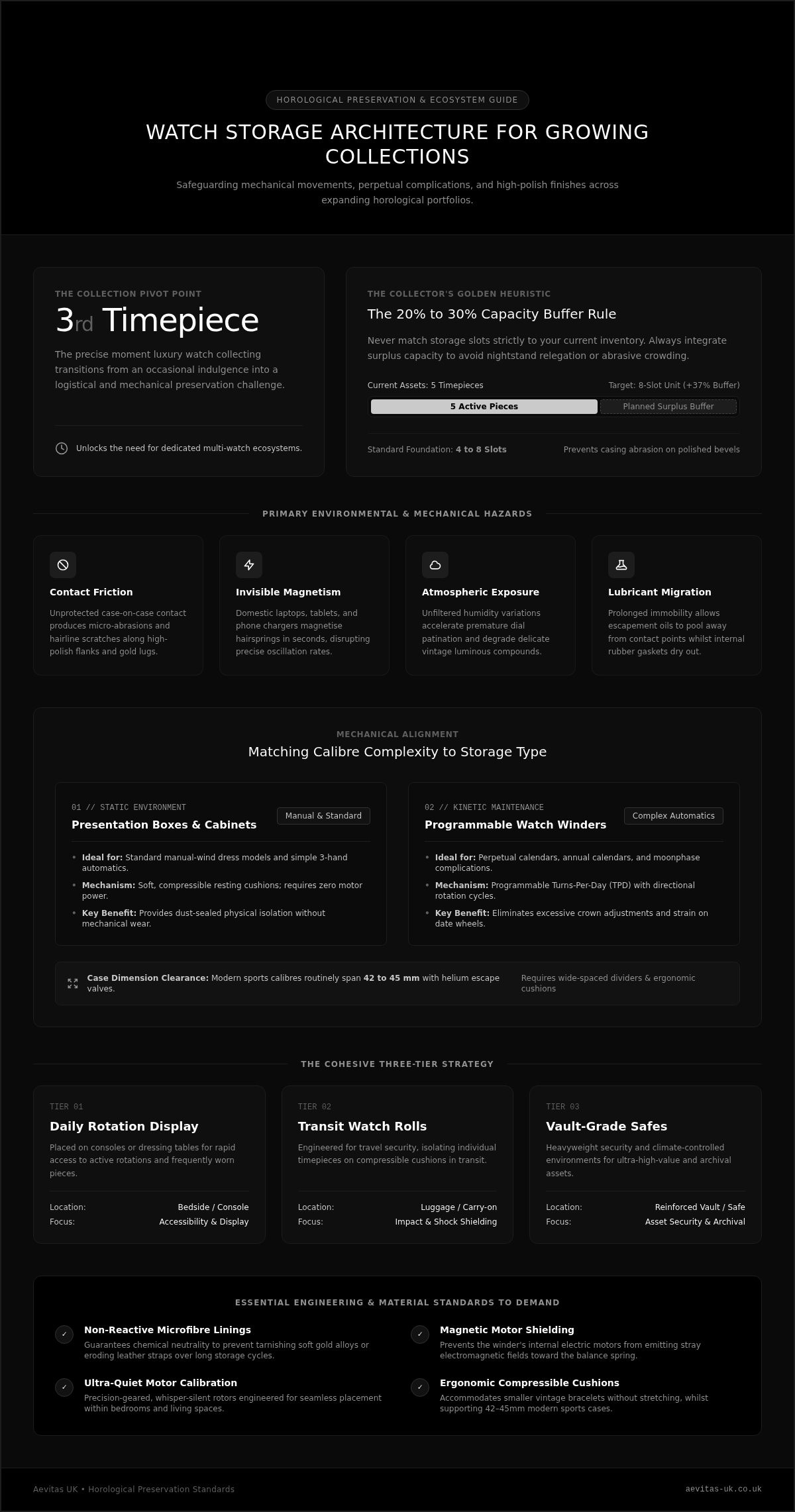
- Plan your capacity with a 20 to 30 percent buffer to ensure your watch storage for a growing collection never forces improper cramming.
- Differentiate between static presentation boxes and multi-watch winders to match the exact mechanical demands of your automatic calibres.
- Protect high-polish cases and delicate complications with non-reactive microfibre interiors, magnetic shielding, and ultra-quiet motor engineering.
- Establish a cohesive three-tier strategy that seamlessly balances daily rotation displays, luxury watch rolls for transit, and vault-grade safe storage.
Why Proper Watch Storage Matters for an Expanding Collection
Transitioning from two or three watches to an expanding assembly changes how you care for your timepieces. When you leave watches loose on bedside tables or piled together in valet trays, you risk costly cosmetic and mechanical harm. Dedicated watch storage for a growing collection protects both the physical exterior and the intricate micro-mechanics within. Preserving these instruments requires an appreciation of the science of timekeeping, where microscopic tolerances dictate overall performance.
Beyond surface protection, long-term immobility presents its own set of challenges. Without occasional movement, synthetic escapement lubricants can migrate or pool away from high-friction contact points, while internal rubber gaskets dry out and lose their hermetic seal over extended periods. An intentional, structured storage solution prevents premature wear and keeps your valuable collection running reliably.
The Horological Risks of Inadequate Storage
Everyday domestic environments pose continuous hazards to luxury timepieces. High-polish stainless steel bezels, soft yellow gold lugs, and anti-reflective crystal coatings accumulate scratches quickly when placed in direct contact with hard surfaces. Stray magnetic fields from modern laptop chargers, mobile phone pads, and tablet speakers can magnetise a balance spring in seconds, throwing off daily rate accuracy.
- Contact friction: Unprotected watch-on-watch contact causes deep micro-abrasions along polished bevels.
- Invisible magnetism: Proximity to domestic electronics alters the oscillation rate of hairsprings.
- Atmospheric exposure: Unfiltered humidity fluctuations speed up dial patination and degrade vintage luminous materials.
Investing in an integrated option like the piano black wooden watch box cufflinks collection provides a dust-sealed, lined environment that isolates fragile cases from household accidents.
Matching Storage Architecture to Mechanical Complications
Different calibres demand distinct storage protocols. While standard manual-wind dress models rest safely on soft cushions, automatic pieces with complicated calendars require active maintenance. A simple three-hand automatic can sit dormant for days, but an annual or perpetual calendar with a moonphase complication demands continuous kinetic winding. Resetting intricate date wheels, leap-year discs, and astronomical indicators through crown adjustments places unnecessary strain on microscopic gears.
A unified setup balances static display cushions for hand-wound horology with programmable kinetic rotors for complex automatics. Choosing dedicated watch storage for a growing collection allows you to separate resting timepieces from those requiring uninterrupted power reserves.
Evaluating Storage Capacity: Choosing for Today and Tomorrow
Most collectors purchase storage to solve an immediate crisis. They buy a box that fits their exact count, only to acquire another timepiece within months. Sound watch storage for a growing collection requires forward planning. Auction authorities like Christie's emphasise that storing and maintaining your watch correctly involves managing space and physical isolation, not just keeping dust at bay.
Apply the collector's golden heuristic: always secure 20 to 30 percent spare capacity beyond your current inventory. If you own five timepieces, target an eight-slot case. This buffer ensures new acquisitions don't end up relegated to unprotected nightstands while you deliberate over your next storage upgrade.
Cushion geometry matters just as much as slot quantity. Modern dive watches and pilot chronographs routinely span 42 to 45 millimetres across, often featuring protruding crowns and helium escape valves. Conversely, vintage dress watches sit on narrow straps with delicate clasps. Quality cases utilise compressible, ergonomic cushions engineered to prevent vintage bracelets from stretching whilst giving broad sports cases adequate clearance.
The 4 to 8 Watch Collection: Establishing the Foundation
Starting with four to eight dedicated slots establishes functional discipline without overwhelming your interior living space. These mid-sized units sit comfortably on dressers or bedside consoles, providing immediate access for daily wear rotations. Generous compartment widths are vital here; narrow slots force watch heads to touch, causing abrasive edge-wear on high-polish flanks.
Multi-purpose organisation elevates this tier substantially. A design like the Piano Black Wooden Watch Box Cufflinks Collection consolidates daily horology alongside essential sartorial accessories, creating a refined morning valet routine in one self-contained footprint.
The 10 to 12+ Timepiece Portfolio: Scalable Storage Systems
Managing ten or more watches shifts your focus from basic storage to portfolio curation. Larger collections benefit from systematic organisation:
- Categorised segmentation: Organise compartments by movement type, metal alloy, or complication level.
- Integrated utility: Tiered cases with pull-out drawers keep spare leather straps, spring bar tools, and deployment clasps dust-free.
- Modular expansion: Multi-unit arrays allow you to scale capacity horizontally without breaking aesthetic harmony.
When your inventory exceeds twelve pieces, single-layer presentation cases become impractical. Transitioning to tiered presentation cabinets or combining display boxes with specialised winding units ensures every mechanical asset receives proper care. If your collection is reaching this milestone, explore scalable display cabinets at aevitas-uk.co.uk to house your growing assembly seamlessly.
Watch Boxes vs Multi Watch Winders: Which Does Your Collection Need?
Choosing between static display cases and powered winding systems comes down to movement mechanics. High-grade mechanical calibres utilise advanced synthetic lubricants to reduce friction along the escapement, balance staff, and geartrain. When a watch stays stationary for months, these specialised oils settle. Operating your timepieces on a steady cycle maintains fluid distribution across jewel bearings. As detailed in Worn & Wound's analysis on long-term watch storage, keeping components shielded and consistently maintained directly preserves mechanical longevity.
A balanced strategy rarely relies on an all-or-nothing approach. A mixed setup pairing a static collector box with an active winding cabinet offers the most practical watch storage for a growing collection.
The Case for Luxury Presentation Boxes
Presentation boxes remain the premier platform for appreciating horological artistry. Bevelled glass display apertures and hand-buffed piano black or burl walnut exteriors turn your collection into a cohesive design statement. Beyond aesthetics, static cases are mandatory for certain calibres.
Manual-wind dress watches and delicate mid-century vintage chronographs derive zero mechanical benefit from an active winder; their mainsprings lack automatic slip-bridles. Resting them inside a plush, microfibre-lined presentation box protects dials and case finishes without subjecting fragile balance pivots to unnecessary motion.
When Active Multi Watch Winders Become Essential
Active multi-winders solve the friction of regular rotation for modern automatic collections. Timepieces with date windows or second time zones, such as a Rolex GMT-Master II, present a chore when allowed to run down. Setting the local hour hand across multiple days causes needless handling. A reliable winder guarantees grab-and-go convenience.
Different manufactures require precise turns-per-day (TPD) schedules and directional settings to run efficiently without overworking the slipping spring:
- Rolex (Calibres 3135, 3235): 650 to 800 TPD, bidirectional rotation.
- Patek Philippe (Calibres 240, 324): 650 to 800 TPD, bidirectional rotation.
- Audemars Piguet (Calibres 3120, 4302): 700 to 800 TPD, bidirectional rotation.
Superior multi-winders feature independent motor programming for every individual rotor. This engineering ensures an Audemars Piguet receives its exact rotational quota without over-winding a neighbouring piece. Review our detailed multi watch winders selection to find silent, shielded drives calibrated for complex horological stables.
Materials, Craftsmanship, and Protection Standards to Demand
A storage case should offer the same structural integrity as the calibres resting within it. Substandard cabinetry often conceals cheap composite substrates that warp when humidity fluctuates. High-grade watch storage for a growing collection demands uncompromising casework, inert interior textiles, and purpose-built hardware capable of enduring decades of constant daily operation.
Motorised cabinets introduce an additional technical imperative: magnetic isolation. Modern electric winders employ ultra-quiet Japanese Mabuchi or brushless motors operating at whisper-quiet sound levels below 10 decibels. However, poorly shielded motors emit electromagnetic fields right beside your watch heads. Premium winders enclose motor housings in dense copper or steel shielding, neutralising stray flux before it can reach delicate balance springs.
Exterior Engineering: Carbon Fibre to Handcrafted Woods
Chassis material sets both structural rigidity and visual character. High-tensile carbon fibre weaves provide a sleek, motorsport-inspired aesthetic that resists scuffs, thermal shifts, and moisture ingress. For classic dressing suites, solid timber carcasses finished in deep burl walnut or multi-layered piano black lacquer provide weight and stability. Multiple coats of clear polyester lacquer protect natural wood veneers against UV bleaching, preserving grain depth under bright interior lighting.
Interior Linings and Hardware That Protect Flawless Finishes
Chemical composition matters just as much as tactile softness inside the compartments. Mass-produced watch boxes frequently use cheap solvent-based glues that emit volatile organic compounds (VOCs). Over several months, these airborne chemicals tarnish polished silver dials and accelerate oxidisation across white and rose gold alloys. Premium cases rely on water-based, non-reactive adhesives paired with dense microfibre or plush velvet lining.
- Adaptive cushions: High-density memory foam pillows compress smoothly for small leather straps, yet retain sufficient firmness to support heavy steel bracelets without sagging.
- Quadrant hinges: Solid milled brass hinges with integrated 90-degree quadrant stop stays prevent heavy glazed lids from slamming shut onto exposed crystals.
- Key-lock closures: Precision mortise locks supply firm lid tension while providing essential deterrence against curious hands.
Demanding these structural safeguards ensures your horological investments stay in showroom condition. To secure your portfolio with hand-polished casework and ultra-soft linings, view the 12-watch box in carbon fibre or piano black and upgrade your display standards today.
Creating a Complete Storage Strategy: Travel, Daily Rotation, and Safes
A comprehensive system unites three tiers: daily display, secure transit, and vault protection. Relying on a single dresser box leaves major security and travel blind spots as your portfolio matures. Developing effective watch storage for a growing collection means assigning every luxury timepiece an intentional home based on wear frequency and replacement value.
Map your holdings across three dedicated functional categories:
- Daily rotation: A primary multi-slot box or desktop multi-winder keeps frequently worn pieces organised, fully wound, and readily accessible.
- Transit protection: Cylindrical leather watch rolls provide crush-resistant individual compartments when taking several timepieces away on business trips or holidays.
- Vault-grade defence: High-security safes house ultra-rare complications, family heirlooms, and pieces kept outside the weekly rotation cycle.
Portable Protection: The Essential Watch Roll
Travel creates significant physical risks for luxury timepieces. Placing loose watches in flight luggage invites impact damage against shoe buckles and toiletry hardware. Dedicated travel rolls solve this vulnerability through reinforced cylindrical outer walls and individual sliding cushions.
Each watch slides securely into rigid lateral grooves rather than resting side-by-side. This arrangement ensures crowns and ceramic bezels cannot collide under turbulent conditions. Outer shells crafted from fine genuine leather combine robust scuff resistance with a discreet profile that slips effortlessly into hand luggage.
High-Value Security: Watch Winder Safes
When the cumulative value of a collection grows into tens of thousands of pounds, standard dresser boxes no longer satisfy domestic insurance criteria. Opportunistic household theft targets lightweight presentation cases that intruders can easily carry away. Integrating motorised winding within certified steel safes resolves this exposure entirely.
Certified safes combine heavy steel plate bodies, active tamper sensors, and drill-resistant manganese locking plates. Biometric fingerprint sensors allow rapid morning access, while interior Japanese Mabuchi rotors ensure automatic calibres stay wound behind reinforced steel doors. For detailed technical standards, explore our dedicated watch winder safe range designed to meet rigorous home protection standards.
Curating Your Setup with Aevitas Watch Storage
Aevitas Watch Storage engineers unified ecosystems designed to adapt as your horological ambitions expand. From single desktop stands and carbon fibre winding towers to high-capacity presentation cases, every unit shares consistent design language and exacting protection standards. We ensure absolute compatibility across Swiss calibres, backed by British design leadership and complimentary insured delivery worldwide.
Take the next step in safeguarding your investments. Explore luxury watch storage solutions tailored for discerning British collectors today.
Elevate and Safeguard Your Expanding Assembly
Curating a horological portfolio is a journey defined by precision, patience, and aesthetic appreciation. As your assembly expands, your storage infrastructure must keep pace. Implementing dedicated watch storage for a growing collection transforms morning routines from disorganised clutter into an experience of quiet luxury. By incorporating a 20 to 30 percent capacity buffer, balancing static presentation cases with precision multi-winders, and securing high-value assets within certified safes, you actively preserve the mechanical integrity and financial value of your timepieces.
Every watch in your collection represents a milestone. Safeguard those achievements with cabinetry engineered to the highest horological standards. Recognised as the UK's leading brand in premium watch winders and luxury presentation boxes, Aevitas Watch Storage offers ultra-quiet motor engineering, certified magnetic shielding, and complimentary insured worldwide delivery on every order. Explore the Aevitas Watch Storage collection of luxury watch storage and precision winders today to give your timepieces the home of distinction they truly deserve.
Frequently Asked Questions
How do I know what size watch box or winder to buy for a growing collection?
Select a unit that provides 20 to 30 percent more capacity than your current timepiece count. When choosing watch storage for a growing collection, purchasing strictly for what you own today guarantees an overflow within months. An eight-slot presentation box or a four-rotor winding tower provides the necessary buffer for incoming acquisitions without cluttering your dressing area.
Will leaving an automatic watch on a winder all the time damage its movement?
No, quality automatic movements cannot be overwound because they feature an internal slipping spring bridle. However, continuous cycling causes unnecessary wear on the mainspring barrel. To prevent excessive tension, invest in programmable winders that offer intermittent rest phases and adjustable daily rotation counts between 650 and 800 turns per day.
Can large watches over 44mm fit into standard storage box compartments?
Oversized watches require presentation boxes with wide compartment dividers of at least 50 millimetres. Standard mass-produced cases place slots too close together, forcing protruding crowns to graze adjacent watch cases. Always verify the internal partition measurements and ensure cushions feature compressible perimeter foam to hold broad modern sports cases securely in place.
What is the difference between a cheap display case and a luxury watch box?
Luxury watch boxes use inert, solvent-free adhesives and soft microfibre interiors that will not discolour precious metals or dry out fine leather straps. Cheap alternatives often off-gas volatile organic compounds, which actively tarnish polished steel and gold. High-end cabinets also incorporate solid timber or carbon fibre chassis with heavy brass quadrant hinges.
Do I need a watch winder if I wear my luxury timepieces in regular rotation?
A winder is vital if your rotation includes complex automatics such as annual calendars, moonphase indicators, or GMT displays. Resetting intricate date gearing by hand puts mechanical stress on movement teeth. For simple three-hand watches, static presentation boxes work brilliantly, while active multi-winders serve high-complication calibres that you rotate weekly.
How should I protect my watch collection against accidental magnetism at home?
Keep your watches at least 15 to 20 centimetres away from laptops, audio speakers, and inductive charging stations. If you use motorised units, choose watch storage for a growing collection built with magnetically shielded motors. Premium winders enclose motor housings in dense copper or steel casings, stopping electrical currents from reaching delicate balance springs.
What should I look for in a travel watch roll to prevent damage in luggage?
Look for a rigid outer shell crafted from genuine leather, reinforced with structured sidewalls that resist crushing under heavy luggage. Timepieces must sit on individual sliding rails rather than flexible dividers that touch. This channel system locks each watch in place, stopping case-on-case contact when bags are shifted during transit.