

Whilst a high-performance motor may look complex, it typically operates on a mere 3 to 5 watts of power. Many collectors hesitate to invest in automated storage because they fear the cumulative impact of "always-on" appliances. It's a reasonable concern; nobody wants to risk a prized Rolex or Patek Philippe on an inefficient motor that might overheat or drain power unnecessarily. Understanding the technical reality of watch winder power consumption is essential for protecting both your timepieces and your household efficiency.
You deserve total confidence that your storage solution is as refined as the movements it protects. This 2026 data-driven guide reveals the precise electrical requirements of luxury winding systems, demonstrating how modern engineering delivers passive precision with negligible draw. We'll explore the technical differences between various adapters, the impressive longevity of battery-powered safes, and why premium carbon fibre models represent the pinnacle of energy-efficient design. From turns-per-day settings to motor friction, you'll discover exactly how to maintain your collection whilst keeping energy usage at an absolute minimum.
Key Takeaways
- Identify why premium motors operate at a mere 2W to 5W, ensuring your collection remains wound without impacting your household energy profile.
- Master the formula to calculate watch winder power consumption, proving that these precision devices cost significantly less to run than a standard 60W bulb.
- Learn how to align Turns Per Day (TPD) settings with your specific watch movement to maximise motor efficiency and protect delicate internal components.
- Evaluate the reliability of mains power versus the portability of battery-operated units, specifically for storage within insurance-approved safes.
- Discover how Aevitas utilises low-friction components and carbon fibre construction to deliver silent, high-performance winding with minimal thermal output.
Understanding Watch Winder Power Consumption and Motor Efficiency
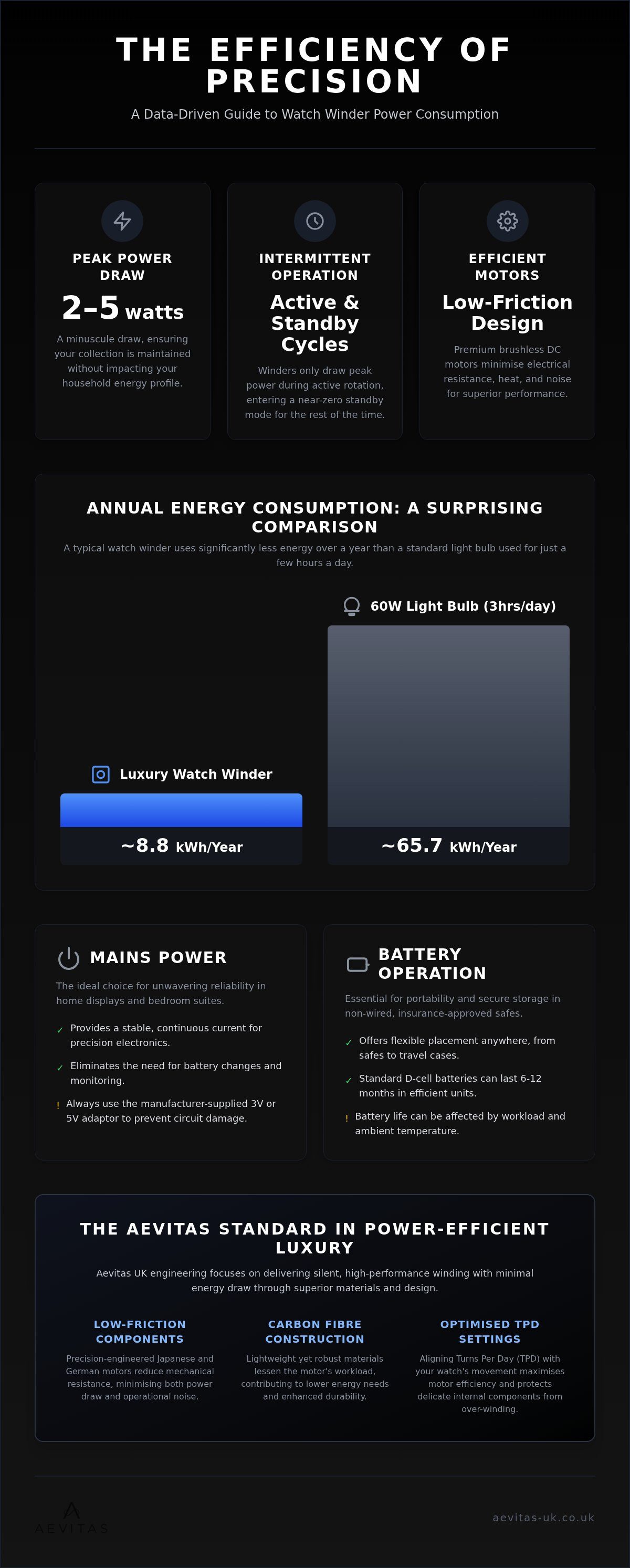
A luxury winder motor typically operates between 2W and 5W, making it one of the least demanding appliances in a modern residence. This efficiency is achieved through a concept known as "intermittent draw." Unlike a refrigerator that may cycle frequently to maintain temperature, a winder only consumes peak power during its active rotation cycles. Between these programmed movements, the device enters a low-power standby mode that draws negligible current. High-end manufacturers like Aevitas prioritise the use of low-friction Japanese or German motors to reduce electrical resistance and mechanical noise. These brands also incorporate sophisticated motor shielding. This protection prevents magnetic interference from reaching the delicate balance spring of the watch, ensuring that watch winder power consumption remains low without compromising horological accuracy.
The Physics of Horological Maintenance
It's a common misconception that a winder "charges" a timepiece. In reality, an Automatic Watch relies on a rotor to tension the mainspring through kinetic movement. The winder simply replaces the motion of a human wrist. Rotating a standard luxury watch, which typically weighs around 150g, requires surprisingly little torque from a modern, well-lubricated gearbox. High-quality watch winders utilise specific sleep phases in their electrical profile. These phases ensure the motor rests for the majority of the day, mirroring natural wear patterns whilst significantly lowering the total energy requirement.
Why Quality Motors Draw Minimal Current
Premium brushless DC motors are far more efficient than the high-friction alternatives found in budget units. These advanced components eliminate the energy-wasting heat generated by mechanical brushes. Sophisticated internal circuitry also smooths out "start-stop" power spikes that can otherwise inflate consumption during the beginning of a cycle. By maintaining a steady, low-torque rotation, the system preserves the longevity of both the motor and the watch's internal lubricants. On average, a single high-efficiency rotor draws approximately 1.5 to 2.5 Ampere-hours over a 24-hour period. This minimal draw is why many collectors can successfully run multi-watch systems for years without noticing a change in their utility costs.
Mains Power vs. Battery Operation: Choosing Your Connection
Choosing between AC mains and battery power depends entirely on your storage environment. Mains power offers unwavering reliability for open displays or bedroom suites where a power point is accessible. Conversely, Watch Winder Safes present a unique challenge. Many insurance-approved cabinets aren't pre-wired for electricity, making high-efficiency battery solutions indispensable. Modern dual-power systems provide the best of both worlds. They prioritise the mains connection to minimise watch winder power consumption from batteries, switching to the internal cells only during power cuts or relocation. This ensures your Patek Philippe or Rolex never misses a rotation cycle. Travel rolls and portable cases often utilise Lithium-ion configurations. These offer a higher energy density, providing several months of operation in a compact form factor for collectors who move between residences.
AC Adaptors and Voltage Regulation
Precision electronics require a stable current. Using the manufacturer-provided 3V or 5V adaptor is essential to prevent circuit burnout. Third-party power bricks often suffer from "vampire draw," where the adaptor continues to pull electricity even when the winder is in its rest phase. High-quality adaptors minimise this waste whilst protecting the motor from voltage fluctuations. For collectors with extensive multi-winder setups, using a dedicated surge protector is a prudent step to safeguard against erratic grid behaviour. It's a simple measure that protects both the motor and the delicate movement of your timepiece.
Battery Life Longevity in Luxury Storage
Battery performance varies based on the motor's workload and the storage environment. A standard dual-rotor system on D-cell batteries typically lasts between 6 and 12 months. However, temperature plays a critical role. Inside a cold safe, chemical discharge rates increase, which can shorten the effective lifespan of the cells. The Single Watch Winder Carbon Fibre is engineered for exceptional efficiency, often exceeding these averages through low-friction components. Monitoring your battery health is a key part of horological maintenance. High-end units often feature a low-battery LED indicator to prevent the motor from stopping unexpectedly. If you're planning a long-term storage strategy, it's wise to explore premium winding solutions that balance security with endurance.
Calculating the Annual Cost of Running a Watch Winder
Quantifying the financial impact of a new appliance is a prudent step for any organised collector. To determine the exact watch winder power consumption for your specific setup, you can use a straightforward formula: (Watts x Hours of active rotation per day / 1000) x 365. This calculation provides the total annual kilowatt-hours (kWh) consumed. For example, a single-rotor unit drawing 4W for 8 hours a day consumes approximately 11.68 kWh annually. When compared to a standard 60W incandescent lightbulb running for the same duration, which uses 175.2 kWh, the winder is over 15 times more efficient. Even when scaling up to a sophisticated 6 Watch Winder Piano Black, the total draw remains remarkably low due to the intermittent nature of the motors.
The true value of a winder is revealed when you contrast these negligible electricity costs against the price of horological neglect. If an automatic movement sits idle for extended periods, internal lubricants can migrate or stagnate, potentially leading to a seized mechanism. A professional service for a high-end calibre often starts at several hundred pounds. In this context, the few pence spent on monthly electricity act as a very low-cost insurance policy for your investment.
Winder Consumption vs. Household Appliances
Putting these figures into a household perspective provides further reassurance. A standard Wi-Fi router typically draws between 10W and 12W continuously, 24 hours a day. In contrast, even a large 9 Watch Winder draws less than 15W at its absolute peak rotation. Most of the time, the device sits in a standby or sleep phase, consuming less energy than a modern television waiting for a remote signal. Collectors can rest assured that maintaining a substantial collection has a near-invisible impact on their home's carbon footprint.
The Financial Impact of Multi-Winder Systems
Large-scale storage requires intelligent power management to remain efficient. The Aevitas Tower Series is designed with shared power rails that distribute current precisely where it's needed. This architecture prevents simultaneous power surges by staggering the start times of individual rotors. It's a level of engineering that ensures stability whilst keeping costs predictable. A deep dive into the data shows that running a high-efficiency 12-watch winder 24/7 typically costs less than £5 per year at standard electricity rates. This efficiency allows you to focus on the aesthetics of your display rather than the nuances of your utility bill.
How Settings Affect Energy Use and Watch Health
Optimising your winder's internal configuration is the most effective way to manage watch winder power consumption whilst ensuring the longevity of your timepieces. Every automatic calibre has a specific requirement for its mainspring to remain at peak tension. When you set your device to the exact specifications of the watch, you eliminate unnecessary motor activity. This precision prevents the slip-clutch from engaging too frequently, which protects the movement from stress and reduces the total electrical draw of the unit.
Turns Per Day (TPD) and Power Draw
The industry standard for most luxury brands, such as Omega and Tag Heuer, falls between 650 and 900 TPD. For instance, a Rolex calibre typically requires 650 TPD to stay fully wound. Microprocessors in premium winding systems calculate the exact intervals needed to reach these targets, spacing rotations throughout the day. Selecting a setting that exceeds these requirements won't make the watch "more wound"; it simply wastes energy and accelerates the wear on the motor's internal components. Lower TPD settings extend both motor life and battery duration by reducing the cumulative active time of the gearbox.
Intelligent Rotation Cycles
Modern horological storage incorporates "Sleep Mode" features that mimic natural human behaviour. Aevitas winders often include a 12-hour rest cycle, which effectively reduces daily power consumption by 50% without compromising the watch's readiness. This rest period allows the mainspring to unwind slightly, mirroring the conditions of being worn on the wrist. Whilst "Speed Winding" modes are useful for quickly tensioning a stopped watch, they involve a temporary high power draw and shouldn't be used for long-term maintenance. You should consult the Watch Winder Settings Guide to identify the correct directional setting (Clockwise, Counter-Clockwise, or Bi-Directional) for your specific model. Using the correct direction ensures the motor only works when the watch's rotor is actually winding the spring, preventing wasted energy during "freewheeling" phases.
To invest in a system that offers this level of technical control and efficiency, browse the Aevitas collection of programmable watch winders today.
The Aevitas Standard in Power-Efficient Luxury
Aevitas defines the intersection of high-end craftsmanship and electrical economy. Whilst some manufacturers prioritise secondary features like UV sterilisation or biometric locks, Aevitas focuses on the core mechanics of horological preservation. These extra features often inflate watch winder power consumption without offering tangible benefits to the movement. By utilising high-grade, low-friction components, Aevitas ensures that energy is directed solely toward silent, purposeful rotation. This efficiency is particularly evident in their Insurance Approved Watch Winder Safes, where advanced power management allows for long-term security without the need for constant battery replacements or intrusive wiring. It's a sophisticated approach that respects both the watch and the environment in which it's stored.
Carbon Fibre: Strength and Lightweight Efficiency
Material choice is a critical factor in motor endurance. The Carbon Fibre Watch Winders range utilises the exceptional strength-to-weight ratio of this advanced composite. Lightweight rotors require less torque to initiate movement, which significantly reduces the strain on the internal gearbox during every start-stop cycle. The Single Watch Winder Carbon Fibre serves as a benchmark for this approach, combining a sleek, modern aesthetic with a motor designed for years of silent service. Aevitas backs this engineering with a 3-year warranty on premium winders, providing a clear indicator of the confidence they place in their motor's durability and long-term efficiency. This focus on lightweight components ensures that the motor doesn't have to work harder than necessary to maintain the kinetic energy of your timepiece.
Future-Proofing Your Collection
The horological landscape is shifting toward "Green Horology," where collectors value sustainability alongside mechanical precision. Investing in energy-conscious storage is no longer just about cost; it's about responsible ownership and preserving the longevity of high-value items. Aevitas continues to lead this trend by refining their circuitry to minimise heat generation and energy waste across their entire catalogue. Whether you're managing a single heirloom or a vast array of complications in a Tower Series display, choosing a premium system is a data-backed decision that protects your financial and emotional investments. You can explore the latest advancements in efficient, luxury storage by viewing the full Aevitas Watch Winder Collection. Selecting the right winder today ensures your collection remains in peak condition for the next generation of enthusiasts.
Organise your collection with Aevitas today.
Secure Your Horological Investment with Efficiency
Managing a luxury collection doesn't have to be a burden on your household energy profile. The technical reality of watch winder power consumption is one of negligible draw and passive precision. Selecting a system that utilises low-friction motors and programmable sleep phases ensures your timepieces remain in peak mechanical condition. This data-backed approach proves that maintaining automatic movements costs far less than a single professional service. Whether you choose mains power for a permanent display or high-capacity batteries for a secure safe, the priority remains horological purity and operational reliability.
Aevitas stands as the best-selling premium brand. Every unit offers the peace of mind that comes with a 3-year warranty on all premium motors. You can protect your investment with confidence, knowing that every rotation is engineered for longevity and efficiency. Explore the most energy-efficient Premium Watch Winders at Aevitas and enjoy free insured worldwide delivery on your order. Your collection deserves a refined maintenance strategy that respects both your watches and your resources.
Frequently Asked Questions
Do watch winders use a lot of electricity?
Watch winders are exceptionally efficient, typically consuming between 2W and 5W of power. This minimal draw means they have a negligible impact on your monthly utility bills. Most devices operate on an intermittent cycle, entering a low-power standby mode when not actively rotating. Even a large collection of automatic watches won't noticeably increase your household's energy usage, making them a sustainable and practical choice for long-term horological maintenance and storage.
How long do batteries last in a watch winder safe?
In an insurance-approved watch winder safe, a standard two-watch unit using D-cell batteries generally operates for 6 to 12 months. This longevity depends on the weight of the timepieces and the programmed Turns Per Day (TPD) settings. Using high-quality alkaline or lithium batteries ensures consistent torque and prevents unexpected stops. Many collectors find this duration ideal for secure storage where mains power access is often restricted or completely unavailable within the cabinet.
Can I leave my watch winder plugged in all the time?
It's perfectly safe and standard practice to leave your device connected to a power source. Premium units are engineered for continuous operation, featuring microprocessors that manage rotation cycles and rest periods. This prevents the motor from overworking and protects the watch's internal mainspring from excessive tension. Constant connection ensures your timepieces are always ready to wear, maintaining the kinetic energy required for accurate timekeeping without any manual intervention or winding.
Is it better to use mains power or batteries for my winder?
The choice depends on your storage scenario. AC mains power is the most cost-effective and reliable method for permanent displays or bedside units. Battery operation provides essential portability for travel cases or security within safes. Whilst battery costs are higher over time, modern low-friction motors maximise cell life. Many Aevitas models offer dual-power functionality, prioritising mains electricity whilst keeping batteries as a reliable backup during unexpected power outages or relocation.
Does a multi-watch winder use significantly more power than a single one?
Whilst a multi-watch system uses more energy than a single rotor, the total watch winder power consumption remains remarkably low. A nine-watch unit typically draws less than 15W at its peak activity. Sophisticated systems stagger the rotation of individual motors to prevent simultaneous power surges. This intelligent distribution ensures that even a large Tower Series cabinet operates with the same efficiency and quiet confidence as a single-rotor carbon fibre model found in smaller collections.
What happens if there is a power cut to my automatic watch winder?
If a power cut occurs, the motor will stop rotating. Most automatic watches have a power reserve of 40 to 70 hours, so they'll continue to run for a few days before stopping. To prevent this, many collectors choose winders with a battery backup feature. Once power is restored, the microprocessor resets the rotation cycle, ensuring your collection returns to its programmed winding schedule without requiring any manual adjustment to the settings or the time.
Do different TPD settings change the cost of running a winder?
Adjusting your Turns Per Day (TPD) settings does influence energy usage, as higher settings require the motor to run for longer durations. However, because the base wattage is so low, the financial difference is measured in pence per year. It's more important to match the TPD to your watch's specific calibre, such as 650 for a Rolex. This precision protects the movement's health and ensures the motor operates with maximum efficiency and minimal wear.
Are Aevitas watch winders energy-efficient?
Aevitas prioritises energy efficiency by utilising advanced, low-friction motors and lightweight carbon fibre rotors. These components minimise mechanical resistance, allowing the system to maintain the watch winder power consumption at an industry-leading level. The integration of programmable sleep modes further reduces waste by ensuring the device only draws power when necessary. This commitment to modern engineering makes them a trusted choice for discerning collectors who value both luxury aesthetics and practical utility.