

The most dangerous place for your new timepiece isn't on your wrist; it's often tucked away in a bedside drawer where dust and household magnetic fields quietly compromise its precision. Acquiring a luxury watch marks a transition into a world of refined craftsmanship, yet it also brings the immediate responsibility of technical preservation. Learning how to store your first automatic watch is the essential difference between owning a lifelong heirloom and facing an avoidable, costly service bill within your first few years of ownership.
You likely feel a mix of pride and apprehension, perhaps questioning if the movement oils will stagnate whilst the watch sits idle or if a dedicated winder is truly necessary for your specific calibre. It's a common dilemma for every discerning collector who prioritises mechanical excellence. This guide reveals the professional standards for preserving the mechanical integrity and aesthetic beauty of your first luxury timepiece. We will examine the functional benefits of carbon fibre winders, the necessity of secure travel rolls, and the environmental controls required to safeguard both resale value and horological accuracy.
Key Takeaways
- Understand the mechanics of movement stagnation and why consistent rotation is vital for maintaining long-term accuracy.
- Identify environmental threats within your home, from humidity to magnetic interference, and learn how to neutralise them effectively.
- Master how to store your first automatic watch by choosing between high-performance winders and protective presentation boxes.
- Adopt a precise pre-storage cleaning routine to eliminate corrosive salts and oils before placing your timepiece into storage.
- Learn the optimal positioning for your watch to ensure internal components remain perfectly aligned whilst the movement is idle.
Why Your First Automatic Watch Requires Specialist Storage
Owning an automatic watch represents a transition from simple quartz convenience to the world of complex mechanical engineering. These timepieces are living machines. They rely on the constant movement of a weighted rotor to tension the mainspring, which powers the gear train. When you consider how to store your first automatic watch, you must view it as a proactive maintenance task rather than a passive storage choice. A luxury watch left to sit idle for months isn't just "off"; it's a machine whose internal components are beginning to stagnate.
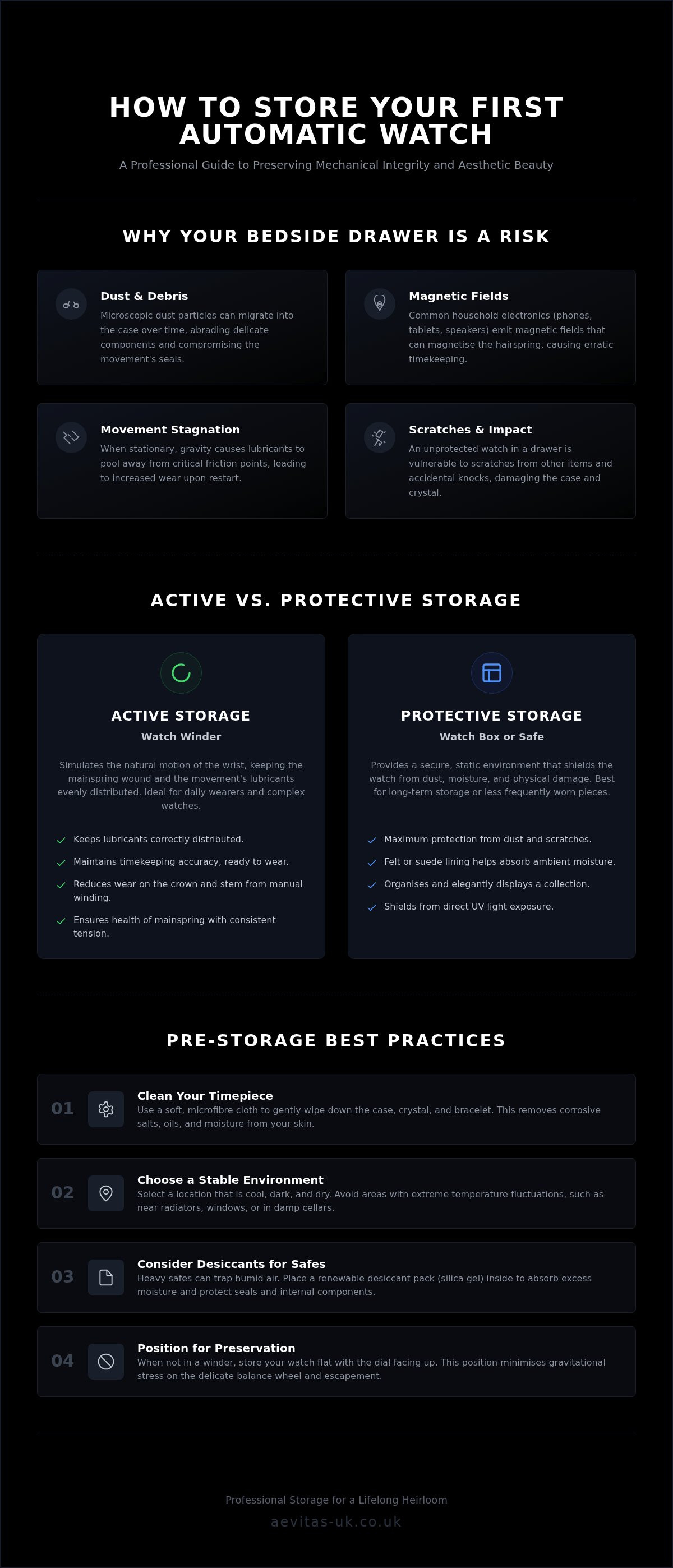
Leaving a watch on a bedside table is a common mistake for new collectors. This exposes the delicate calibre to several silent threats. Dust particles can migrate into the case over time, whilst modern homes are filled with magnetic fields from smartphones and charging pads. These fields can magnetise the hairspring, causing the watch to run erratically. Specialist storage provides a controlled environment that shields the movement from these invisible hazards.
The Role of Synthetic Lubricants in Modern Movements
Modern calibres use sophisticated synthetic oils designed for longevity and thermal stability. Unlike the animal-based lubricants of the past, these don't "gum up" in the traditional sense, but they remain subject to the laws of physics. Viscosity refers to a fluid's resistance to flow; in horology, it determines how effectively oil clings to a high-speed pivot under pressure. If a watch remains stationary for months, gravity causes these lubricants to pool away from critical friction points. This leaves delicate components dry and vulnerable when the movement eventually restarts.
Mechanical Stress vs. Stationary Wear
A common misconception amongst new collectors is that a stopped watch is a preserved watch. In reality, mechanical components thrive on regular engagement. Understanding how to store your first automatic watch involves choosing between "dead" storage and "active" storage.
- Gaskets and Seals: Rubber and silicone gaskets maintain water resistance. Without the heat and movement of regular wear, these can become brittle and perish over time.
- Mainspring Health: Keeping a mainspring under consistent, moderate tension is often better for its metallurgy than letting it fully unwind for extended periods.
- Active Storage: Utilising a watch winder ensures the movement remains in active storage. This keeps the lubricants distributed and the time accurate for your next wear, reducing the need to manually reset and stress the crown and winding stem.
The Ideal Storage Environment: Protecting Against Environmental Hazards
The home environment is rarely as stable as it appears. For a mechanical timepiece, subtle shifts in the atmosphere can lead to significant internal degradation. The British climate presents a unique challenge, as damp air and high humidity levels can penetrate even well-sealed cases if the gaskets are aged. When moisture enters, it causes internal corrosion or "fogging" under the crystal, which requires an immediate professional service to rectify.
Temperature stability is equally critical. Placing your watch on a shelf above a radiator is a common error that thins the lubricants and stresses the metal components as they expand and contract. Similarly, prolonged exposure to UV light through a window can cause "tropical" fading on the dial and make leather straps brittle. Learning how to store your first automatic watch correctly means identifying a cool, dark, and dry location away from these variables.
Effective planning for how to store your first automatic watch must also include a survey of your home's electronic landscape. Modern households are saturated with magnetic fields that were non-existent when many traditional watchmaking standards were established.
Humidity Control and Seal Integrity
Moisture is a silent killer of mechanical movements. Whilst luxury watches are designed to be water-resistant, they aren't impervious to long-term exposure to damp environments. Using felt-lined luxury watch boxes provides a natural buffer, as the material helps absorb minor ambient moisture before it affects the timepiece. If you choose to keep your collection in a heavy safe, always include a desiccant pack. Safes often trap humid air, creating a micro-climate that accelerates seal perishability.
Modern Magnetic Hazards at Home
In the digital age, magnetism is perhaps the most pervasive threat to horological accuracy. Household items like tablet covers, smart speakers, and even high-end laptop magnets can easily magnetise a watch's balance spring. A magnetised watch typically behaves erratically, often running several minutes fast per day as the coils of the hairspring stick together. This occurs because the magnetic charge forces the spring to "shorten" its path, accelerating the beat rate.
Shielding your collection is the only permanent solution. Investing in watch winder safes provides a dual benefit: physical security and a steel-walled barrier against electromagnetic interference. This ensures your movement remains regulated and ready for the wrist without the need for frequent demagnetisation. It offers a sense of calm, knowing your investment is protected from both theft and the invisible forces of modern technology.
Comparing Watch Winders, Boxes, and Travel Rolls
Selecting the correct vessel for your timepiece is the final step in mastering how to store your first automatic watch. The choice depends entirely on your wearing habits and the complexity of your watch's calibre. Whilst a single watch might sit comfortably on a stand, a growing collection requires a more structured approach to ensure both physical protection and mechanical readiness. You must match the storage solution to the specific "Turns Per Day" (TPD) requirements of your movement to avoid under-winding or unnecessary tension.
Collectors generally categorise storage into three formats: active, static, and mobile. Active storage keeps the movement oscillating, static storage focuses on dust-free display, and mobile solutions prioritise impact resistance. Each serves a distinct purpose in a modern horological lifestyle. Understanding these differences allows you to invest in a solution that complements your routine rather than complicating it.
When a Watch Winder is Non-Negotiable
For the busy professional, the primary benefit of a watch winder is the "grab and go" convenience it provides. If your watch features a date complication or a moon phase, resetting these every time the power reserve depletes is a tedious task. More importantly, frequent use of the screw-down crown to manually wind and set the time can lead to premature wear on the delicate threads and internal gaskets. By maintaining a consistent TPD, you preserve the crown's seal integrity and keep the lubricants perfectly distributed. You can explore more expert insights on the Aevitas UK blog regarding movement maintenance.
The Aesthetic Appeal of Luxury Watch Boxes
If you prefer to rotate your watches less frequently, a static display is often the superior choice. This turns your first purchase into a sophisticated centrepiece for your dressing room or office. A high-quality presentation box provides a secure, dust-free environment whilst allowing you to appreciate the craftsmanship of the dial and case through a glass viewing portal. It's an essential tool for organising your collection as it expands from a single piece to a curated set. We recommend viewing the Aevitas UK watch box collection for options that combine sustainable wood finishes with plush, protective interiors.
For those who travel, luxury watch roll travel cases are the essential choice for the mobile gentleman. These rolls offer a compact, reinforced structure that prevents the watch from shifting or scratching whilst in transit. Whether you are heading to a business meeting or a weekend away, a leather roll ensures your timepiece remains as pristine as the day you bought it, regardless of the journey's rigours.
Best Practices for Long-Term Maintenance and Care
Maintenance begins the moment you take the watch off your wrist. If you are learning how to store your first automatic watch, you must understand that the condition in which you store it is just as important as the storage device itself. A simple "Monthly Rotation" rule is essential for any timepiece kept in a static box. You should ensure you wind the movement at least once every four weeks to keep the gears engaged and the lubricants flowing through the gear train. For those whose collection includes pieces received as commemorative gifts, Engraveitnow Ltd provides excellent resources on selecting and maintaining personalised keepsakes.
Positioning also plays a subtle role in horological health. Whilst most collectors store watches dial-up, some enthusiasts use different angles to counteract the cumulative effects of gravity on the escapement. Storing a watch "crown-up" or "crown-down" can slightly alter its daily rate, though dial-up remains the safest standard for long-term preservation. For those with leather straps, ensure the strap is not buckled too tightly around a storage cushion, as this can lead to permanent creasing or cracking of the hide over time.
Before your watch enters its luxury watch box, a thorough cleaning is mandatory. Use a clean, lint-free microfibre cloth to remove fingerprints and skin oils from the case and bracelet. Ensure the crown is fully depressed or screwed down to maintain the air-tight seal against ambient dust and moisture. The natural acidity of human perspiration can micro-corrode polished stainless steel if left uncleaned in a stagnant environment.
Winding and Setting Protocols
Correct handling of the movement prevents internal stress. When manually winding your watch before storage, rotate the crown slowly and stop after approximately 30 to 40 turns for most modern calibres. Most importantly, avoid the "Danger Zone" between 9 PM and 3 AM. Setting the date during these hours can damage the delicate date-change gears that are already mechanically engaged. To ensure your timepiece remains in peak condition, follow our guide on how to keep an automatic watch wound correcty.
Consistency is the hallmark of a true collector. By integrating these rituals into your routine, you ensure your investment retains its value and mechanical precision for decades. To find the perfect home for your maintained timepiece, browse our premium watch winder collection today.
Elevating Your Collection with Aevitas UK Storage Solutions
Aevitas UK has established itself as the premier authority for British watch enthusiasts, offering a curated selection of storage solutions that balance heritage with modern engineering. When you decide how to store your first automatic watch, it's more than a simple choice of utility. You are selecting a partner in the preservation of a mechanical legacy. Our brand acts as a knowledgeable guide, ensuring that the transition from wearing your watch to storing it is a seamless ritual of refinement and control.
Matching your storage to the prestige of your first luxury timepiece is essential for any serious collector. A high-calibre movement deserves an environment that reflects its value. Whether you require the active rotation of a winder or the elegant display of a presentation box, our products provide the structural integrity and aesthetic polish required to safeguard your investment for decades to come. By choosing a professional standard, you are committing to the longevity and resale value of your timepiece.
The Performance of Carbon Fibre
Modern horology often looks to the future, and our carbon fibre watch winders represent the pinnacle of that progression. Carbon fibre offers a modern, lightweight, and incredibly durable alternative to traditional wood, providing a sleek aesthetic that fits perfectly into contemporary interiors. Beyond the surface, Aevitas UK winders feature advanced silent motor technology. This ensures your watch remains perpetually wound without the mechanical hum often associated with entry-level devices. For a comprehensive look at this material's benefits, consult The Ultimate Guide to Carbon Fibre Watch Winders for Luxury Collections.
Secure and Stylish Travel Solutions
The design philosophy behind our leather watch rolls is rooted in the needs of the mobile gentleman. Protecting your investment whilst on the move requires a solution that is both compact and uncompromising in its security. Our rolls are crafted to prevent any internal movement, shielding the case and crystal from impacts and abrasions during transit. This allows you to personalise your storage to reflect your individual style, ensuring your collection remains as mobile as your lifestyle demands.
We prioritise the safety of your collection from the moment of purchase. Aevitas UK offers free insured delivery on all orders worldwide, ensuring your storage solution arrives in perfect condition. When you consider how to store your first automatic watch, remember that the quality of the container should always reflect the quality of the calibre inside. Explore our full range to find the perfect home for your new acquisition.
Securing the Future of Your Horological Legacy
Mastering how to store your first automatic watch is the final step in transitioning from a casual owner to a dedicated collector. By controlling environmental hazards and adopting a rigorous pre-storage cleaning ritual, you protect the intricate calibre from silent degradation. Whether you choose the active maintenance of a carbon fibre winder or the elegant security of a luxury leather roll, your choice should reflect the craftsmanship of the watch itself. A well-stored watch is a preserved legacy.
As the UK's best-selling premium watch winder brand, Aevitas UK provides the technical superiority and luxury leather craftsmanship your collection deserves. We ensure your new acquisition remains pristine with free insured worldwide delivery on every order. Secure your first investment with Aevitas UK’s premium storage collections and enjoy the peace of mind that comes with professional-grade protection. Your journey into the world of fine watchmaking has only just begun; ensure it starts with the right foundations.
Frequently Asked Questions
Is it bad to let an automatic watch stop during storage?
Letting a watch stop for a few days is harmless, but leaving it stationary for months can lead to lubricant stagnation. When you consider how to store your first automatic watch, aim for a balance between rest and activity. A movement that never runs may eventually suffer from pooled oils at the critical pivots. We recommend winding the watch at least once a month to ensure the gear train remains lubricated and functional.
How long can I leave my automatic watch without winding it?
Most automatic watches have a power reserve of 38 to 72 hours. Once this energy is spent, the movement will stop. Whilst an idle watch isn't immediately damaged, you shouldn't leave it unwound for more than four weeks. Regular engagement keeps the internal components supple. If you don't plan to wear the watch weekly, a dedicated winder is the most efficient way to maintain mechanical readiness without manual intervention.
Do watch winders cause unnecessary wear on the movement?
A high-quality winder does not cause excessive wear when configured correctly. These devices are designed to mimic the natural movement of a human wrist, providing only the energy required to keep the mainspring tensioned. In contrast, frequent manual winding via the crown can stress the winding pinion and wear down the waterproof gaskets. Using a winder with precise Turns Per Day (TPD) settings is actually a protective measure for your calibre.
What is the best temperature for storing luxury watches?
The ideal environment is a stable room temperature between 18°C and 22°C. Fluctuations are the true enemy of horological precision. Storing your timepiece in a cool, dry place away from direct sunlight and heat sources like radiators prevents the synthetic lubricants from thinning or migrating. Consistency in temperature ensures that the metal components within the escapement don't expand or contract, which maintains the watch's regulated accuracy over long periods.
Can I store my watch in its original retail box?
Whilst original retail packaging is excellent for provenance, it isn't always the best long-term storage environment. These boxes are often made of materials that trap humidity rather than wick it away. Learning how to store your first automatic watch correctly involves choosing a dedicated presentation box or carbon fibre winder that offers superior protection against dust. If you use the original box, ensure you place a desiccant pack inside to manage ambient moisture.
How do I know the correct TPD setting for my watch winder?
You can typically find the correct TPD requirements in your watch's technical manual or via the manufacturer's website. Most luxury calibres require between 650 and 900 turns per day to remain fully wound. Some movements only wind in one direction, whilst others are bi-directional. Setting your winder to the exact specifications of your calibre prevents the slipping clutch from engaging unnecessarily, which further preserves the longevity of the mainspring assembly.
Should I store my watch with the crown pulled out to save power?
Never store a mechanical watch with the crown pulled out. This is a common myth that stems from quartz watch behaviour. Pulling the crown doesn't "save" energy in an automatic watch; instead, it leaves the movement vulnerable to dust, moisture, and debris. The open gap compromises the case's seal integrity, inviting internal corrosion. Always ensure the crown is fully depressed or screwed down before placing your timepiece into any storage solution.
How often should I clean my watch storage box or winder?
You should perform a light dusting of the exterior surfaces once a week to prevent grit from accumulating. For the interior, wipe the cushions and lining every three to six months using a clean, dry microfibre cloth. This removes any residual skin oils or salts transferred from your watches. Keeping the storage environment pristine ensures that no abrasive particles can scratch the polished surfaces of your timepieces whilst they are seated in the box.
0 comments