

The heavy steel safe you trust to guard your horological collection might quietly be destroying it. When sealed vaults trap atmospheric moisture, sudden temperature drops trigger microclimate condensation directly across hand-finished movements and rare dials. Stripping all air moisture isn't the remedy either; aggressive desiccation rapidly cracks rubber gaskets and thickens delicate synthetic oils. Mastering the ideal humidity for watch storage requires striking an exacting balance between metal anti-corrosion and component preservation.
You already know that fine calibres demand meticulous attention to detail, yet conflicting advice regarding safe heaters, silica gels, and airtight boxes leaves many collectors understandably uneasy. In this guide, you'll discover the precise relative humidity and temperature parameters required to protect luxury timepieces from dial discolouration, gasket decay, and lubricant migration. We will examine the definitive environmental benchmarks, review modern monitoring tools, and explore how high-grade presentation enclosures and watch winder safes shield fine investments across the United Kingdom from damaging atmospheric fluctuations.
Key Takeaways
- Identify the ideal humidity for watch storage, maintaining a calibrated 40% to 50% relative humidity window at stable room temperatures to preserve internal mechanisms.
- Understand how atmospheric moisture breaches case seals, leading to dial oxidation, gasket desiccation, and premature synthetic lubricant migration.
- Eliminate hazardous microclimates within heavy steel safes by managing dew-point shifts and ensuring proper enclosure air dynamics.
- Implement reliable monitoring routines using high-precision digital hygrometers verified through regular calibration protocols.
- Combine climate-regulated enclosures with active mechanical rotation to prevent oil stasis and protect complex complications over the long term.
What is the Ideal Humidity for Watch Storage? The Definitive Range
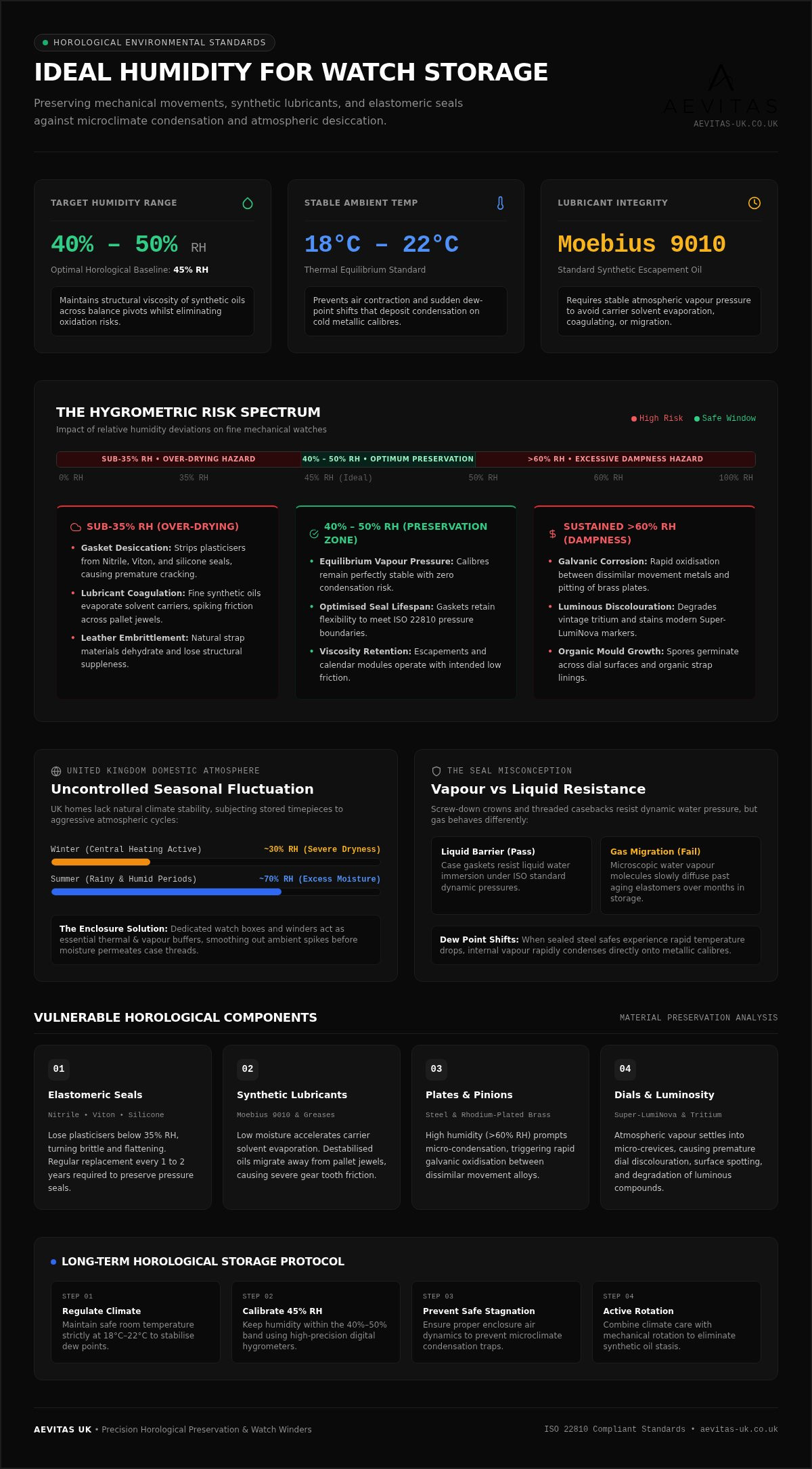
Precision horology requires environmental equilibrium. The definitive ideal humidity for watch storage spans 40% to 50% Relative Humidity (RH), coupled with stable ambient temperatures maintained strictly between 18°C and 22°C. In horological preservation, relative humidity denotes the vapour density of the air expressed as a percentage of the maximum moisture the air can hold at that specific temperature. When ambient temperatures drop, air contracts and relative humidity rises, shifting the dew point closer to cold metallic calibres.
Relying purely on case architecture is a common miscalculation. Threaded casebacks, screw-down crowns, and synthetic seals resist liquid immersion under dynamic pressure, but they cannot stop ambient gas migration indefinitely. Over extended months in storage, microscopic water vapour molecules penetrate past aging elastomeric barriers, equilibrating internal movement cavities with external ambient conditions.
The 40% to 50% Relative Humidity Standard
Horological conservation consensus establishes 45% RH as the optimum baseline for mechanical movements. Within this calibrated window, modern synthetic lubricants like Moebius 9010 retain their structural viscosity across balance pivots, whilst complex calendar modules avoid friction-induced drag. Across the United Kingdom, uncontrolled domestic humidity routinely swings between 30% during winter central heating and 70% throughout rainy summer periods. Houses lack inherent climate stability. Positioning timepieces inside purpose-built watch boxes provides an essential primary barrier against these aggressive ambient shifts, smoothing out atmospheric spikes before vapour interacts with delicate calibres.
The Hazard of the Extremes: Over-Drying vs Dampness
Deviating from this narrow band initiates rapid material degradation on both ends of the hygrometric spectrum. Basic relative humidity principles demonstrate that extreme shifts fundamentally destabilise non-metallic components:
- Sub-35% RH (Excessive Dryness): Strips essential moisture from nitrile, Viton, and silicone gaskets. Seals dry out, crack, and lose elasticity, while natural leather straps become brittle. Synthetic oils can also desiccate prematurely, increasing friction across pallet jewels.
- Sustained >60% RH (Excessive Dampness): Triggers rapid galvanic corrosion between dissimilar movement alloys, pits brass mainplates, and discolours vintage tritium or modern Super-LumiNova markers. It also encourages destructive mould growth inside organic strap linings.
Brief seasonal exposure rarely ruins a robust steel sports model immediately. Persistent exposure within unventilated enclosures causes lasting harm. When elevated moisture lingers undisturbed within a dark display cabinet or drawer, atmospheric vapour settles into micro-crevices, silently accelerating mechanical wear and aesthetic decay.
The Anatomy of Moisture Damage: How Humidity Affects Luxury Timepieces
Water vapour behaves like an invisible gas under pressure. Even when case threads are secured tightly, ambient humidity slowly diffuses past crown gaskets and caseback seals via microscopic imperfections. When volatile atmospheric swings disrupt the interior of a watch, precision-machined steel pinions, balance wheels, and rhodium-plated brass plates quickly become vulnerable to destructive micro-condensation.
Gasket Degradation, Seal Desiccation, and Lubricant Viscosity
Elastomeric seals require atmospheric balance. When storage conditions drop into parched territory below 35% RH, nitrile, Viton, and silicone O-rings forfeit their plasticisers. They stiffen, flatten, and crack, failing ISO 22810 pressure boundaries long before their standard one- to two-year service lifecycle finishes. Simultaneously, low moisture accelerates the evaporation of carrier solvents in fine synthetic oils like Moebius 9010. Starved of stable vapour pressure, these lubricants coagulate or migrate away from high-beat escapement pallet jewels. Friction spikes, balance amplitude plummets, and gear train teeth begin grinding steel against steel.
Dial Oxidation, Luminescent Patina, and Metal Rust
Excessive moisture wreaks havoc on dials and hands. As highlighted by the Canadian Conservation Institute guidelines on caring for metal objects, maintaining an environment between 45% and 50% RH prevents moisture from catalysing oxidation on sensitive metallic alloys. Unchecked vapour causes galvanic corrosion across 316L stainless steel threads and pits bare brass plates beneath bridges. On dials, trapped humidity triggers lacquer blistering, paint flaking, and sub-dial spotting. While sunlight naturally warms vintage dials into coveted "tropical" honey tones, water vapour causes dark, blotchy decay and breaks down luminous compounds. It turns historical tritium into crumbling powder and oxidises modern Super-LumiNova surrounds.
Preserving Leather Straps Alongside Steel Cases
Collectors face a delicate dilemma when storing metal calibres fitted to exotic leather. Steel movements thrive best around 45% RH to eliminate oxidation risks. Meanwhile, natural alligator, crocodile, and calfskin straps lose essential oils and crack if the microclimate drops below 40% RH. Conversely, humidity over 60% turns organic straps into sponge-like sinks, welcoming mould and degrading soft suede backings. Maintaining the ideal humidity for watch storage resolves this conflict by keeping both leather pliable and internal calibres dry. To preserve heirloom pieces without risking material rot, house them within breathable watch boxes lined with non-reactive fabrics that gently buffer daily atmospheric swings.
Watch Safes and Enclosures: Preventing Destructive Microclimates
Burglary safes offer formidable physical security, but their dense construction creates an overlooked thermodynamic dilemma. Heavy steel walls possess substantial thermal mass. They absorb ambient warmth slowly and release it just as sluggishly, isolating the internal volume from external air movement. When an unventilated vault experiences external room temperature swings, that trapped air shifts rapidly towards saturation, transforming a protective stronghold into a damaging greenhouse for fine calibres.
Uncirculated air allows stale moisture pockets to settle into corners, pooling around intricate mechanical movements. Compounding the issue, low-grade safe interiors assembled with chemical solvent glues release acidic fumes. In stagnant, humid air, these volatile compounds trigger microscopic surface fogging across anti-reflective sapphire coatings and speed up dial tarnishing.
The Condensation Trap Inside Steel Watch Safes
Rapid temperature changes reveal the hidden hazard of airtight vaults. As explained in the National Weather Service discussion on relative humidity and dew point, dropping the ambient air temperature increases relative humidity until vapour condenses into liquid water. When central heating cools at night, the air within a locked steel safe contracts. The steel casing cools faster than the interior air cavity, pulling the relative humidity to 100% at the boundary walls. Moisture condenses instantly, migrating straight to the cold steel cases of stored timepieces. Securing valuable horological pieces requires specialised insurance approved watch winder safes engineered to accommodate internal air convection, preventing microclimate moisture pooling across valuable collections.
Timber Cabinets vs Carbon Fibre Presentation Cases
External presentation storage requires equal forethought. Different materials offer distinct atmospheric behaviour when maintaining the ideal humidity for watch storage:
- Solid Hardwood Cabinets: Natural timbers, including seasoned walnut and burl wood, behave as gentle hygroscopic buffers. Timber breathes, naturally absorbing excess ambient dampness during humid periods and releasing micro-vapour when indoor heating dries the surrounding air.
- Carbon Fibre Enclosures: High-tensile carbon fibre provides peerless dimensional stability. It remains totally inert, resisting thermal warping, swelling, and ambient moisture absorption in challenging climates.
- Inert Interior Linings: Premium storage solutions rely on chemically neutral, lint-free microfibre and plush velvet interiors. These high-grade linings cushion polished cases without trapping damp residue or releasing abrasive off-gassing agents against raw steel.
Matching storage architecture to ambient room conditions ensures your collection stays within safe limits. Whether you choose the organic buffering of solid timber or the impenetrable stability of modern carbon composites, proper materials form the first line of defence against airborne moisture.
How to Control and Monitor Humidity: A Step-by-Step Protocol
Achieving environmental control over a horological collection demands a systematic, measurable approach rather than passive hope. Guesswork risks microclimate moisture spikes that compromise high-grade calibres. By implementing a disciplined monitoring routine, you establish the ideal humidity for watch storage and shield sensitive components from volatile ambient swings.
Step 1: Install Accurate Digital Hygrometers
Analogue dial hygrometers look traditional, but they drift significantly over time. Equip your main storage enclosures with digital hygrometers featuring Swiss-made capacitive MEMS sensors. These instruments deliver precision tolerances within ±2% to ±3% RH and ±0.3°C accuracy. Position the sensor directly beside your timepieces on the display tray rather than near the exterior lid where external room air intrudes. Choose units equipped with local Bluetooth or Wi-Fi data logging; this allows you to review historical humidity curves and receive real-time push alerts during winter central heating or summer humidity spikes without breaching the cabinet seal.
Step 2: Balance Moisture Using Two-Way Regulators
Traditional silica gel canisters pull ambient humidity aggressively down towards 0% to 15%, inadvertently parching rubber gaskets and causing fine leather to shrink. Replace raw silica with two-way osmotic vapour membranes engineered specifically for a 49% RH target. These semi-permeable salt solutions work symmetrically: they absorb surplus airborne water vapour when the room runs humid and release clean vapour when conditions dry out. In well-sealed presentation enclosures, replace these membrane packs every two to four months to maintain an unyielding equilibrium right at the 45% to 50% threshold.
- Bi-Annual Sensor Calibration: Verify digital hygrometer accuracy every six months using a standard saturated salt-slurry test in an airtight container (which reliably yields 75% RH at 20°C).
- Equilibrium Pack Refresh: Inspect two-way membrane packs quarterly; discard and replace them as soon as internal contents feel rigid or crystallised.
- Microclimate Auditing: Review monthly data logs to confirm safe temperatures remain within 18°C to 22°C alongside stable relative humidity.
Step 3: Strategic Room and Furniture Placement
Enclosure placement dictates baseline thermal stability. Always position storage cases against interior partition walls; exterior building walls transmit outdoor thermal variations, driving sharp internal dew-point shifts. Keep luxury displays far away from direct sunlight, central heating radiators, air-conditioning draughts, and adjoining en-suite bathrooms. For larger domestic collections, running a dedicated residential dehumidifier ensures the ambient room never breaches 55% RH.
Pairing these disciplined habits with high-grade storage protects your horological investments for decades to come. Explore the Aevitas Watch Storage collection of luxury watch boxes to secure precision-crafted enclosures lined with inert, non-reactive materials designed to maintain microclimate stability.
Integrating Climate Care with Mechanical Maintenance
Atmospheric control forms only half of long-term horological preservation. Even when an enclosure maintains the ideal humidity for watch storage, completely static timepieces remain vulnerable to gravitational oil pooling. Fine calibres rely on kinetic balance; without occasional movement, fluid lubricants gradually migrate away from jewel cups and balance pivots, leaving friction surfaces exposed.
The Role of Watch Winders in Atmospheric Protection
Rotating automatic calibres on regulated duty cycles keeps modern synthetic oils evenly distributed across the escapement. For timepieces featuring perpetual calendars or split-second chronographs, periodic running prevents complex gear trains from seizing under subtle moisture fluctuations. Beyond mechanical exercise, precision winding cases create an indispensable physical barrier against dust, airborne particulate, and sudden draughts. Choosing high-performance multi watch winders allows collectors to integrate mechanical health with microclimate defence, maintaining operational readiness inside dressing rooms or vaults.
Annual Pressure Testing and Collector Best Practices
Environmental stability cannot compensate for failed physical gaskets. Under ISO 22810 standards, water resistance remains a temporary condition dependent on supple elastomeric seals. Schedule annual dry and wet vacuum pressure tests to confirm that caseback O-rings and crystal gaskets retain their elastic compression. Always verify that screw-down crowns are fully threaded against the case tube before placing watches into storage; leaving a crown pulled out completely exposes movement cavities to ambient air. Vintage models with simple push-down crowns require even closer vigilance, as their single gasket architectures offer minimal resistance against humidity diffusion.
- Kinetic Rotation: Keep complex automatic movements on programmed winding cycles to maintain fluid distribution across high-beat contact points.
- Atmospheric Buffering: Store resting pieces within dedicated presentation enclosures that isolate timepieces from sudden temperature fluctuations.
- Annual Validation: Pair biannual hygrometer recalibration with professional gasket pressure testing to verify your environmental defence remains intact.
By uniting dynamic rotation, seasonal monitoring, and sealed cabinetry, you eliminate the underlying causes of mechanical decay. This multi-layered routine ensures each timepiece performs flawlessly the moment it returns to your wrist.
Mastering Climate Precision for Your Collection
Preserving fine timepieces demands far more than passive display; it requires active environmental command. Maintaining the ideal humidity for watch storage between 40% and 50% RH prevents microscopic steel oxidation, protects supple elastomeric gaskets, and stabilises synthetic escapement lubricants. When you pair steady microclimates with regular kinetic rotation, your automatic calibres avoid oil stasis and remain in peak mechanical condition for decades.
Don't allow unventilated vaults or shifting household dampness to compromise centuries of horological artistry. Protect your horological investment with precision-engineered storage solutions from Aevitas Watch Storage. Handcrafted from solid timber and high-tensile carbon fibre, each enclosure incorporates non-reactive velvet linings built to safeguard prestigious Swiss timepieces from Rolex, Patek Philippe, and Audemars Piguet. Backed by complimentary insured worldwide delivery on all luxury storage solutions, you can effortlessly give your treasured timepieces the museum-calibre protection they deserve.
Frequently Asked Questions
What is the absolute best humidity level for storing luxury watches?
The absolute best relative humidity level for luxury watch storage is between 40% and 50% RH, with 45% representing the ideal baseline. This specific window prevents steel movement oxidation whilst keeping exotic leather straps supple and conditioned. Maintaining this targeted bracket at a stable room temperature between 18°C and 22°C ensures the ideal humidity for watch storage throughout volatile British seasonal climate shifts.
Can low humidity actually cause damage to an automatic watch?
Yes, sustained low humidity below 35% RH causes severe mechanical and material degradation. Excessively dry air parches elastomeric rubber and Viton gaskets, causing them to shrink, lose elasticity, and crack over time. Hyper-dry environments also accelerate carrier solvent evaporation in synthetic movement lubricants. Without fluid oil cushioning high-beat pallet jewels, balance amplitude drops and gear train friction surges, causing accelerated mechanical wear.
Should I keep silica gel packets inside my watch box or safe?
No, it's best to avoid raw silica gel canisters inside primary watch enclosures. Silica strips moisture aggressively down towards 10% or 15% RH, which desiccates gaskets and cracks delicate leather straps. Instead, deploy two-way osmotic humidity control packs calibrated to 49% RH. These semi-permeable membranes both absorb and release vapour, maintaining steady atmospheric equilibrium without stripping vital moisture from organic and elastomeric components.
How does ambient room temperature interact with storage humidity?
Does a 300-metre dive watch need humidity protection during storage?
Yes, professional dive watches still require active humidity protection during storage. Factory water-resistance ratings protect against dynamic liquid pressure during active diving, not continuous atmospheric vapour diffusion during static storage. Over extended months, ambient humidity gradually penetrates past threaded seals. Without maintaining the ideal humidity for watch storage, moisture trapped within the case attacks dial lacquers, discolours luminous indices, and slowly pits movement plates.
Can high humidity ruin genuine leather or alligator watch straps?
Yes, relative humidity exceeding 60% RH quickly destroys genuine calfskin, alligator, and crocodile watch straps. Natural leather acts like a sponge, drawing excess moisture directly out of damp ambient air. In stagnant storage enclosures, damp straps quickly become breeding grounds for mould and mildew, leading to persistent odours and discolouration. Sustained dampness also degrades water-soluble bonding glues, resulting in premature strap lining delamination.
Why do watch crystals fog up inside storage boxes or safes?
Watch crystals fog up because airborne moisture inside the watch case condenses against the colder interior surface of the sapphire glass. When external room temperatures drop quickly, the crystal chills much faster than the movement cavity. Any humidity trapped within the casing instantly condenses into fine liquid droplets. Visible fogging indicates an compromised gasket seal and demands prompt professional attention to prevent internal rust.