

Most collectors fear a dropped case or a shattered crystal, but the most devastating threat to a horological investment is entirely invisible. Whilst physical impact causes immediate trauma, moisture acts as a silent predator, slowly degrading the intricate components of a high-value movement. Protecting luxury watches from humidity is not merely a recommendation; it is a fundamental requirement for any serious enthusiast looking to preserve the mechanical integrity of their collection.
You likely recognise the deep-seated worry that comes with noticing "tropical" fading or internal rust on a prized asset. These aren't just cosmetic shifts. They are signs of environmental damage that can decimate a watch's resale value and heritage. This guide delivers the professional techniques and premium storage solutions required to shield your timepieces from the silent threat of moisture.
We will outline a clear maintenance routine to ensure your collection remains in showroom condition. You'll also gain clarity on whether airtight safes help or hinder your goals, alongside a deep dive into how luxury watch winder safes and leather rolls offer the ultimate climate protection for the modern collector.
Key Takeaways
- Understand the mechanical risks of moisture and the professional standards for protecting luxury watches from humidity to prevent movement degradation and lubricant coagulation.
- Aim for the "Goldilocks Zone" of 45% to 55% Relative Humidity to preserve both the internal movement and external components like leather straps and gaskets.
- Discover why specialised storage solutions, such as airtight Watch Winder Safes, provide the necessary climate control to shield high-value assets from environmental shifts.
- Learn how active maintenance using a Multi Watch Winder prevents the mechanical failures associated with static watches in humid conditions by ensuring consistent oil distribution.
- Identify the best materials for your collection, from moisture-resistant carbon fibre to traditional burl walnut, to ensure your storage matches your preservation needs.
The Hidden Impact of Humidity on Luxury Timepieces
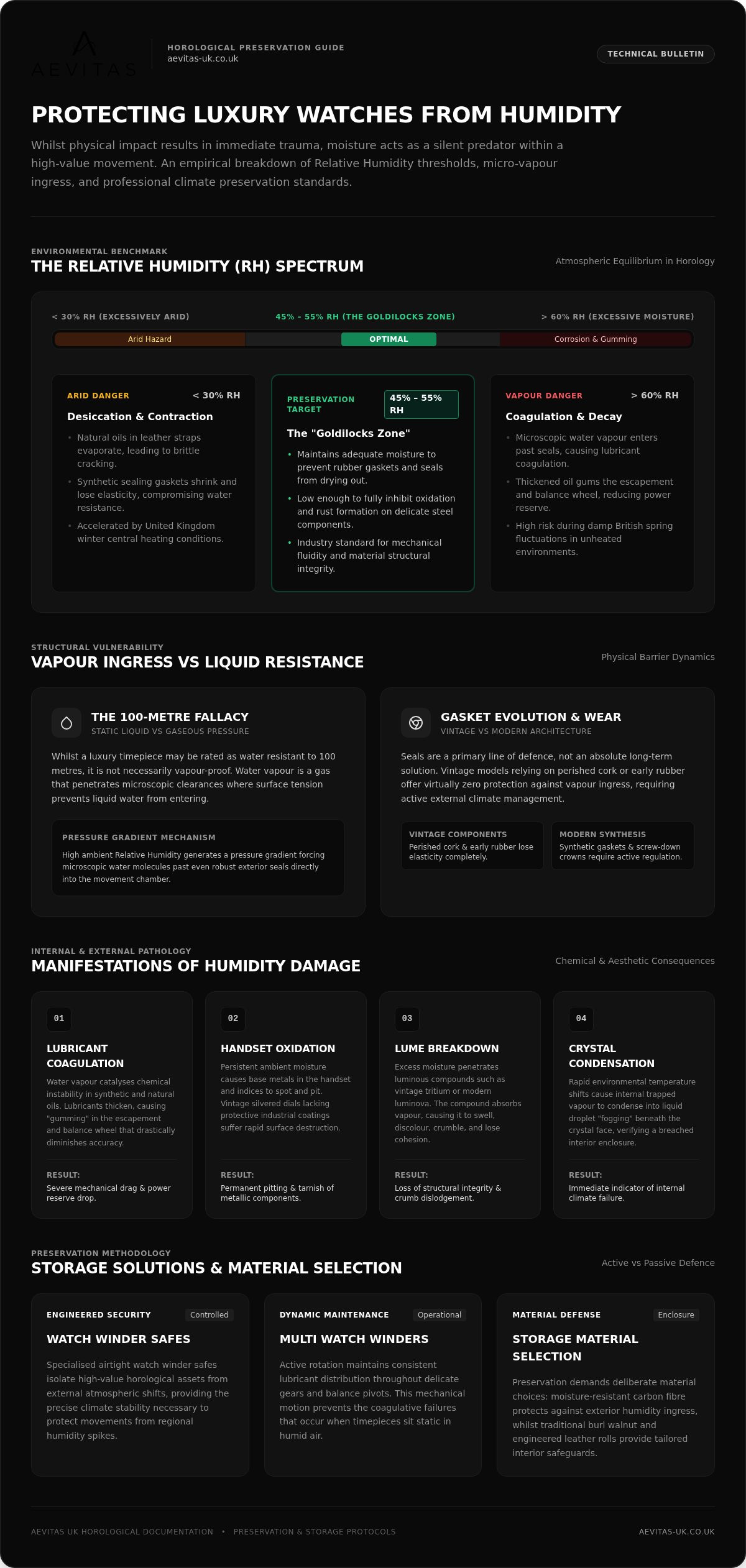
Humidity is often misunderstood as mere liquid water. In the context of high-end horology, we measure this threat as Relative Humidity (RH), which represents the ratio of water vapour in the air compared to its saturation point at a given temperature. High RH levels create a pressure gradient that forces microscopic water molecules past even the most robust seals. This is why protecting luxury watches from humidity is a technical necessity, not an optional precaution. Whilst a watch might be rated as "water resistant" to 100 metres, it isn't necessarily vapour-proof. Vapour is a gas; it moves with ease where liquid cannot, penetrating the inner sanctum of the movement.
Degradation of Internal Lubricants
Moisture acts as a primary catalyst for chemical instability within a movement. When water vapour enters the case, it interacts with the synthetic and natural oils used to reduce friction between moving parts. This exposure leads to coagulation, a process where the lubricants thicken and lose their viscosity. Instead of aiding movement, these oils begin "gumming" the escapement and balance wheel. This adds significant mechanical drag, forcing the mainspring to work harder and ultimately reducing the power reserve and accuracy. Hygroscopic damage is the absorption of moisture by internal components.
The Aesthetic Toll: Dials, Hands, and Lume
The external beauty of a timepiece is just as vulnerable as its mechanical heart. Humidity is the primary driver behind the "tropical dial" phenomenon, where moisture and UV exposure permanently alter the dial's chemical composition. Whilst some collectors prize the resulting chocolate or caramel hues, it is technically a form of irreversible decay. Moisture also causes the base metals in hands and indices to spot or pit, particularly on vintage silvered dials that lack modern protective coatings.
- Oxidation: Constant exposure to moisture causes handset metals to tarnish, leading to permanent surface damage.
- Luminous Compounds: Humidity causes tritium or modern luminova to swell, crumble, or discolour, destroying its structural integrity.
- Condensation: Rapid temperature drops cause moisture trapped inside the case to "fog" under the crystal, indicating a compromised internal environment.
Vintage timepieces are particularly susceptible to these environmental threats. Older models often rely on perished cork or early rubber gaskets that have lost their elasticity, offering almost no protection against vapour ingress. In contrast, modern watches utilise advanced synthetic gaskets and screw-down crowns to create a more formidable barrier. However, no seal is permanent. Even the most sophisticated modern diver's watch requires active climate management to ensure the internal atmosphere remains dry. Protecting luxury watches from humidity involves understanding that seals are a first line of defence, not a total solution for long-term preservation.
Determining the Ideal Environment for Watch Preservation
The industry standard for high-end timepiece storage is a consistent 45% to 55% Relative Humidity. This specific range is high enough to prevent rubber gaskets and seals from drying out, yet low enough to inhibit the formation of rust on steel components. Whilst many collectors focus on the dangers of moisture, excessively dry air (below 30% RH) is equally hazardous. In arid conditions, the natural oils in leather straps evaporate, causing them to become brittle and crack. Simultaneously, the synthetic gaskets responsible for water resistance can shrink and lose their elasticity, compromising the watch's seal.
Indoor humidity levels in the United Kingdom fluctuate significantly with the seasons. During winter, central heating often drops indoor RH to dangerously low levels. Conversely, a damp British spring can push humidity well above 60% in unheated rooms. These fluctuations cause internal pressure changes that can stress the watch's architecture. For those seeking an integrated solution, choosing a watch winder safe provides a secure, controlled atmosphere that mitigates these external fluctuations.
Monitoring Equipment for Collectors
You cannot manage what you do not measure. A high-precision digital hygrometer is an essential tool for any serious collector. Unlike analogue versions, which often require frequent calibration, digital sensors provide immediate and accurate readings of the micro-climate inside your storage cabinet. When protecting luxury watches from humidity, placing the sensor at the same level as the watches is vital. Air density and temperature vary even within a small safe, so a reading taken at the top may not reflect the conditions at the base.
- Baseline Readings: Monitor your storage area for 48 hours before adding watches to understand the natural environmental rhythm.
- Sensor Placement: Position your hygrometer away from external walls or heat sources like radiators to avoid false data.
- Stability: Aim for temperature consistency alongside RH control. Rapid temperature shifts are the primary cause of internal condensation under the crystal.
Consistency is the hallmark of professional curation. By establishing a stable environment, you eliminate the mechanical stress caused by the constant expansion and contraction of delicate components. This methodical approach ensures your collection retains its precision and its value for decades to come.
Practical Steps to Regulate Moisture in Your Collection
Active regulation transforms a passive storage area into a controlled environment. Once you've established your baseline readings, you must implement barriers against vapour ingress. Protecting luxury watches from humidity requires a multi-layered approach that combines chemical absorbents with high-grade mechanical seals. It's about creating a stable micro-climate that remains indifferent to the external British weather.
Using Desiccants Effectively
Silica gel remains the most reliable first line of defence for smaller presentation boxes. Collectors should opt for orange-indicating silica beads over standard white packs. These beads change colour to dark green or black when they reach saturation, providing a clear visual cue for maintenance. For a standard 12-watch presentation box, 20 to 30 grams of desiccant is typically sufficient to maintain the 45-55% RH target. You'll need to recharge these beads in a low-heat oven or replace the packs every three to six months, depending on the ambient humidity of your room.
Atmospheric Control in High-Security Safes
Whilst heavy-duty safes offer unparalleled security, their thick walls and fireproof linings can inadvertently trap moisture. This creates a stagnant micro-climate that accelerates oxidation. Premium Watch Winder Safes combat this by utilising precision-engineered airtight seals that isolate the interior from external environmental shifts. If you're managing a larger vault, integrating an active dehumidification rod can provide a consistent, low-level heat that prevents moisture from settling on metallic surfaces. It's also beneficial to ensure your safe features a high-quality velvet or felt lining; these materials act as natural buffers, absorbing and releasing minute amounts of moisture to level out humidity spikes.
Regularly airing out your collection is a simple yet effective habit. Opening your storage cabinet once a week for ten minutes prevents the buildup of stagnant air pockets. However, these external measures are only effective if the watch itself is sound. You should arrange a professional gasket pressure test every 12 to 18 months. This ensures the internal seals remain vapour-tight. Protecting luxury watches from humidity is a holistic process; it requires both a controlled environment and a mechanically resilient timepiece. By combining these practical steps, you ensure that moisture never has the opportunity to compromise your investment.
Selecting Protective Storage: Materials and Design
Choosing a storage solution requires more than an eye for aesthetics. The materials you select serve as the final physical barrier against environmental threats. Protecting luxury watches from humidity is significantly easier when the storage medium itself is engineered to repel moisture. Whether you prefer the industrial precision of carbon fibre or the organic warmth of burl walnut, each material offers distinct advantages in climate regulation. It's about finding a balance between heritage style and modern technical performance.
The Performance of Carbon Fibre and Gloss Finishes
Carbon fibre is the gold standard for collectors prioritising a non-porous environment. Unlike natural materials, carbon fibre doesn't absorb atmospheric moisture, making it an exceptional shield in humid climates. A Carbon Fibre Watch Winder provides a stable, tech-focused home for modern timepieces. Similarly, high-gloss piano black finishes create a hard, resinous shell that prevents water vapour from penetrating the wooden core. These finishes are incredibly durable, maintaining their structural integrity even when home humidity levels fluctuate. Premium grey luxury linings are specifically engineered to possess moisture-wicking properties, drawing residual vapour away from the watch case.
Natural Wood and Heritage Storage
Traditional Watch Boxes crafted from solid wood provide a different set of benefits. High-quality burl walnut acts as a natural insulator, slowing down temperature changes that can lead to internal condensation. Quality is paramount here. We use kiln-dried walnut because it's significantly less prone to warping or expanding in damp conditions compared to cheaper alternatives. To ensure the seal remains intact, you should maintain the exterior finish with a high-grade wax. This preserves the wood's density and keeps the micro-climate inside the box consistent. Protecting luxury watches from humidity involves ensuring these natural materials are treated to resist the very elements they guard against.
Protection shouldn't end at the threshold of your home. Transit is often when watches are most vulnerable to rapid environmental shifts, such as moving from a humid airport to a climate-controlled cabin. Travel-ready Leather Watch Rolls offer a compact, cushioned environment that buffers against these spikes. Whilst leather is naturally breathable, our premium rolls are treated to resist moisture absorption, ensuring your timepieces remain dry whilst on the move. You'll find that a well-constructed roll prevents the "greenhouse effect" that can occur in cheaper, plastic-lined cases.
Elevate your collection's safety by choosing a storage solution that balances heritage craftsmanship with modern environmental protection. Explore our full range of premium watch boxes and winders to find the perfect fit for your collection.
Long-Term Maintenance and Specialist Storage Solutions
Mechanical preservation is an active pursuit that extends beyond the physical walls of a safe. Whilst high-quality materials provide a barrier, the internal health of a movement depends on consistent activity. Protecting luxury watches from humidity requires a strategy that addresses both the external environment and the internal mechanics. Static watches are significantly more vulnerable to environmental decay. When a movement remains stationary in a humid atmosphere, the risk of lubricant coagulation and component oxidation increases. Movement is the best defence against the "gumming" of delicate parts.
The Role of Constant Motion
A Multi Watch Winder serves a dual purpose in your preservation strategy. By keeping the movement in a state of constant, controlled rotation, it ensures that internal lubricants remain fluid and evenly distributed across the gear train. This prevents oils from "setting" or pooling, a common issue in humid environments where moisture can accelerate chemical breakdown. The kinetic energy generated by the rotation also helps maintain a stable internal temperature within the case. It is essential to select the correct Turns Per Day (TPD) settings for your specific calibre. This ensures the mainspring remains sufficiently wound without being subjected to unnecessary mechanical stress.
Curating a Safe Haven for Your Collection
- Quarterly Inspections: Check your digital hygrometer and recharge any silica desiccant packs every three months.
- Seal Rotation: Ensure every watch in your collection spends time on a winder to keep gaskets supple and lubricants active.
- Professional Servicing: Stick to a strict five-year service interval for modern pieces, or three years for vintage models, to replace ageing gaskets.
Aevitas Watch Storage remains dedicated to the principles of British craftsmanship and technical protection. We understand that your collection represents both a financial investment and a personal legacy. By integrating professional-grade equipment, you gain total control over the variables that threaten your timepieces. Explore our full range of Watch Winders to establish a comprehensive care routine. Protecting luxury watches from humidity is a lifelong commitment to excellence, ensuring your timepieces remain as precise and beautiful as the day they were first acquired.
Securing Your Horological Legacy
Preservation is a continuous process of environmental management. You now understand that maintaining the 45-55% Relative Humidity "Goldilocks Zone" is essential for preventing both mechanical seizing and material decay. By combining technical storage materials with active maintenance through precision winders, you ensure your timepieces remain in showroom condition whilst in storage. This methodical approach transforms your collection from a simple hobby into a lasting heritage.
Protecting luxury watches from humidity is a fundamental investment in the longevity of your collection. As the UK’s best-selling premium winder brand, Aevitas UK provides solutions compatible with all major luxury houses, including Rolex and Patek Philippe. With free worldwide insured delivery, professional-grade protection is accessible and reliable. Our products are designed to meet the rigorous standards of the most discerning collectors, offering a sense of calm and control over your environment.
Protect your investment today. Browse the Aevitas UK Collection of Luxury Watch Storage and Winders.
Your collection deserves the highest standard of care. Take the first step toward total climate control and enjoy the lasting peace of mind that comes with professional curation.
Frequently Asked Questions
Can humidity actually damage a waterproof watch like a Rolex Submariner?
Humidity can certainly damage watches rated for high water resistance. Whilst a Rolex Submariner is engineered for extreme depths, seals are designed to block liquid water rather than microscopic water vapour. Over years, gaskets can perish or dry out, allowing gas-state moisture to enter the case. Once inside, this moisture causes internal corrosion and degrades the movement's lubricants. Constant environmental management is the only way to ensure these professional-grade seals remain effective.
What is the best humidity level for storing luxury watches long-term?
The ideal environment for protecting luxury watches from humidity is between 45% and 55% Relative Humidity. This specific range is often called the "Goldilocks Zone" because it provides enough moisture to keep rubber gaskets and leather straps from becoming brittle, whilst remaining dry enough to prevent rust. Maintaining this balance is critical for long-term preservation. You should use a digital hygrometer to ensure your storage area doesn't fluctuate outside these parameters.
Do I need a dehumidifier in the room where I keep my watch collection?
You don't necessarily need a room-wide dehumidifier if your storage solution provides localised climate control. Whilst a dehumidifier can help in particularly damp British basements, it's often more efficient to use desiccants or active dehumidification rods inside a dedicated Watch Winder Safe. These tools create a stable micro-climate for your collection without the energy costs of treating an entire room. This targeted approach ensures your timepieces remain protected regardless of the wider house environment.
Is it safe to store my watches in a leather roll if I live in a humid climate?
Storing watches in a luxury leather roll is safe in humid climates provided you choose premium, treated materials. High-quality leather is naturally breathable, but it can absorb moisture if left in stagnant, damp air for long periods. You should ensure your travel roll is kept in a well-ventilated area and isn't stored against damp external walls. For those in tropical regions, adding a small silica pack to the roll's compartment provides an extra layer of security.
How often should I check the silica gel packs in my watch box?
You should inspect your silica gel packs every three to six months to ensure they're still effective. If you're using orange-indicating beads, they'll turn dark green or black when they've reached their maximum absorption capacity. In the damp United Kingdom climate, you might find they need replacing or recharging more frequently during the winter months. Regular checks prevent the desiccant from becoming a source of moisture itself once it's fully saturated.
Will a watch winder safe protect my timepieces from moisture better than a wooden box?
A Watch Winder Safe offers superior protection compared to a standard wooden box due to its precision-engineered airtight seals. These safes isolate the internal atmosphere from external humidity spikes, creating a consistent environment that wood, a porous material, cannot match. Whilst a burl walnut box provides excellent insulation, the mechanical barrier of a safe's heavy-duty door and gasket system is the most effective method for protecting luxury watches from humidity.
Can high humidity cause the sapphire crystal on my watch to fog up internally?
Internal fogging under the sapphire crystal is a direct result of moisture being trapped inside the watch case. When the watch experiences a rapid temperature drop, the water vapour condenses into visible droplets on the underside of the glass. This is a critical warning sign that your watch's seals have been compromised. If you notice this, it's vital to have the watch inspected by a professional to prevent permanent movement damage or dial spotting.
What are the first signs of humidity damage I should look for on my watch dial?
Early signs of humidity damage often appear as subtle spotting or "pitting" on the dial surface and handset. You might also notice that the luminous material on the indices has started to discolour, turn grey, or appear slightly swollen. Silvered dials are particularly prone to tarnishing, which can look like a faint yellowish or brownish haze. Catching these aesthetic shifts early allows you to rectify your storage conditions before the damage becomes irreversible and costly.